


As we all know, the Databricks certificate has a very high reputation in the global market and has a great influence. But how to get the certificate has become a headache for many people. Our learning materials provide you with an opportunity. Once you choose our Associate-Developer-Apache-Spark-3.5 exam practice, we will do our best to provide you with a full range of thoughtful services. Our products are designed from the customer's perspective, and experts that we employed will update our learning materials according to changing trends to ensure the high quality of the materials. What are you still waiting for? Choosing our Associate-Developer-Apache-Spark-3.5 guide questions: Databricks Certified Associate Developer for Apache Spark 3.5 - Python and work for getting the certificate, you will make your life more colorful.
Getting the Most Rewards in the Least Time
We don't just want to make profitable deals, but also to help our users pass the exams with the least amount of time to get a certificate. Choosing our Associate-Developer-Apache-Spark-3.5 exam practice, you only need to spend 20-30 hours to prepare for the exam. Maybe you will ask whether such a short time can finish all the content, we want to tell you that you can rest assured ,because our learning materials are closely related to the exam outline and the questions of our Associate-Developer-Apache-Spark-3.5 guide questions: Databricks Certified Associate Developer for Apache Spark 3.5 - Python are related to the latest and basic knowledge. What's more, our learning materials are committed to grasp the most knowledgeable points with the fewest problems. So 20-30 hours of study is enough for you to deal with the exam. When you get a Associate-Developer-Apache-Spark-3.5 certificate, you will be more competitive than others, so you can get a promotion and your wages will also rise your future will be controlled by yourselves.
Online and Thoughtful Service
Once you have any questions about our Associate-Developer-Apache-Spark-3.5 actual exam, you can contact our staff online or send us an email. We have a dedicated all-day online service to help you solve problems. Before purchasing, you may be confused about what kind of Associate-Developer-Apache-Spark-3.5 guide questions: Databricks Certified Associate Developer for Apache Spark 3.5 - Python you need. You can consult our staff online. After the consultation, your doubts will be solved and you will choose the learning materials that suit you. Our online staff is professionally trained and they have great knowledge. So they can clearly understand your requirements and ideas and then help you make the right choices. When you have purchased our Associate-Developer-Apache-Spark-3.5 exam practice, but you do not know how to install it, we can also provide remote guidance to help you complete the installation. In a word, we still provide you with sincere after-sales service. All in all, we will always be there to help you until you pass the Associate-Developer-Apache-Spark-3.5 exam and get a certificate.
Attraction of High Pass Rate
As the authoritative provider of Associate-Developer-Apache-Spark-3.5 actual exam, we always pursue high pass rate compared with our peers to gain more attention from those potential customers. We guarantee that if you follow the guidance of our learning materials, you will pass the exam without a doubt and get a certificate. Our Associate-Developer-Apache-Spark-3.5 exam practice is carefully compiled after many years of practical effort and is adaptable to the needs of the exam. If you eventually fail the exam, we will refund the fee according to the contract. We are confident that in the future, our Associate-Developer-Apache-Spark-3.5 guide questions: Databricks Certified Associate Developer for Apache Spark 3.5 - Python will be more attractive and the pass rate will be further enhanced.
Databricks Associate-Developer-Apache-Spark-3.5 Exam Syllabus Topics:
| Section | Weight | Objectives |
|---|---|---|
| Topic 1: Using Spark SQL | 20% | - Running SQL queries - Integrating Spark SQL with DataFrames - Using catalog and metadata APIs - Working with functions and expressions |
| Topic 2: Apache Spark Architecture and Components | 20% | - Spark architecture overview - Execution and deployment modes - Fault tolerance and garbage collection - Execution hierarchy and lazy evaluation - Shuffling, actions, and broadcasting |
| Topic 3: Developing Apache Spark DataFrame API Applications | 30% | - Joining and combining datasets - Partitioning and bucketing data - Creating DataFrames and defining schemas - Handling missing values and data quality - Filtering, sorting, and aggregating data - Selecting, renaming, and modifying columns - User-defined functions (UDFs) - Reading and writing data in various formats |
| Topic 4: Structured Streaming | 10% | - Defining streaming queries - Fault tolerance and state management - Output modes and triggers - Streaming concepts and architecture |
| Topic 5: Troubleshooting and Tuning Apache Spark DataFrame API Applications | 10% | - Optimizing transformations and actions - Identifying performance bottlenecks - Debugging and logging - Managing memory and resource usage |
| Topic 6: Using Pandas API on Apache Spark | 5% | - Overview of Pandas API on Spark - Key differences and limitations - Converting between Pandas and Spark structures |
| Topic 7: Using Spark Connect to Deploy Applications | 5% | - Running applications via Spark Connect - Connecting to remote Spark clusters - Spark Connect architecture |
Databricks Certified Associate Developer for Apache Spark 3.5 - Python Sample Questions:
1. How can a Spark developer ensure optimal resource utilization when running Spark jobs in Local Mode for testing?
Options:
A) Configure the application to run in cluster mode instead of local mode.
B) Use the spark.dynamicAllocation.enabled property to scale resources dynamically.
C) Set the spark.executor.memory property to a large value.
D) Increase the number of local threads based on the number of CPU cores.
2. A developer initializes a SparkSession: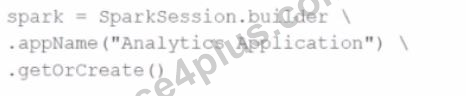
spark = SparkSession.builder \
.appName("Analytics Application") \
.getOrCreate()
Which statement describes the spark SparkSession?
A) If a SparkSession already exists, this code will return the existing session instead of creating a new one.
B) The getOrCreate() method explicitly destroys any existing SparkSession and creates a new one.
C) A SparkSession is unique for each appName, and calling getOrCreate() with the same name will return an existing SparkSession once it has been created.
D) A new SparkSession is created every time the getOrCreate() method is invoked.
3. An engineer has two DataFrames: df1 (small) and df2 (large). A broadcast join is used:
python
CopyEdit
from pyspark.sql.functions import broadcast
result = df2.join(broadcast(df1), on='id', how='inner')
What is the purpose of using broadcast() in this scenario?
Options:
A) It increases the partition size for df1 and df2.
B) It filters the id values before performing the join.
C) It reduces the number of shuffle operations by replicating the smaller DataFrame to all nodes.
D) It ensures that the join happens only when the id values are identical.
4. A data scientist is working with a Spark DataFrame called customerDF that contains customer information. The DataFrame has a column named email with customer email addresses. The data scientist needs to split this column into username and domain parts.
Which code snippet splits the email column into username and domain columns?
A) customerDF.withColumn("username", substring_index(col("email"), "@", 1)) \
.withColumn("domain", substring_index(col("email"), "@", -1))
B) customerDF.select(
regexp_replace(col("email"), "@", "").alias("username"),
regexp_replace(col("email"), "@", "").alias("domain")
)
C) customerDF.withColumn("username", split(col("email"), "@").getItem(0)) \
.withColumn("domain", split(col("email"), "@").getItem(1))
D) customerDF.select(
col("email").substr(0, 5).alias("username"),
col("email").substr(-5).alias("domain")
)
5. 37 of 55.
A data scientist is working with a Spark DataFrame called customerDF that contains customer information.
The DataFrame has a column named email with customer email addresses.
The data scientist needs to split this column into username and domain parts.
Which code snippet splits the email column into username and domain columns?
A) customerDF = customerDF.select("email").alias("username", "domain")
B) customerDF = customerDF.withColumn("domain", col("email").split("@")[1])
C) customerDF = customerDF \
.withColumn("username", split(col("email"), "@").getItem(0)) \
.withColumn("domain", split(col("email"), "@").getItem(1))
D) customerDF = customerDF.withColumn("username", regexp_replace(col("email"), "@", ""))
Solutions:
| Question # 1 Answer: D | Question # 2 Answer: A | Question # 3 Answer: C | Question # 4 Answer: C | Question # 5 Answer: C |
 1300 Customer Reviews

