


Attraction of High Pass Rate
As the authoritative provider of SEND actual exam, we always pursue high pass rate compared with our peers to gain more attention from those potential customers. We guarantee that if you follow the guidance of our learning materials, you will pass the exam without a doubt and get a certificate. Our SEND exam practice is carefully compiled after many years of practical effort and is adaptable to the needs of the exam. If you eventually fail the exam, we will refund the fee according to the contract. We are confident that in the future, our SEND guide questions: Endocrinology and Diabetes (Specialty Certificate Examination) will be more attractive and the pass rate will be further enhanced.
Online and Thoughtful Service
Once you have any questions about our SEND actual exam, you can contact our staff online or send us an email. We have a dedicated all-day online service to help you solve problems. Before purchasing, you may be confused about what kind of SEND guide questions: Endocrinology and Diabetes (Specialty Certificate Examination) you need. You can consult our staff online. After the consultation, your doubts will be solved and you will choose the learning materials that suit you. Our online staff is professionally trained and they have great knowledge. So they can clearly understand your requirements and ideas and then help you make the right choices. When you have purchased our SEND exam practice, but you do not know how to install it, we can also provide remote guidance to help you complete the installation. In a word, we still provide you with sincere after-sales service. All in all, we will always be there to help you until you pass the SEND exam and get a certificate.
As we all know, the MRCPUK certificate has a very high reputation in the global market and has a great influence. But how to get the certificate has become a headache for many people. Our learning materials provide you with an opportunity. Once you choose our SEND exam practice, we will do our best to provide you with a full range of thoughtful services. Our products are designed from the customer's perspective, and experts that we employed will update our learning materials according to changing trends to ensure the high quality of the materials. What are you still waiting for? Choosing our SEND guide questions: Endocrinology and Diabetes (Specialty Certificate Examination) and work for getting the certificate, you will make your life more colorful.
Getting the Most Rewards in the Least Time
We don't just want to make profitable deals, but also to help our users pass the exams with the least amount of time to get a certificate. Choosing our SEND exam practice, you only need to spend 20-30 hours to prepare for the exam. Maybe you will ask whether such a short time can finish all the content, we want to tell you that you can rest assured ,because our learning materials are closely related to the exam outline and the questions of our SEND guide questions: Endocrinology and Diabetes (Specialty Certificate Examination) are related to the latest and basic knowledge. What's more, our learning materials are committed to grasp the most knowledgeable points with the fewest problems. So 20-30 hours of study is enough for you to deal with the exam. When you get a SEND certificate, you will be more competitive than others, so you can get a promotion and your wages will also rise your future will be controlled by yourselves.
MRCPUK SEND Exam Syllabus Topics:
| Section | Objectives |
|---|---|
| Thyroid Disorders | - Thyroid Disease
|
| Diabetes Mellitus | - Complications
|
| General Endocrinology | - Integrated Clinical Practice
|
| Pituitary and Hypothalamic Disorders | - Pituitary Disease
|
| Adrenal Disorders | - Adrenal Disease
|
| Reproductive Endocrinology | - Gonadal Disorders
|
| Calcium and Bone Metabolism | - Parathyroid and Metabolic Bone Disease
|
MRCPUK Endocrinology and Diabetes (Specialty Certificate Examination) Sample Questions:
Question 1
A 28-year-old woman presented to the emergency department with a 3-day history of abdominal pain. Her past medical history included intermenstrual bleeding, and she was undergoing 6-monthly renal ultrasound surveillance for a cystic lesion.
Investigations:
serum creatinine84 umol/L (60-110)
serum corrected calcium3.20 mmol/L (2.20-2.60)
serum phosphate0.7 mmol/L (0.8-1.4)
plasma parathyroid hormone19.5 pmol/L (0.9-5.4)
What is the most likely condition underlying the clinical presentation?
A. Cowden's syndrome
B. hyperparathyroidism-jaw tumour syndrome
C. multiple endocrine neoplasia type 2B
D. von Hippel-Lindau syndrome
E. multiple endocrine neoplasia type 1
Question 2
A 25-year-old woman who was 4 months pregnant presented with weight loss of 3 kg over the previous 4 weeks, associated with intermittent palpitations, tremor and feeling of warmth. She was not taking any medication.
On examination, her pulse was 100 beats per minute and regular, and her blood pressure was 130/60 mmHg. A symmetrical non-tender goitre was palpable, with an audible bruit. There was no exophthalmos.
Investigations:
serum thyroid-stimulating hormone<0.1 mU/L (0.4-5.0)
serum free T445.2 pmol/L (10.0-22.0)
serum free T322.8 pmol/L (3.0-7.0)
anti-thyroid stimulating hormone receptor
antibodies40 U/L (<7)
What is the most appropriate treatment?
A. carbimazole
B. propylthiouracil
C. propranolol
D. radioactive iodine
E. subtotal thyroidectomy
Question 3
A 45-year-old man had type 2 diabetes mellitus of 2 years' duration. He had no history of ischaemic heart disease or microvascular complications, and was euthyroid. There was no family history of ischaemic heart disease. He was a non-smoker and drank 4 to 8 units of alcohol per week. He was taking metformin only.
On examination, his blood pressure was 120/78 mmHg and his body mass index was 24 kg/m2 (18-25).
His calculated 10-year cardiovascular risk was 8.5%.
Investigations (fasting):
serum sodium142 mmol/L (137-144)
serum potassium3.8 mmol/L (3.5-4.9)
serum creatinine90 umol/L (60-110)
haemoglobin A1c48 mmol/L (20-42)
urinary albumin:creatinine ratio1.5 mg/mmol (<2.5)
serum cholesterol5.1 mmol/L (<5.2)
serum HDL cholesterol1.50 mmol/L (>1.55)
fasting serum triglycerides1.22 mmol/L (0.45-1.69)
What does the NICE guidance (CG181, July 2014) on type 2 diabetes mellitus recommend as the most appropriate next step in management?
A. micronised fenofibrate
B. simvastatin
C. no change
D. atorvastatin
E. omega-3 marine triglycerides
Question 4
A 56-year-old man presented with a 6-month history of erectile dysfunction. He had noticed a gradual reduction in his frequency of shaving from daily to twice a week. His libido had diminished and he felt that he was not as strong as he once was. He also described general aches and pains. He was a farm worker and had drunk a bottle of vodka daily for several years, but had stopped drinking 2 years previously. He was a non-smoker.
Investigations:
serum urea6.2 mmol/L (2.5-7.0)
serum creatinine89 umol/L (60-110)
serum albumin40 g/L (37-49)
serum total bilirubin17 umol/L (1-22) serum alanine aminotransferase48 U/L (5-35) serum aspartate aminotransferase37 U/L (1-31) haemoglobin A1c55 mmol/mol (20-42)
serum cortisol (09.00 h)389 nmol/L (200-700) serum testosterone0.7 nmol/L (9.0-35.0) plasma follicle-stimulating hormone2.1 U/L (1.0-7.0) plasma luteinising hormone2.4 U/L (1.0-10.0) serum prolactin458 mU/L (<360) serum thyroid-stimulating hormone3.4 mU/L (0.4-5.0)
MR scan of pituitarysee image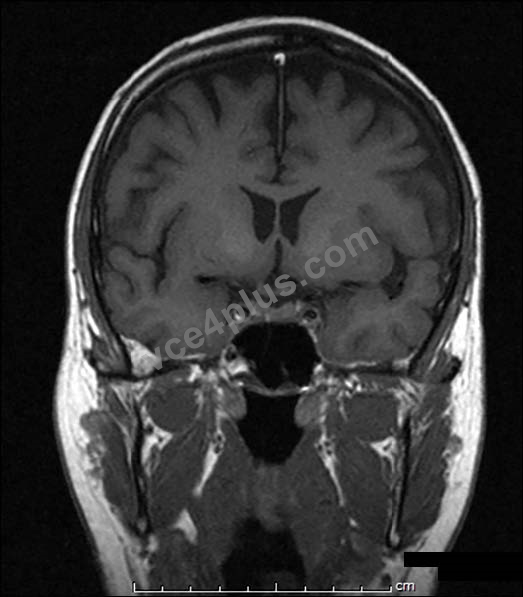
What is the most likely explanation of his symptoms?
A. cirrhosis of liver
B. pituitary adenoma
C. age-related hypogonadism
D. hyperprolactinaemia
E. haemochromatosis
Question 5
A 55-year-old man with mild polyuria and tiredness was seen on a renal ward. He had had a living-related kidney transplant 6 months previously. He had good graft function while being treated with prednisolone 5 mg daily, mycophenolate mofetil 1 g twice daily and tacrolimus 3 mg twice daily. He was also taking atenolol 50 mg daily and simvastatin 40 mg daily.
Investigations:
haemoglobin A1c75 mmol/mol (20-42)
random plasma glucose18.0 mmol/L
Which drug is most likely to be responsible for his diabetes of new onset?
A. atenolol
B. tacrolimus
C. mycophenolate mofetil
D. simvastatin
E. prednisolone
Solutions:
| Question 1 Answer: B | Question 2 Answer: A | Question 3 Answer: C | Question 4 Answer: E | Question 5 Answer: B |
 1309 Customer Reviews

