

Share Latest May-2026 PCCPTest Practice Test Questions, Exam Dumps
Positive Aspects of Valid Dumps PCCP Exam Dumps!
Palo Alto Networks PCCP Exam Syllabus Topics:
| Topic | Details |
|---|---|
| Topic 1 |
|
| Topic 2 |
|
| Topic 3 |
|
NEW QUESTION # 79
TCP is the protocol of which layer of the OSI model?
- A. Transport
- B. Session
- C. Data Link
- D. Application
Answer: A
Explanation:
TCP stands for Transmission Control Protocol, and it is one of the main protocols used in the internet. TCP provides reliable, ordered, and error-free delivery of data between applications 1. In terms of the OSI model, TCP is a transport-layer protocol. The transport layer is the fourth layer of the OSI model, and it is responsible for establishing end-to-end connections, segmenting data into packets, and ensuring reliable and efficient data transfer 2. The transport layer also provides flow control, congestion control, and error detection and correction mechanisms 2. TCP is not the only transport-layer protocol; another common one is UDP (User Datagram Protocol), which is faster but less reliable than TCP 3. References: 1: TCP/IP TCP, UDP, and IP protocols - IBM 2: Transport Layer | Layer 4 | The OSI-Model 3: TCP/IP Model vs. OSI Model | Similarities and Differences - Fortinet
NEW QUESTION # 80
Which action must Secunty Operations take when dealing with a known attack?
- A. Disclose details of lhe attack in accordance with regulatory standards.
- B. Limit the scope of who knows about the incident.
- C. Document, monitor, and track the incident.
- D. Increase the granularity of the application firewall.
Answer: C
Explanation:
Security Operations (SecOps) is the process of coordinating and aligning security teams and IT teams to improve the security posture of an organization. SecOps involves implementing and maintaining security controls, technologies, policies, and procedures to protect the organization from cyber threats and incidents.
When dealing with a known attack, SecOps must take the following action: document, monitor, and track the incident. This action is important because it helps SecOps to:
*Record the details of the attack, such as the source, target, impact, timeline, and response actions.
*Monitor the status and progress of the incident response and recovery efforts, as well as the ongoing threat activity and indicators of compromise.
*Track the performance and effectiveness of the security controls and technologies, as well as the lessons learned and improvement opportunities. References:
*Palo Alto Networks Certified Cybersecurity Entry-level Technician (PCCET)
*6 Incident Response Steps to Take After a Security Event - Exabeam
*Dealing with Cyber Attacks-Steps You Need to Know | NIST
NEW QUESTION # 81
Layer 4 of the TCP/IP Model corresponds to which three Layer(s) of the OSI Model? (Choose three.)
- A. Presentation
- B. Transport
- C. Network
- D. Session
- E. Application
Answer: A,B,D
Explanation:
Layer 4 of the TCP/IP model is the transport layer, which is responsible for providing reliable and efficient data transmission between hosts. The transport layer can use different protocols, such as TCP or UDP, depending on the requirements of the application. The transport layer also performs functions such as segmentation, acknowledgement, flow control, and error recovery. 1 The transport layer of the TCP/IP model corresponds to three layers of the OSI model: the transport layer, the session layer, and the presentation layer. The session layer of the OSI model manages the establishment, maintenance, and termination of sessions between applications. The session layer also provides services such as synchronization, dialogue control, and security. The presentation layer of the OSI model handles the representation, encoding, and formatting of data for the application layer. The presentation layer also performs functions such as compression, encryption, and translation. 23 References:
*1: TCP/IP Model - GeeksforGeeks
*2: Transport Layer | Layer 4 | The OSI-Model
*3: Transport Layer Explanation - Layer 4 of the OSI Model
NEW QUESTION # 82
Why have software developers widely embraced the use of containers?
- A. Containers share application dependencies with other containers and with their host computer.
- B. Containers require separate development and production environments to promote authentic code.
- C. Containers are host specific and are not portable across different virtual machine hosts.
- D. Containers simplify the building and deploying of cloud native applications.
Answer: D
Explanation:
Containers are portable and lightweight alternatives to virtual machines that allow developers to package, isolate, and deploy applications across different cloud environments. Containers simplify the building and deploying of cloud native applications by providing consistent and efficient development, testing, and production environments. Containers also offer benefits such as rapid provisioning, high scalability, resource optimization, and security isolation. References:
* What are containerized applications? from Google Cloud
* What are containers and why do you need them? from IBM Developer
* Embracing containers for software-defined cloud infrastructure from Red Hat
NEW QUESTION # 83
How can local systems eliminate vulnerabilities?
- A. Perform an attack on local systems.
- B. Patch systems and software effectively and continuously.
- C. Test and deploy patches on a focused set of systems.
- D. Create preventative memory-corruption techniques.
Answer: B
Explanation:
Local systems can eliminate vulnerabilities by patching systems and software effectively and continuously.
Patching is the process of applying updates or fixes to software or hardware components that have known vulnerabilities or bugs. Patching can prevent attackers from exploiting these vulnerabilities and compromising the security or functionality of the systems. Patching should be done regularly and promptly, as new vulnerabilities are constantly discovered and exploited by cybercriminals. Patching should also be done effectively, meaning that the patches are tested and verified before deployment, and that they do not introduce new vulnerabilities or issues. Patching should also be done continuously, meaning that the systems are monitored for new vulnerabilities and patches are applied as soon as they are available. Continuous patching can reduce the window of opportunity for attackers to exploit unpatched vulnerabilities and cause damage or data breaches. References:
*1: What is Patch Management? | Palo Alto Networks
*2: Patch Management Best Practices: How to Keep Your Systems Secure | Snyk
*3: Vulnerability Remediation Process - 4 Steps to Remediation | Snyk
NEW QUESTION # 84
Which option describes the "selective network security virtualization" phase of incrementally transforming data centers?
- A. during the selective network security virtualization phase, all intra-host traffic is load balanced
- B. during the selective network security virtualization phase, all intra-host traffic is forwarded to a Web proxy server
- C. during the selective network security virtualization phase, all intra-host communication paths are strictly controlled
- D. during the selective network security virtualization phase, all intra-host traffic is encapsulated and encrypted using the IPSEC protocol
Answer: C
Explanation:
Selective network security virtualization: Intra-host communications and live migrations are architected at this phase. All intra-host communication paths are strictly controlled to ensure that traffic between VMs at different trust levels is intermediated either by an on-box, virtual security appliance or by an off-box, physical security appliance.
NEW QUESTION # 85
What is the definition of a zero-day threat?
- A. The period between the discovery of a vulnerability and development and release of a patch
- B. A specific day during which zero threats occurred
- C. The amount of time it takes to discover a vulnerability and release a security fix
- D. The day a software vendor becomes aware of an exploit and prevents any further hacking
Answer: A
Explanation:
A zero-day threat is an attack that takes advantage of a security vulnerability that does not have a fix in place.
It is referred to as a "zero-day" threat because once the flaw is eventually discovered, the developer or organization has "zero days" to then come up with a solution. A zero-day threat can compromise a system or network by exploiting the unknown vulnerability, and can cause data loss, unauthorized access, or other damages. Zero-day threats are difficult to detect and prevent, and require advanced security solutions and practices to mitigate them. References:
* Palo Alto Networks Certified Cybersecurity Entry-level Technician (PCCET)
* Zero-day (computing) - Wikipedia
* What is a zero-day exploit? | Zero-day threats | Cloudflare
NEW QUESTION # 86
Which IoT connectivity technology is provided by satellites?
- A. 2G/2.5G
- B. VLF
- C. 4G/LTE
- D. L-band
Answer: D
Explanation:
2G/2.5G: 2G connectivity remains a prevalent and viable IoT connectivity option due to the low cost of 2G modules, relatively long battery life, and large installed base of
2G sensors and M2M applications.
# 3G: IoT devices with 3G modules use either Wideband Code Division Multiple Access (W-CDMA) or Evolved High Speed Packet Access (HSPA+ and Advanced HSPA+) to achieve data transfer rates of 384Kbps to 168Mbps.
# 4G/Long-Term Evolution (LTE): 4G/LTE networks enable real-time IoT use cases, such as autonomous vehicles, with 4G LTE Advanced Pro delivering speeds in excess of
3Gbps and less than 2 milliseconds of latency.
# 5G: 5G cellular technology provides significant enhancements compared to 4G/LTE networks and is backed by ultra-low latency, massive connectivity and scalability for IoT devices, more efficient use of the licensed spectrum, and network slicing for application traffic prioritization.
NEW QUESTION # 87
Which two workflows are improved by integrating SIEMs with other security solutions? (Choose two.)
- A. Incident response
- B. Initial security team training
- C. Log normalization
- D. Hardware procurement
Answer: A,C
Explanation:
Log normalization - SIEMs standardize log formats from various sources, making it easier to analyze and correlate security events.
Incident response - Integration enables faster detection, investigation, and automated or guided response to security incidents by using correlated data from multiple tools.
Hardware procurement and security team training are not directly influenced by SIEM integration.
NEW QUESTION # 88
What differentiates SOAR from SIEM?
- A. SOAR platforms filter alerts with their broader coverage of security incidents.
- B. SOAR platforms collect data and send alerts.
- C. SOAR platforms focus on analyzing network traffic.
- D. SOAR platforms integrate automated response into the investigation process.
Answer: D
Explanation:
SOAR (Security Orchestration, Automation, and Response) differs from SIEM by adding automated incident response and workflow orchestration to the detection and alerting capabilities found in SIEM. This enables faster and more efficient handling of security incidents.
NEW QUESTION # 89
On which security principle does virtualization have positive effects?
- A. availability
- B. non-repudiation
- C. confidentiality
- D. integrity
Answer: A
Explanation:
Virtualization improves the availability of IT systems and resources by enabling features such as12:
* Resource optimization: Virtualization allows multiple virtual instances to share the same physical infrastructure, reducing hardware costs and increasing resource utilization.
* Scalability: Virtualization enables rapid provisioning and deprovisioning of virtual instances, allowing organizations to scale up or down their IT capacity according to demand.
* Disaster recovery: Virtualization facilitates backup and replication of virtual instances, allowing organizations to restore their IT systems and data in the event of a disaster or outage.
* Fault tolerance: Virtualization supports high availability and load balancing of virtual instances, ensuring that IT systems and services remain operational even if one or more virtual instances fail. References: Virtualization Benefits: How Virtualization Improves Efficiency and Security | VMware, Virtualization Security - A Complete Guide - CyberExperts.com
NEW QUESTION # 90
In which two cloud computing service models are the vendors responsible for vulnerability and patch management of the underlying operating system? (Choose two.)
- A. IaaS
- B. SaaS
- C. PaaS
- D. On-premises
Answer: B,C
Explanation:
In cloud computing, there are three main service models: Software as a Service (SaaS), Platform as a Service (PaaS), and Infrastructure as a Service (IaaS). Each model defines the level of responsibility and control that the cloud provider and the cloud customer have over the cloud resources and services. The cloud provider is responsible for vulnerability and patch management of the underlying operating system in SaaS and PaaS models, while the cloud customer is responsible for it in IaaS model. In SaaS, the cloud provider delivers software applications over the internet and manages all aspects of the cloud infrastructure, platform, and application. The cloud customer only needs to access the software through a web browser or an API. In PaaS, the cloud provider offers a platform for developing, testing, and deploying applications and manages the cloud infrastructure and operating system. The cloud customer can use the platform tools and services to create and run their own applications. In IaaS, the cloud provider supplies the basic cloud infrastructure, such as servers, storage, and networking, and the cloud customer can provision and configure their own operating system, middleware, and applications. References: Cloud Computing Service Models, Cloud Security Fundamentals - Module 2: Cloud Computing Models, Palo Alto Networks Certified Cybersecurity Entry-level Technician (PCCET)
NEW QUESTION # 91
Under which category does an application that is approved by the IT department, such as Office 365, fall?
- A. sanctioned
- B. unsanctioned
- C. prohibited
- D. tolerated
Answer: A
Explanation:
A sanctioned application is an application that is approved by the IT department and meets the security and compliance requirements of the organization. Sanctioned applications are allowed to access the organization's network and data and are monitored and protected by the IT department. Examples of sanctioned applications are Office 365, Salesforce, and Zoom. Sanctioned applications are different from unsanctioned, prohibited, and tolerated applications, which are not approved by the IT department and may pose security risks to the organization. Unsanctioned applications are applications that are used by the employees without the IT department's knowledge or consent, such as Dropbox, Gmail, or Facebook. Prohibited applications are applications that are explicitly forbidden by the IT department, such as BitTorrent, Tor, or malware. Tolerated applications are applications that are not approved by the IT department, but are not blocked or restricted, such as Skype, Spotify, or YouTube. References: Palo Alto Networks Certified Cybersecurity Entry-level Technician (PCCET), Cloud Security Fundamentals - Module 4: Cloud Security Best Practices, Application Visibility and Control
NEW QUESTION # 92
What is a key method used to secure sensitive data in Software-as-a-Service (SaaS) applications?
- A. Allow users to choose their own applications to access data.
- B. Allow downloads to managed devices but block them from unmanaged devices.
- C. Leave data security in the hands of the cloud service provider.
- D. Allow downloads to both managed and unmanaged devices.
Answer: B
Explanation:
One of the best practices for securing sensitive data in SaaS applications is to control the access and usage of data based on the device type. Managed devices are those that are enrolled and monitored by the organization' s IT department, and have security policies and controls applied to them. Unmanaged devices are those that are not under the organization's control, such as personal laptops or mobile phones. Allowing downloads to managed devices but blocking them from unmanaged devices prevents data leakage and unauthorized access to sensitive data. This can be achieved by using a cloud access security broker (CASB) solution, such as Prisma SaaS from Palo Alto Networks, which can enforce granular policies based on device posture, user identity, and data sensitivity 12. References: 1: Securing SaaS applications on the cloud is a critical aspect of protecting sensitive data and maintaining the trust of customers. By implementing best practices, such as enhanced authentication, data encryption, Break Glass, and oversight, organizations can mitigate the security risks associated with SaaS applications2: Prisma SaaS - Palo Alto Networks
NEW QUESTION # 93
What are two limitations of signature-based anti-malware software? (Choose two.)
- A. It uses a static file for comparing potential threats.
- B. It is unable to detect polymorphic malware.
- C. It only uses packet header information.
- D. It requires samples lo be buffered
Answer: A,B
Explanation:
Signature-based systems struggle with polymorphic or obfuscated malware, which changes its code to avoid detection. Signature-based detection relies on static databases of known threat signatures, limiting its ability to identify new or unknown threats.
NEW QUESTION # 94
Which security component can detect command-and-control traffic sent from multiple endpoints within a corporate data center?
- A. Port-based firewall
- B. Next-generation firewall
- C. Stateless firewall
- D. Personal endpoint firewall
Answer: B
Explanation:
A next-generation firewall (NGFW) is a security component that can detect command-and-control (C2) traffic sent from multiple endpoints within a corporate data center. A NGFW is a network device that combines traditional firewall capabilities with advanced features such as application awareness, intrusion prevention, threat intelligence, and cloud-based analysis. A NGFW can identify and block C2 traffic by inspecting the application layer protocols, signatures, and behaviors of the network traffic, as well as correlating the traffic with external sources of threat intelligence. A NGFW can also leverage inline cloud analysis to detect and prevent zero-day C2 threats in real-time. A NGFW can provide granular visibility and control over the network traffic, as well as generate alerts and reports on the C2 activity. References:
* Palo Alto Networks Certified Cybersecurity Entry-level Technician (PCCET)
* Command and Control, Tactic TA0011 - Enterprise | MITRE ATT&CK
* Advanced Threat Prevention: Inline Cloud Analysis - Palo Alto Networks
NEW QUESTION # 95
Which feature of cloud-native security platforms (CNSPs) focuses on protecting virtual machine (VM), container, and serverless deployments against application-level attacks during runtime?
- A. Data security
- B. Asset inventory
- C. Workload security
- D. Configuration assessment
Answer: C
Explanation:
Workload security in a Cloud-Native Security Platform (CNSP) focuses on protecting VMs, containers, and serverless deployments against application-level attacks during runtime. It ensures that workloads remain secure by monitoring behavior, enforcing policies, and detecting threats in real time.
NEW QUESTION # 96
Match each tunneling protocol to its definition.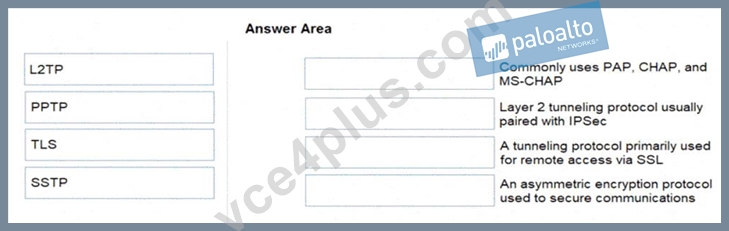
Answer:
Explanation: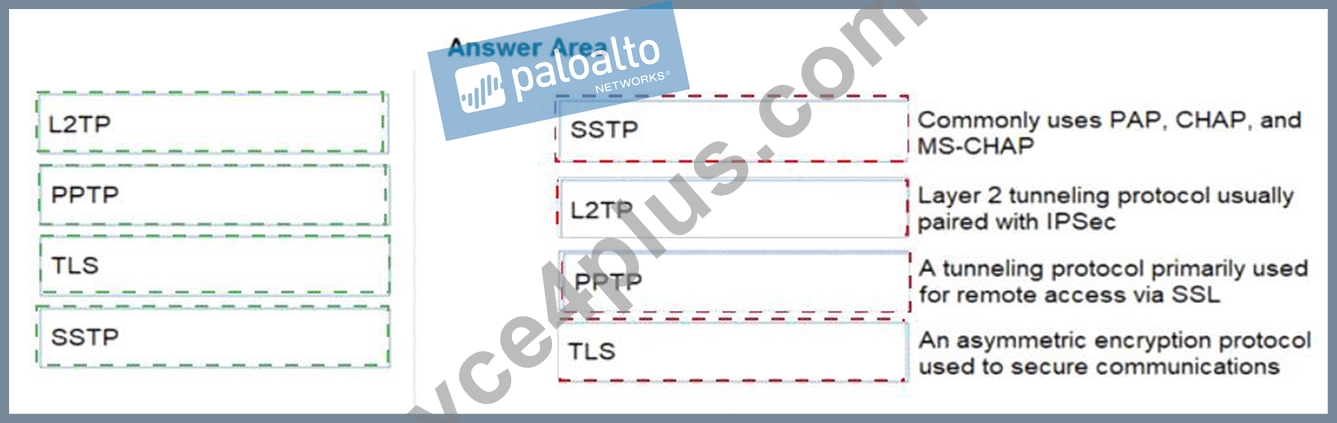
Explanation: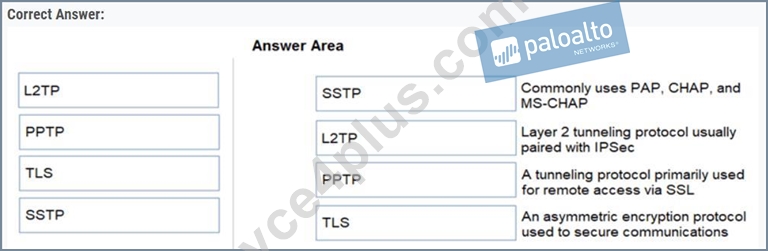
NEW QUESTION # 97
Which endpoint product from Palo Alto Networks can help with SOC visibility?
- A. AutoFocus
- B. WildFire
- C. STIX
- D. Cortex XDR
Answer: D
Explanation:
Cortex XDR is an endpoint product from Palo Alto Networks that can help with SOC visibility by allowing you to rapidly detect and respond to threats across your networks, endpoints, and clouds. It assists SOC analysts by allowing them to view all the alerts from all Palo Alto Networks products in one place, and to perform root cause analysis and automated response actions. Cortex XDR also integrates with other Palo Alto Networks products, such as WildFire, AutoFocus, and Cortex Data Lake, to provide comprehensive threat intelligence and data enrichment12. References:
* SOC Services - Palo Alto Networks
* Endpoint Protection - Palo Alto Networks
* Security Operations | Palo Alto Networks
* Cortex - Palo Alto Networks
NEW QUESTION # 98
When does a TLS handshake occur?
- A. Only during DNS over HTTPS queries
- B. Independently of HTTPS communications
- C. Before establishing a TCP connection
- D. After a TCP handshake has been established
Answer: D
Explanation:
A TLS handshake occurs after the TCP handshake is complete. The TLS handshake is responsible for establishing a secure, encrypted session between client and server, including the negotiation of encryption algorithms and exchange of keys.
NEW QUESTION # 99
Which component of cloud security is used to identify misconfigurations during the development process?
- A. SaaS security
- B. Code security
- C. Container security
- D. Network security
Answer: B
Explanation:
Code security focuses on identifying vulnerabilities and misconfigurations early in the development process. It uses tools like static code analysis and infrastructure-as-code (IaC) scanning to ensure secure coding and configuration before deployment.
NEW QUESTION # 100
Which activities do local organization security policies cover for a SaaS application?
- A. how the application processes the data
- B. how the application can be used
- C. how the application can transit the Internet
- D. how the data is backed up in one or more locations
Answer: B
Explanation:
Local organization security policies are the rules and guidelines that define how a SaaS application can be used by the employees, contractors, and partners of an organization. These policies cover aspects such as authentication, authorization, data access, data protection, data sharing, and compliance. Local organization security policies aim to ensure that the SaaS application is used in a secure, ethical, and legal manner, and that the organization's data and assets are not compromised or misused123. References:
* Securing SaaS tools for your organisation - GOV.UK
* SaaS Security: A Complete Best Practices Guide - BetterCloud
* Security policy document examples for B2B SaaS apps
NEW QUESTION # 101
What role do containers play in cloud migration and application management strategies?
- A. They are used to orchestrate virtual machines (VMs) in cloud environments.
- B. They serve as a template manager for software applications and services.
- C. They enable companies to use cloud-native tools and methodologies.
- D. They are used for data storage in cloud environments.
Answer: C
Explanation:
Containers encapsulate applications and their dependencies into lightweight, portable units that can run consistently across multiple environments. This abstraction supports cloud-native development by enabling microservices architectures, rapid deployment, and scaling within orchestration platforms like Kubernetes. Containers accelerate cloud migration by decoupling applications from infrastructure, facilitating automation, and continuous integration/continuous deployment (CI/CD) workflows. Palo Alto Networks addresses container security by integrating runtime protection, vulnerability scanning, and compliance enforcement within its Prisma Cloud platform, ensuring safe adoption of cloud-native tools and methodologies.
NEW QUESTION # 102
......
Practice LATEST PCCP Exam Updated 227 Questions: https://www.vce4plus.com/Palo-Alto-Networks/PCCP-valid-vce-dumps.html
First Attempt Guaranteed Success in PCCP Exam: https://drive.google.com/open?id=1m7D0-TUABZf0rRV8OPYconcmx2PGFFG8