

Updated Mar-2026 Test Engine to Practice DP-100 Dumps & Practice Exam
Dumps Collection DP-100 Test Engine Dumps Training With 519 Questions
NEW QUESTION # 138
You write five Python scripts that must be processed in the order specified in Exhibit A - which allows the same modules to run in parallel, but will wait for modules with dependencies.
You must create an Azure Machine Learning pipeline using the Python SDK, because you want to script to create the pipeline to be tracked in your version control system. You have created five PythonScriptSteps and have named the variables to match the module names.
You need to create the pipeline shown. Assume all relevant imports have been done.
Which Python code segment should you use?
- A.

- B.

- C.

- D.

Answer: D
Explanation:
The steps parameter is an array of steps. To build pipelines that have multiple steps, place the steps in order in this array.
Reference:
https://docs.microsoft.com/en-us/azure/machine-learning/how-to-use-parallel-run-step
NEW QUESTION # 139
You are performing sentiment analysis using a CSV file that includes 12,000 customer reviews written in a short sentence format. You add the CSV file to Azure Machine Learning Studio and configure it as the starting point dataset of an experiment. You add the Extract N-Gram Features from Text module to the experiment to extract key phrases from the customer review column in the dataset.
You must create a new n-gram dictionary from the customer review text and set the maximum n-gram size to trigrams.
What should you select? To answer, select the appropriate options in the answer area.
NOTE: Each correct selection is worth one point.
Answer:
Explanation:
Reference:
https://docs.microsoft.com/en-us/azure/machine-learning/studio-module-reference/extract-n-gram-features-from-text
NEW QUESTION # 140
You create an Azure Machine Learning compute target named ComputeOne by using the STANDARD_D1 virtual machine image.
You define a Python variable named was that references the Azure Machine Learning workspace. You run the following Python code:
For each of the following statements, select Yes if the statement is true. Otherwise, select No.
NOTE: Each correct selection is worth one point.
Answer:
Explanation:
Explanation:
Box 1:Yes
ComputeTargetException class: An exception related to failures when creating, interacting with, or configuring a compute target. This exception is commonly raised for failures attaching a compute target, missing headers, and unsupported configuration values.
Create(workspace, name, provisioning_configuration)
Provision a Compute object by specifying a compute type and related configuration.
This method creates a new compute target rather than attaching an existing one.
Box 2: Yes
Box 3: No
The line before print('Step1') will fail.
Reference:
https://docs.microsoft.com/en-us/python/api/azureml-core/azureml.core.compute.computetarget
NEW QUESTION # 141
You are preparing to use the Azure ML SDK to run an experiment and need to create compute. You run the following code:
For each of the following statements, select Yes if the statement is true. Otherwise, select No.
NOTE: Each correct selection is worth one point.
Answer:
Explanation:
Explanation:
Box 1: No
If a training cluster already exists it will be used.
Box 2: Yes
The wait_for_completion method waits for the current provisioning operation to finish on the cluster.
Box 3: Yes
Low Priority VMs use Azure's excess capacity and are thus cheaper but risk your run being pre-empted.
Box 4: No
Need to use training_compute.delete() to deprovision and delete the AmlCompute target.
Reference:
https://notebooks.azure.com/azureml/projects/azureml-getting-started/html/how-to-use-azureml/training/train-on-amlcompute/train-on-amlcompute.ipynb
https://docs.microsoft.com/en-us/python/api/azureml-core/azureml.core.compute.computetarget
NEW QUESTION # 142
You create an experiment in Azure Machine Learning Studio- You add a training dataset that contains 10.000 rows. The first 9.000 rows represent class 0 (90 percent). The first 1.000 rows represent class 1 (10 percent).
The training set is unbalanced between two Classes. You must increase the number of training examples for class 1 to 4,000 by using data rows. You add the Synthetic Minority Oversampling Technique (SMOTE) module to the experiment.
You need to configure the module.
Which values should you use? To answer, select the appropriate options in the dialog box in the answer area.
NOTE: Each correct selection is worth one point.
Answer:
Explanation:
NEW QUESTION # 143
You are creating an experiment by using Azure Machine Learning Studio.
You must divide the data into four subsets for evaluation. There is a high degree of missing values in the data.
You must prepare the data for analysis.
You need to select appropriate methods for producing the experiment.
Which three modules should you run in sequence? To answer, move the appropriate actions from the list of actions to the answer area and arrange them in the correct order.
NOTE: More than one order of answer choices is correct. You will receive credit for any of the correct orders you select.
Answer:
Explanation:
Explanation
The Clean Missing Data module in Azure Machine Learning Studio, to remove, replace, or infer missing values.
NEW QUESTION # 144
You are training machine learning models in Azure Machine Learning. You use Hyperdrive to tune the hyperparameter.
In previous model training and tuning runs, many models showed similar performance.
You need to select an early termination policy that meets the following requirements:
* accounts for the performance of all previous runs when evaluating the current run
* avoids comparing the current run with only the best performing run to date Which two early termination policies should you use? Each correct answer presents part of the solution.
NOTE: Each correct selection is worth one point.
- A. Default
- B. Median stopping
- C. Truncation selection
- D. Bandit
Answer: A,B
Explanation:
The Median Stopping policy computes running averages across all runs and cancels runs whose best performance is worse than the median of the running averages.
If no policy is specified, the hyperparameter tuning service will let all training runs execute to completion.
Incorrect Answers:
B: BanditPolicy defines an early termination policy based on slack criteria, and a frequency and delay interval for evaluation.
The Bandit policy takes the following configuration parameters:
slack_factor: The amount of slack allowed with respect to the best performing training run. This factor specifies the slack as a ratio.
D: The Truncation selection policy periodically cancels the given percentage of runs that rank the lowest for their performance on the primary metric. The policy strives for fairness in ranking the runs by accounting for improving model performance with training time. When ranking a relatively young run, the policy uses the corresponding (and earlier) performance of older runs for comparison. Therefore, runs aren't terminated for having a lower performance because they have run for less time than other runs.
Reference:
https://docs.microsoft.com/en-us/python/api/azureml-train-core/azureml.train.hyperdrive.medianstoppingpolicy
https://docs.microsoft.com/en-us/python/api/azureml-train-core/
azureml.train.hyperdrive.truncationselectionpolicy
https://docs.microsoft.com/en-us/python/api/azureml-train-core/azureml.train.hyperdrive.banditpolicy
NEW QUESTION # 145
Note: This question is part of a series of questions that present the same scenario. Each question in the series contains a unique solution that might meet the stated goals. Some question sets might have more than one correct solution, while others might not have a correct solution.
After you answer a question in this section, you will NOT be able to return to it. As a result, these questions will not appear in the review screen.
An IT department creates the following Azure resource groups and resources:
The IT department creates an Azure Kubernetes Service (AKS)-based inference compute target named aks-cluster in the Azure Machine Learning workspace.
You have a Microsoft Surface Book computer with a GPU. Python 3.6 and Visual Studio Code are installed.
You need to run a script that trains a deep neural network (DNN) model and logs the loss and accuracy metrics.
Solution: Install the Azure ML SDK on the Surface Book. Run Python code to connect to the workspace and then run the training script as an experiment on local compute.
Does the solution meet the goal?
- A. Yes
- B. No
Answer: B
Explanation:
Need to attach the mlvm virtual machine as a compute target in the Azure Machine Learning workspace.
Reference:
https://docs.microsoft.com/en-us/azure/machine-learning/concept-compute-target
NEW QUESTION # 146
Note: This question is part of a series of questions that present the same scenario. Each question in the series contains a unique solution that might meet the stated goals. Some question sets might have more than one correct solution, while others might not have a correct solution.
After you answer a question in this section, you will NOT be able to return to it. As a result, these questions will not appear in the review screen.
You create a model to forecast weather conditions based on historical data.
You need to create a pipeline that runs a processing script to load data from a datastore and pass the processed data to a machine learning model training script.
Solution: Run the following code:
Does the solution meet the goal?
- A. Yes
- B. No
Answer: B
Explanation:
train_step is missing.
Reference:
https://docs.microsoft.com/en-us/python/api/azureml-pipeline-core/azureml.pipeline.core.pipelinedata?view=azure-ml-py
NEW QUESTION # 147
You use the Azure Machine Learning SDK to run a training experiment that trains a classification model and calculates its accuracy metric.
The model will be retrained each month as new data is available.
You must register the model for use in a batch inference pipeline.
You need to register the model and ensure that the models created by subsequent retraining experiments are registered only if their accuracy is higher than the currently registered model.
What are two possible ways to achieve this goal? Each correct answer presents a complete solution.
NOTE: Each correct selection is worth one point.
- A. Specify the model framework version when registering the model, and only register subsequent models if this value is higher.
- B. Register the model with the same name each time regardless of accuracy, and always use the latestversion of the model in the batch inferencing pipeline.
- C. Specify a tag named accuracy with the accuracy metric as a value when registering the model, and only register subsequent models if their accuracy is higher than the accuracy tag value of the currentlyregistered model.
- D. Specify a different name for the model each time you register it.
- E. Specify a property named accuracy with the accuracy metric as a value when registering the model, and only register subsequent models if their accuracy is higher than the accuracy property value of thecurrently registered model.
Answer: A,C
Explanation:
E: Using tags, you can track useful information such as the name and version of the machine learning library used to train the model. Note that tags must be alphanumeric.
Reference:
https://notebooks.azure.com/xavierheriat/projects/azureml-getting-started/html/how-to-use-azureml
/deployment/register-model-create-image-deploy-service/register-model-create-image-deploy-service.ipynb
NEW QUESTION # 148
You need to configure the Permutation Feature Importance module for the model training requirements.
What should you do? To answer, select the appropriate options in the dialog box in the answer area.
NOTE: Each correct selection is worth one point.
Answer:
Explanation:
Explanation: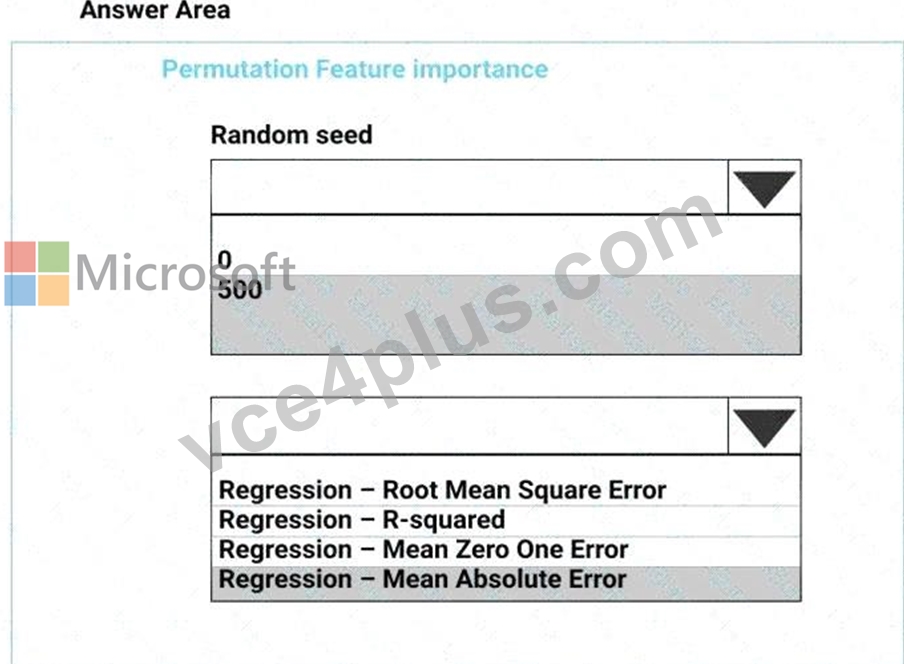
Box 1: 500
For Random seed, type a value to use as seed for randomization. If you specify 0 (the default), a number is generated based on the system clock.
A seed value is optional, but you should provide a value if you want reproducibility across runs of the same experiment.
Here we must replicate the findings.
Box 2: Mean Absolute Error
Scenario: Given a trained model and a test dataset, you must compute the Permutation Feature Importance scores of feature variables. You need to set up the Permutation Feature Importance module to select the correct metric to investigate the model's accuracy and replicate the findings.
Regression. Choose one of the following: Precision, Recall, Mean Absolute Error , Root Mean Squared Error, Relative Absolute Error, Relative Squared Error, Coefficient of Determination References:
https://docs.microsoft.com/en-us/azure/machine-learning/studio-module-reference/permutation-feature- importance
NEW QUESTION # 149
You create a binary classification model to predict whether a person has a disease.
You need to detect possible classification errors.
Which error type should you choose for each description? To answer, select the appropriate options in the answer area.
NOTE: Each correct selection is worth one point.
Answer:
Explanation: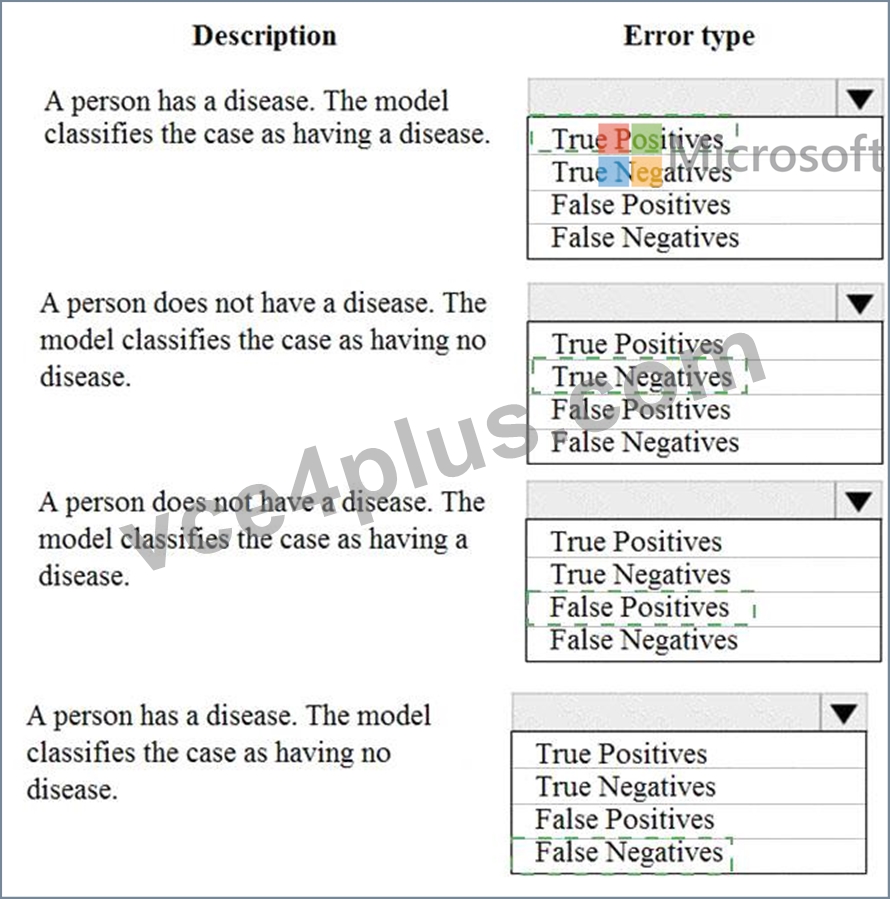
Explanation

Box 1: True Positive
A true positive is an outcome where the model correctly predicts the positive class Box 2: True Negative A true negative is an outcome where the model correctly predicts the negative class.
Box 3: False Positive
A false positive is an outcome where the model incorrectly predicts the positive class.
Box 4: False Negative
A false negative is an outcome where the model incorrectly predicts the negative class.
Note: Let's make the following definitions:
"Wolf" is a positive class.
"No wolf" is a negative class.
We can summarize our "wolf-prediction" model using a 2x2 confusion matrix that depicts all four possible outcomes:
Reference:
https://developers.google.com/machine-learning/crash-course/classification/true-false-positive-negative
NEW QUESTION # 150
You create a binary classification model to predict whether a person has a disease.
You need to detect possible classification errors.
Which error type should you choose for each description? To answer, select the appropriate options in the answer area.
NOTE: Each correct selection is worth one point.
Answer:
Explanation:
Explanation

Box 1: True Positive
A true positive is an outcome where the model correctly predicts the positive class Box 2: True Negative A true negative is an outcome where the model correctly predicts the negative class.
Box 3: False Positive
A false positive is an outcome where the model incorrectly predicts the positive class.
Box 4: False Negative
A false negative is an outcome where the model incorrectly predicts the negative class.
Note: Let's make the following definitions:
"Wolf" is a positive class.
"No wolf" is a negative class.
We can summarize our "wolf-prediction" model using a 2x2 confusion matrix that depicts all four possible outcomes:
Reference:
https://developers.google.com/machine-learning/crash-course/classification/true-false-positive-negative
NEW QUESTION # 151
You need to correct the model fit issue.
Which three actions should you perform in sequence? To answer, move the appropriate actions from the list of actions to the answer area and arrange them in the correct order.
Answer:
Explanation: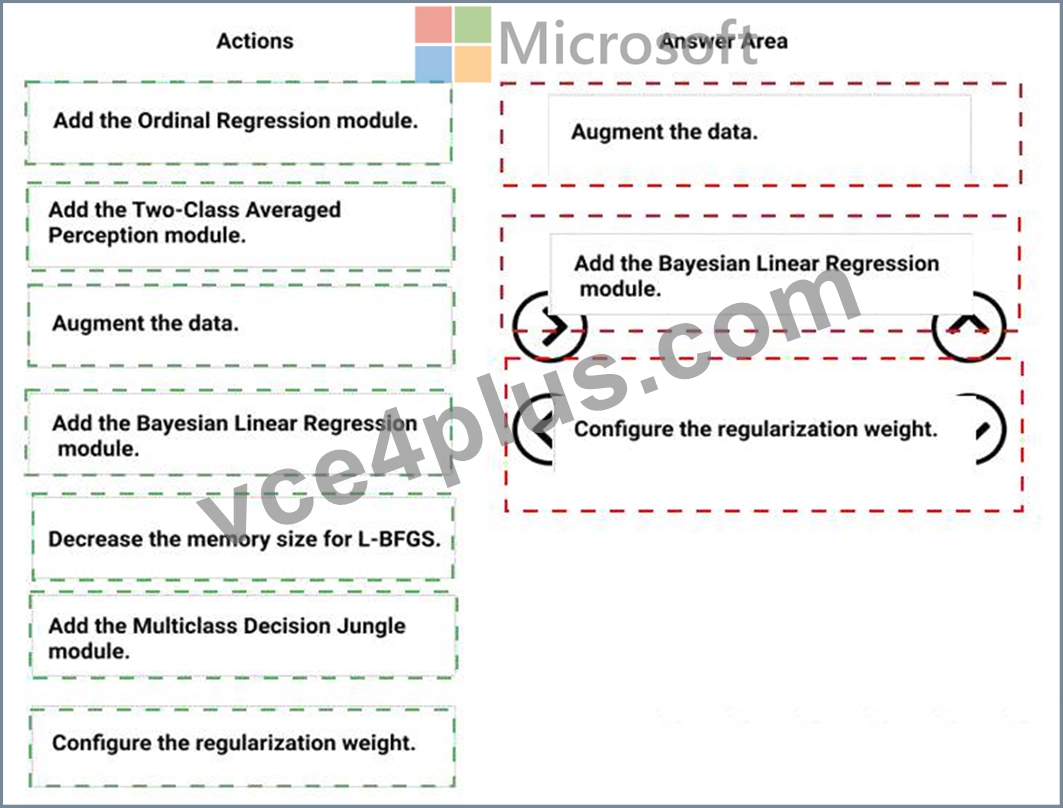
Explanation:
Step 1: Augment the data
Scenario: Columns in each dataset contain missing and null values. The datasets also contain many outliers.
Step 2: Add the Bayesian Linear Regression module.
Scenario: You produce a regression model to predict property prices by using the Linear Regression and Bayesian Linear Regression modules.
Step 3: Configure the regularization weight.
Regularization typically is used to avoid overfitting. For example, in L2 regularization weight, type the value to use as the weight for L2 regularization. We recommend that you use a non-zero value to avoid overfitting.
Scenario:
Model fit: The model shows signs of overfitting. You need to produce a more refined regression model that reduces the overfitting.
NEW QUESTION # 152
Note: This question is part of a series of questions that present the same scenario. Each question in the series contains a unique solution that might meet the stated goals. Some question sets might have more than one correct solution, while others might not have a correct solution.
After you answer a question in this section, you will NOT be able to return to it. As a result, these questions will not appear in the review screen.
You are using Azure Machine Learning to run an experiment that trains a classification model.
You want to use Hyperdrive to find parameters that optimize the AUC metric for the model. You configure a HyperDriveConfig for the experiment by running the following code:
You plan to use this configuration to run a script that trains a random forest model and then tests it with validation data. The label values for the validation data are stored in a variable named y_test variable, and the predicted probabilities from the model are stored in a variable named y_predicted.
You need to add logging to the script to allow Hyperdrive to optimize hyperparameters for the AUC metric.
Solution: Run the following code: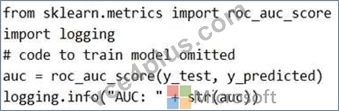
Does the solution meet the goal?
- A. Yes
- B. No
Answer: A
Explanation:
Python printing/logging example:
logging.info(message)
Destination: Driver logs, Azure Machine Learning designer
Reference:
https://docs.microsoft.com/en-us/azure/machine-learning/how-to-debug-pipelines
NEW QUESTION # 153
You plan to create a speech recognition deep learning model.
The model must support the latest version of Python.
You need to recommend a deep learning framework for speech recognition to include in the Data Science Virtual Machine (DSVM).
What should you recommend?
- A. Weka
- B. TensorFlow
- C. Deeplearning4j
- D. Rattle
Answer: B
Explanation:
TensorFlow is an open source library for numerical computation and large-scale machine learning. It uses Python to provide a convenient front-end API for building applications with the framework TensorFlow can train and run deep neural networks for handwritten digit classification, image recognition, word embeddings, recurrent neural networks, sequence-to-sequence models for machine translation, natural language processing, and PDE (partial differential equation) based simulations.
Incorrect Answers:
A: Rattle is the R analytical tool that gets you started with data analytics and machine learning.
C: Weka is used for visual data mining and machine learning software in Java.
References:
https://www.infoworld.com/article/3278008/what-is-tensorflow-the-machine-learning-library-explained.html
NEW QUESTION # 154
You use Azure Machine Learning to implement hyperparameter tuning for an Azure ML Python SDK v2-based model training.
Training runs must terminate when the primary metric is lowered by 25 percent or more compared to the best performing run.
You need to configure an early termination policy to terminate training jobs.
Which values should you use? To answer, select the appropriate options in the answer area.
NOTE: Each correct selection is worth one point.
Answer:
Explanation:
Explanation
NEW QUESTION # 155
You are preparing to use the Azure ML SDK to run an experiment and need to create compute. You run the following code:
For each of the following statements, select Yes if the statement is true. Otherwise, select No.
NOTE: Each correct selection is worth one point.
Answer:
Explanation:
Explanation:
Box 1: No
If a training cluster already exists it will be used.
Box 2: Yes
The wait_for_completion method waits for the current provisioning operation to finish on the cluster.
Box 3: Yes
Low Priority VMs use Azure's excess capacity and are thus cheaper but risk your run being pre-empted.
Box 4: No
Need to use training_compute.delete() to deprovision and delete the AmlCompute target.
Reference:
https://notebooks.azure.com/azureml/projects/azureml-getting-started/html/how-to-use-azureml/training/train- on-amlcompute/train-on-amlcompute.ipynb
https://docs.microsoft.com/en-us/python/api/azureml-core/azureml.core.compute.computetarget
NEW QUESTION # 156
......
Microsoft DP-100 Dumps Cover Real Exam Questions: https://www.vce4plus.com/Microsoft/DP-100-valid-vce-dumps.html
Real DP-100 dumps - Real Microsoft dumps PDF: https://drive.google.com/open?id=1Va2x89wFv6-1AyQvKloSbeM9e_W5cSCs