

VCE4Plus PSE-SWFW-Pro-24 Exam Questions | Real PSE-SWFW-Pro-24 Practice Dumps
Verified PSE-SWFW-Pro-24 Exam Dumps Q&As - Provide PSE-SWFW-Pro-24 with Correct Answers
NEW QUESTION # 44
Which two statements accurately describe cloud-native load balancing with Palo Alto Networks VM-Series firewalls and/or Cloud NGFW in public cloud environments? (Choose two.)
- A. Cloud NGFW in AWS or Azure has load balancing built into the underlying solution and does not require the deployment of a separate load balancer.
- B. Cloud NGFW's distributed architecture model requires deployment of a single centralized firewall and will force all traffic to the firewall across pre-built VPN tunnels.
- C. VM-Series firewall load balancing is automated and is handled by the internal mechanics of the NGFW software without the need for a load balancer.
- D. VM-Series firewall deployments in the public cloud will require the deployment of a cloud-native load balancer if high availability (HA) or redundancy is needed.
Answer: A,D
Explanation:
Cloud-native load balancing with Palo Alto Networks firewalls in public clouds involves understanding the distinct approaches for VM-Series and Cloud NGFW:
A . Cloud NGFW's distributed architecture model requires deployment of a single centralized firewall and will force all traffic to the firewall across pre-built VPN tunnels: This is incorrect. Cloud NGFW uses a distributed architecture where traffic is steered to the nearest Cloud NGFW instance, often using Gateway Load Balancers (GWLBs) or similar services. It does not rely on a single centralized firewall or force all traffic through VPN tunnels.
B . VM-Series firewall deployments in the public cloud will require the deployment of a cloud-native load balancer if high availability (HA) or redundancy is needed: This is correct. VM-Series firewalls, when deployed for HA or redundancy, require a cloud-native load balancer (e.g., AWS ALB/NLB/GWLB, Azure Load Balancer) to distribute traffic across the active firewall instances. This ensures that if one firewall fails, traffic is automatically directed to a healthy instance.
C . Cloud NGFW in AWS or Azure has load balancing built into the underlying solution and does not require the deployment of a separate load balancer: This is also correct. Cloud NGFW integrates with cloud-native load balancing services (e.g., Gateway Load Balancer in AWS) as part of its architecture. This provides automatic scaling and high availability without requiring you to manage a separate load balancer.
D . VM-Series firewall load balancing is automated and is handled by the internal mechanics of the NGFW software without the need for a load balancer: This is incorrect. VM-Series firewalls do not have built-in load balancing capabilities for HA. A cloud-native load balancer is essential for distributing traffic and ensuring redundancy.
Reference:
Cloud NGFW documentation: Look for sections on architecture, traffic steering, and integration with cloud-native load balancing services (like AWS Gateway Load Balancer).
VM-Series deployment guides for each cloud provider: These guides explain how to deploy VM-Series firewalls for HA using cloud-native load balancers.
These resources confirm that VM-Series requires external load balancers for HA, while Cloud NGFW has load balancing integrated into its design.
NEW QUESTION # 45
What are three components of Cloud NGFW for AWS? (Choose three.)
- A. Amazon S3 bucket
- B. Cloud NGFW Resource
- C. Cloud NGFW Tenant
- D. Cloud NGFW Inspector
- E. Local or Global Rulestacks
Answer: B,D,E
Explanation:
Cloud NGFW for AWS is a Next-Generation Firewall as a Service. Its key components work together to provide comprehensive network security.
A . Cloud NGFW Resource: This represents the actual deployed firewall instance within your AWS environment. It's the core processing engine that inspects and secures network traffic. The Cloud NGFW resource is deployed in a VPC and associated with subnets, enabling traffic inspection between VPCs, subnets, and to/from the internet.
B . Local or Global Rulestacks: These define the security policies that govern traffic inspection. Rulestacks contain rules that match traffic based on various criteria (e.g., source/destination IP, port, application) and specify the action to take (e.g., allow, deny, inspect). Local Rulestacks are specific to a single Cloud NGFW resource, while Global Rulestacks can be shared across multiple Cloud NGFW resources for consistent policy enforcement.
C . Cloud NGFW Inspector: The Cloud NGFW Inspector is the core component performing the deep packet inspection and applying security policies. It resides within the Cloud NGFW Resource and analyzes network traffic based on the configured rulestacks. It provides advanced threat prevention capabilities, including intrusion prevention (IPS), malware detection, and URL filtering.
D . Amazon S3 bucket: While S3 buckets can be used for logging and storing configuration backups in some firewall deployments, they are not a core component of the Cloud NGFW architecture itself. Cloud NGFW uses its own logging and management infrastructure.
E . Cloud NGFW Tenant: The term "Tenant" is usually associated with multi-tenant architectures where resources are shared among multiple customers. While Palo Alto Networks provides a managed service for Cloud NGFW, the deployment within your AWS account is dedicated and not considered a tenant in the traditional multi-tenant sense. The management of the firewall is done through Panorama or Cloud Management.
Reference:
While direct, concise documentation specifically listing these three components in this exact format is difficult to pinpoint in a single document, the Palo Alto Networks documentation consistently describes these elements as integral. The concepts are spread across multiple documents and are best understood in context of the overall Cloud NGFW architecture:
Cloud NGFW for AWS Administration Guide: This is the primary resource for understanding Cloud NGFW. It details deployment, configuration, and management, covering the roles of the Cloud NGFW resource, rulestacks, and the underlying inspection engine. You can find this documentation on the Palo Alto Networks support portal by searching for "Cloud NGFW for AWS Administration Guide".
NEW QUESTION # 46
Which three statements describe the functionality of Dynamic Address Groups and tags? (Choose three.)
- A. Dynamic Address Groups that are referenced in Security policies must be committed on the firewall.
- B. To dynamically register tags, use either the XML API or the VM Monitoring agent on the firewall or on the User-ID agent.
- C. Static tags are part of the configuration on the firewall, while dynamic tags are part of the runtime configuration.
- D. Dynamic Address Groups use tags as filtering criteria to determine their members, and filters do not use logical operators.
- E. IP-Tag registrations to Dynamic Address Groups must be committed on the firewall after each change.
Answer: A,B,C
Explanation:
Dynamic Address Groups (DAGs) use tags to dynamically populate their membership.
Why A, B, and C are correct:
A . Static tags are part of the configuration on the firewall, while dynamic tags are part of the runtime configuration: Static tags are configured directly on objects. Dynamic tags are applied based on runtime conditions (e.g., by the VM Monitoring agent or User-ID agent).
B . Dynamic Address Groups that are referenced in Security policies must be committed on the firewall: Like any configuration change that affects security policy, changes to DAGs (including tag associations) must be committed to take effect.
C . To dynamically register tags, use either the XML API or the VM Monitoring agent on the firewall or on the User-ID agent: These are the mechanisms for dynamically applying tags based on events or conditions.
Why D and E are incorrect:
D . IP-Tag registrations to Dynamic Address Groups must be committed on the firewall after each change: While changes to the configuration of a DAG (like adding a new tag filter) require a commit, the registration of IP addresses with tags does not. The DAG membership updates dynamically as tags are applied and removed.
E . Dynamic Address Groups use tags as filtering criteria to determine their members, and filters do not use logical operators: DAG filters do support logical operators (AND, OR) to create more complex membership criteria.
Palo Alto Networks Reference:
PAN-OS Administrator's Guide: The section on Dynamic Address Groups provides details on how they work, including the use of tags as filters and the mechanisms for dynamic tag registration.
VM Monitoring and User-ID Agent Documentation: These documents explain how these components can be used to dynamically apply tags.
The documentation confirms the correct statements regarding static vs. dynamic tags, the need to commit DAG changes, and the methods for dynamic tag registration. It also clarifies that DAG filters do use logical operators and that IP-tag registrations themselves don't require commits.
NEW QUESTION # 47
What are three Palo Alto Networks VM-Series firewall reference architecture deployment models? (Choose three.)
- A. GCP VM-Series: VPC network peering model with Shared VPC
- B. Azure VM-Series: Distributed VCN - common firewall
- C. Cloud NGFW for AWS: Combined Model
- D. Cloud NGFW for Azure: Virtual WAN integration
- E. AWS VM-Series: Isolated Transit Gateway
Answer: A,D,E
Explanation:
Palo Alto Networks provides various reference architectures for deploying VM-Series firewalls in different cloud environments. Let's examine the options:
* A: Cloud NGFW for AWS: Combined Model: While Cloud NGFW is an offering, the term
"Combined Model" isn't a standard, documented reference architecture name. Cloud NGFW for AWS focuses on simplified deployment and management but doesn't use this specific terminology for its deployment models.
* B: AWS VM-Series: Isolated Transit Gateway: This is a VALID deployment model. It involves deploying VM-Series firewalls in an isolated VPC connected to AWS Transit Gateway. This provides centralized security inspection for traffic flowing between different VPCs and on-premises networks connected to the Transit Gateway.
NEW QUESTION # 48
Why are VM-Series firewalls now grouped by four tiers?
- A. To simplify the portfolio and reduce the number of VM-Series models customers must choose from
- B. To define the priority level of support customers expect when opening a TAC case, from lowest tier 1 to highest tier 4
- C. To define the maximum limits for key criteria based on allocated memory
- D. To obscure the supported hypervisor manufacturer into generic terms
Answer: A
Explanation:
The VM-Series tiering simplifies the product portfolio.
Why B is correct: The four-tier model (VE, VE-Lite, VE-Standard, VE-High) simplifies the selection process for customers by grouping VM-Series models based on performance and resource allocation. This makes it easier to choose the appropriate VM-Series instance based on their needs without having to navigate a long list of individual models.
Why A, C, and D are incorrect:
A . To obscure the supported hypervisor manufacturer into generic terms: The tiering is not related to obscuring hypervisor information. The documentation clearly states supported hypervisors.
C . To define the maximum limits for key criteria based on allocated memory: While memory is a factor in performance, the tiers are based on a broader set of resource allocations (vCPUs, memory, throughput) and features, not just memory.
D . To define the priority level of support customers expect when opening a TAC case: Support priority is based on support contracts, not the VM-Series tier.
Palo Alto Networks Reference: VM-Series datasheets and the VM-Series deployment guides explain the tiering model and its purpose of simplifying the portfolio.
NEW QUESTION # 49
Which three methods may be used to deploy CN-Series firewalls? (Choose three.)
- A. Helm charts
- B. Panorama plugin for Kubernetes
- C. YAML file
- D. Terraform templates
- E. Docker Swarm
Answer: A,C,D
Explanation:
The CN-Series firewalls are containerized firewalls designed to protect Kubernetes environments. They offer several deployment methods to integrate with Kubernetes orchestration.
* A. Terraform templates: Terraform is an Infrastructure-as-Code (IaC) tool that allows you to define and provision infrastructure using declarative configuration files. 1 Palo Alto Networks provides Terraform modules and examples to deploy CN-Series firewalls, enabling automated and repeatable deployments.
1. prathmeshh.hashnode.dev
prathmeshh.hashnode.dev
* B. Panorama plugin for Kubernetes: While Panorama is used to manage CN-Series firewalls centrally, there isn't a direct "Panorama plugin for Kubernetes" for deploying the firewalls themselves.
Panorama is used for management after they're deployed using other methods.
* C. YAML file: Kubernetes uses YAML files (manifests) to define the desired state of deployments, including pods, services, and other resources. You can deploy CN-Series firewalls by creating YAML files that define the necessary Kubernetes objects, such as Deployments, Services, and ConfigMaps.
This is a core method for Kubernetes deployments.
* D. Helm charts: Helm is a package manager for Kubernetes. Helm charts package Kubernetes resources, including YAML files, into reusable and shareable units. Palo Alto Networks provides Helm charts for deploying CN-Series firewalls, simplifying the deployment process and managing updates.
* E. Docker Swarm: Docker Swarm is a container orchestration tool, but CN-Series firewalls are specifically designed for Kubernetes and are not deployed using Docker Swarm.
References:
The Palo Alto Networks documentation clearly outlines these deployment methods:
* CN-Series Deployment Guide: This is the primary resource for deploying CN-Series firewalls. It provides detailed instructions and examples for using Terraform, YAML files, and Helm charts. You can find this on the Palo Alto Networks support portal by searching for "CN-Series Deployment Guide".
NEW QUESTION # 50
An RFP from a customer who needs multi-cloud Layer 7 network security for both Amazon Web Services (AWS) and Azure environments is being evaluated. The requirements include full management control of the firewall, VPN termination, and BGP routing.
Which firewall solution should be recommended to meet the requirements?
- A. CN-Series
- B. VM-Series
- C. Cloud NGFW
- D. PA-Series
Answer: B
Explanation:
Comprehensive and Detailed In-Depth Step-by-Step Explanation:The customer's request for multi-cloud Layer 7 network security in AWS and Azure, with full management control, VPN termination, and BGP routing, requires a flexible and feature-rich firewall solution. The Palo Alto Networks Systems Engineer Professional - Software Firewall documentation outlines the capabilities of its firewall products for multi- cloud environments.
* VM-Series (Option A): The VM-Series firewall is a virtualized next-generation firewall (NGFW) ideal for multi-cloud deployments in AWS and Azure. It provides Layer 7 application visibility and control, full management control through tools like Panorama or Strata Cloud Manager, VPN termination (e.g., IPSec site-to-site VPNs), and BGP dynamic routing to peer with cloud and on-premises routers. The documentation highlights VM-Series as a versatile solution for public clouds, supporting custom configurations, policy enforcement, and advanced routing protocols, meeting all the customer's requirements without the limitations of cloud-native or container-specific firewalls.
Options B (CN-Series), C (Cloud NGFW), and D (PA-Series) are incorrect. CN-Series firewalls are designed for containerized environments (e.g., Kubernetes) and do not support VPN termination or BGP routing natively, making them unsuitable for this multi-cloud, Layer 7 security use case. Cloud NGFW, while cloud- native for AWS and Azure, offers limited management control (as it is a managed service) and does not natively support VPN termination or BGP routing, as these features are handled by the cloud provider or require VM-Series integration. PA-Series firewalls are physical appliances, not virtualized or cloud-native, and cannot be deployed in AWS or Azure to meet the multi-cloud requirement.
References: Palo Alto Networks Systems Engineer Professional - Software Firewall, Section: Multi-Cloud Security, VM-Series Deployment Guide for AWS and Azure, VPN and BGP Routing Documentation.
NEW QUESTION # 51
What are two benefits of using Palo Alto Networks NGFWs in a public cloud service provider (CSP) environment? (Choose two.)
- A. Automated scaling
- B. Consistent Security policies throughout the multi-cloud environment
- C. Deployable in any CSP environment
- D. Management of all network traffic in every CSP environment
Answer: A,B
Explanation:
Comprehensive and Detailed In-Depth Step-by-Step Explanation:Palo Alto Networks Next-Generation Firewalls (NGFWs), such as VM-Series, CN-Series, and Cloud NGFW, are designed to secure public cloud environments like AWS, Azure, and GCP. The Palo Alto Networks Systems Engineer Professional - Software Firewall documentation highlights the following benefits for deploying NGFWs in public cloud service provider (CSP) environments:
* Consistent Security policies throughout the multi-cloud environment (Option B): Palo Alto Networks NGFWs, managed through tools like Panorama or Strata Cloud Manager (SCM), enable consistent security policy enforcement across multiple public cloud providers. This ensures uniformity in security posture, reducing complexity and risk in multi-cloud deployments. The documentation emphasizes the importance of centralized policy management for maintaining consistency, whether using VM-Series, CN-Series, or Cloud NGFW.
* Automated scaling (Option D): NGFWs in public clouds leverage the auto-scaling capabilities of the CSP (e.g., AWS Auto Scaling, Azure Scale Sets) to dynamically adjust resources based on traffic demand. This is particularly true for Cloud NGFW and VM-Series, which integrate with cloud-native load balancers and scaling services to ensure performance without manual intervention, enhancing efficiency and cost-effectiveness.
Options A (Management of all network traffic in every CSP environment) and C (Deployable in any CSP environment) are incorrect. Managing all network traffic in every CSP environment is not feasible due to differences in cloud architectures and native services, and it is not a claimed benefit of Palo Alto Networks NGFWs. While NGFWs are deployable in major CSPs (AWS, Azure, GCP), they are not universally deployable in "any" CSP environment, as compatibility depends on specific integrations and support, making Option C overly broad and inaccurate.
References: Palo Alto Networks Systems Engineer Professional - Software Firewall, Section: Public Cloud Security, Multi-Cloud Deployment Guide, Automated Scaling Documentation for VM-Series and Cloud NGFW.
NEW QUESTION # 52
Which two software firewall types can protect egress traffic from workloads attached to an Azure vWAN hub? (Choose two.)
- A. CN-Series
- B. VM-Series
- C. PA-Series
- D. Cloud NGFW
Answer: B,D
Explanation:
Azure vWAN (Virtual WAN) is a networking service that connects on-premises locations, branches, and Azure virtual networks. Protecting egress traffic from workloads attached to a vWAN hub requires a solution that can integrate with the vWAN architecture.
* A. Cloud NGFW: Cloud NGFW is designed for cloud environments and integrates directly with Azure networking services, including vWAN. It can be deployed as a secured virtual hub or as a spoke VNet insertion to protect egress traffic.
* B. PA-Series: PA-Series are hardware appliances and are not directly deployable within Azure vWAN.
They would require complex configurations involving on-premises connectivity and backhauling traffic, which is not a typical or recommended vWAN design.
* C. CN-Series: CN-Series is designed for containerized environments and is not suitable for protecting general egress traffic from workloads connected to a vWAN hub.
* D. VM-Series: VM-Series firewalls can be deployed in Azure virtual networks that are connected to the vWAN hub. They can then be configured to inspect and control egress traffic. This is a common deployment model for VM-Series in Azure.
NEW QUESTION # 53
What are three benefits of Palo Alto Networks VM-Series firewalls as they relate to direct integration with third-party network virtualization solution providers? (Choose three.)
- A. Integration with a third-party network virtualization solution allows management and deployment of the entire virtual network and hosts directly from Panorama.
- B. Integration with Nutanix AHV allows the firewall to be dynamically informed of changes in the environment and ensures policy is applied to virtual machines (VMs) as they join the network.
- C. Integration with network virtualization solution providers allows manual deployment and management of firewall rules through multiple interfaces and front ends specific to each technology.
- D. Integration with Cisco ACI allows insertion of a virtual firewall and enforcement of dynamic policies between endpoint groups without the need for manual policy adjustments.
- E. Integration with VMware NSX provides comprehensive visibility and security of all virtualized data center traffic including intra-host ESXi virtual machine (VM) communications.
Answer: B,D,E
Explanation:
The question focuses on the benefits of VM-Series firewalls concerning direct integration with third-party network virtualization solutions.
* A. Integration with Cisco ACI allows insertion of a virtual firewall and enforcement of dynamic policies between endpoint groups without the need for manual policy adjustments. This is a key benefit. The integration between Palo Alto Networks VM-Series and Cisco ACI automates the insertion of the firewall into the traffic path and enables dynamic policy enforcement based on ACI endpoint groups (EPGs). This eliminates manual policy adjustments and simplifies operations.
* C. Integration with Nutanix AHV allows the firewall to be dynamically informed of changes in the environment and ensures policy is applied to virtual machines (VMs) as they join the network.
This is also a core advantage. The integration with Nutanix AHV allows the VM-Series firewall to be aware of VM lifecycle events (creation, deletion, migration). This dynamic awareness ensures that security policies are automatically applied to VMs as they are provisioned or moved within the Nutanix environment.
* D. Integration with VMware NSX provides comprehensive visibility and security of all virtualized data center traffic including intra-host ESXi virtual machine (VM) communications. This is a significant benefit. The integration between VM-Series and VMware NSX provides granular visibility and security for all virtualized traffic, including east-west (VM-to-VM) traffic within the same ESXi host. This level of microsegmentation is crucial for securing modern data centers.
Why other options are incorrect:
* B. Integration with a third-party network virtualization solution allows management and deployment of the entire virtual network and hosts directly from Panorama. While Panorama provides centralized management for VM-Series firewalls, it does not manage the underlying virtual network infrastructure or hosts of third-party providers like VMware NSX or Cisco ACI. These platforms have their own management planes. Panorama manages the security policies and firewalls, not the entire virtualized infrastructure.
* E. Integration with network virtualization solution providers allows manual deployment and management of firewall rules through multiple interfaces and front ends specific to each technology. This is the opposite of what integration aims to achieve. The purpose of integration is to automate and simplify management, not to require manual configuration through multiple interfaces.
Direct integration aims to reduce manual intervention and streamline operations.
Palo Alto Networks References:
To verify these points, you can refer to the following types of documentation on the Palo Alto Networks support site (live.paloaltonetworks.com):
* VM-Series Deployment Guides: These guides often have sections dedicated to integrations with specific virtualization platforms like VMware NSX, Cisco ACI, and Nutanix AHV.
* Solution Briefs and White Papers: Palo Alto Networks publishes documents outlining the benefits and technical details of these integrations.
* Technology Partner Pages: On the Palo Alto Networks website, there are often pages dedicated to technology partners like VMware, Cisco, and Nutanix, which describe the joint solutions and integrations.
NEW QUESTION # 54
Which three statements describe benefits of the memory scaling feature introduced in PAN-OS 10.2? (Choose three.)
- A. Increased maximum throughput with additional memory
- B. Increased maximum number of Dynamic Address Groups with additional memory
- C. Increased number of tags per IP address with additional memory
- D. Increased maximum sessions with additional memory
- E. Increased maximum security rule count with additional memory
Answer: B,D,E
Explanation:
Memory scaling in PAN-OS 10.2 and later enhances capacity for certain functions.
* Why B, C, and E are correct:
* B. Increased maximum sessions with additional memory: More memory allows the firewall to maintain state for a larger number of concurrent sessions.
* C. Increased maximum number of Dynamic Address Groups with additional memory:
DAGs consume memory, so scaling memory allows for more DAGs.
* E. Increased maximum security rule count with additional memory: More memory allows the firewall to store and process a larger number of security rules.
* Why A and D are incorrect:
* A. Increased maximum throughput with additional memory: Throughput is primarily related to CPU and network interface performance, not memory.
* D. Increased number of tags per IP address with additional memory: The number of tags per IP is not directly tied to the memory scaling feature.
Palo Alto Networks References:
* PAN-OS Release Notes for 10.2 and later: The release notes for PAN-OS versions introducing memory scaling explain the benefits in detail.
* PAN-OS Administrator's Guide: The guide may also contain information about resource limits and the impact of memory scaling.
The release notes specifically mention the increased capacity for sessions, DAGs, and security rules as key benefits of memory scaling.
NEW QUESTION # 55
Why should a customer use advanced versions of Cloud-Delivered Security Services (CDSS) subscriptions compared to legacy versions when creating or editing a deployment profile?
(e.g., using Advanced Threat Prevention instead of Threat Prevention.)
- A. To improve firewall throughput by inspecting hashes of advanced packet headers
- B. To download and install new threat-related signature databases in real-time
- C. To use cloud-scale machine learning inline for detection of highly evasive and zero-day threats
- D. To use external dynamic lists for blocking known malicious threat sources and destinations
Answer: C
Explanation:
Advanced CDSS subscriptions offer enhanced threat prevention capabilities:
A . To improve firewall throughput by inspecting hashes of advanced packet headers: While some security features use hashing, this is not the primary advantage of advanced CDSS.
B . To download and install new threat-related signature databases in real-time: Both standard and advanced CDSS subscriptions receive regular threat updates.
C . To use cloud-scale machine learning inline for detection of highly evasive and zero-day threats: This is a key differentiator of advanced CDSS. It leverages cloud-based machine learning to detect sophisticated threats that traditional signature-based methods might miss.
D . To use external dynamic lists for blocking known malicious threat sources and destinations: Both standard and advanced CDSS can use external dynamic lists.
Reference:
Information about the specific features of advanced CDSS, such as inline machine learning, can be found on the Palo Alto Networks website and in datasheets comparing different CDSS subscription levels.
NEW QUESTION # 56
What is an advantage of using a Palo Alto Networks Cloud NGFW compared to deploying a VM-Series firewall in the cloud?
- A. The customer maintains complete control of the Cloud NGFW.
- B. Cloud NGFW can easily be deployed using NGFW Software Credits.
- C. Layer 2 network functionality can be customized on Cloud NGFW.
- D. Cloud NGFW integrates natively into the AWS management console.
Answer: D
Explanation:
Comprehensive and Detailed In-Depth Step-by-Step Explanation:Cloud NGFW and VM-Series firewalls are both Palo Alto Networks solutions for cloud security, but they differ in architecture and deployment models (cloud-native vs. virtualized). The Palo Alto Networks Systems Engineer Professional - Software Firewall documentation compares these solutions, highlighting their unique advantages.
* Cloud NGFW integrates natively into the AWS management console (Option A): Cloud NGFW is a cloud-native service specifically designed for AWS and Azure, integrating seamlessly with the native management consoles (e.g., AWS Management Console, Azure Portal). This native integration allows customers to manage Cloud NGFW alongside other AWS services (e.g., VPC, EC2) without requiring additional tools, reducing complexity and enhancing usability. The documentation emphasizes this as a key advantage over VM-Series, which is a virtual machine requiring separate management through Panorama or other tools, not natively integrated into the cloud provider's console.
Options B (The customer maintains complete control of the Cloud NGFW), C (Layer 2 network functionality can be customized on Cloud NGFW), and D (Cloud NGFW can easily be deployed using NGFW Software Credits) are incorrect. Customers do not maintain complete control of Cloud NGFW, as it is a managed service with some automation handled by AWS/Azure, unlike VM-Series, which offers full control as a virtual appliance (Option B is inaccurate). Layer 2 network functionality is not a customizable or primary feature of Cloud NGFW, which focuses on Layer 3-7 security in public clouds, making Option C incorrect.
While Cloud NGFW can be deployed using NGFW credits (Option D), this is not a unique advantage over VM-Series, as VM-Series also supports flexible licensing, so it does not distinguish Cloud NGFW as superior in this regard.
References: Palo Alto Networks Systems Engineer Professional - Software Firewall, Section: Cloud NGFW vs. VM-Series Comparison, Cloud NGFW for AWS Deployment Guide, AWS Integration Documentation.
NEW QUESTION # 57
What is the primary purpose of the pan-os-python SDK?
- A. To provide a Python interface to interact with PAN-OS firewalls and Panorama
- B. To replace the PAN-OS web interface with a Python-based interface
- C. To automate the deployment of PAN-OS firewalls by using Python
- D. To create a Python-based firewall that is compatible with the latest PAN-OS
Answer: A
Explanation:
The question asks about the primary purpose of the pan-os-python SDK.
* D. To provide a Python interface to interact with PAN-OS firewalls and Panorama: This is the correct answer. The pan-os-python SDK (Software Development Kit) is designed to allow Python scripts and applications to interact programmatically with Palo Alto Networks firewalls (running PAN- OS) and Panorama. It provides functions and classes that simplify tasks like configuration management, monitoring, and automation.
Why other options are incorrect:
* A. To create a Python-based firewall that is compatible with the latest PAN-OS: The pan-os- python SDK is not about creating a firewall itself. It's a tool for interacting with existing PAN-OS firewalls.
* B. To replace the PAN-OS web interface with a Python-based interface: While you can build custom tools and interfaces using the SDK, its primary purpose is not to replace the web interface. The web interface remains the standard management interface.
* C. To automate the deployment of PAN-OS firewalls by using Python: While the SDK can be used as part of an automated deployment process (e.g., in conjunction with tools like Terraform or Ansible), its core purpose is broader: to provide a general Python interface for interacting with PAN-OS and Panorama, not just for deployment.
Palo Alto Networks References:
The primary reference is the official pan-os-python SDK documentation, which can be found on GitHub (usually in the Palo Alto Networks GitHub organization) and is referenced on the Palo Alto Networks Developer portal. Searching for "pan-os-python" on the Palo Alto Networks website or on GitHub will locate the official repository.
The documentation will clearly state that the SDK's purpose is to:
* Provide a Pythonic way to interact with PAN-OS devices.
* Abstract the underlying XML API calls, making it easier to write scripts.
* Support various operations, including configuration, monitoring, and operational commands.
The documentation will contain examples demonstrating how to use the SDK to perform various tasks, reinforcing its role as a Python interface for PAN-OS and Panorama.
NEW QUESTION # 58
Which feature allows customers to dynamically increase the capability of their VM-Series firewalls without needing to increase performance they do not need?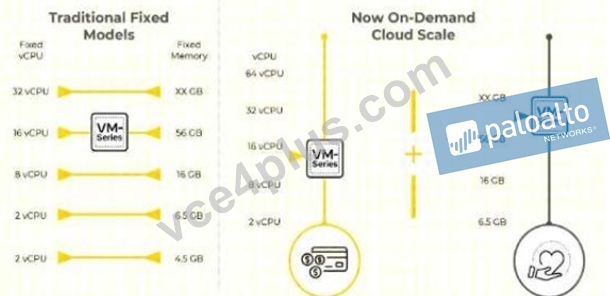
- A. Elastic Memory Profiles
- B. Increased fixed vCPUs and memory
- C. Elastic vCPU profiles
- D. Increased RAM cache
Answer: C
Explanation:
Comprehensive and Detailed In-Depth Step-by-Step Explanation:The Palo Alto Networks Systems Engineer Professional - Software Firewall documentation describes the flexible licensing and resource management options for VM-Series firewalls, particularly under PAN-OS 11.x and later versions. The question focuses on dynamically adjusting VM-Series firewall capabilities (e.g., performance and throughput) without over- provisioning unnecessary resources, a key feature of Palo Alto Networks' credit-based flexible licensing model.
* Elastic vCPU profiles (Option A): Elastic vCPU profiles, part of the flexible licensing model for VM- Series firewalls, allow customers to dynamically adjust the number of virtual CPUs (vCPUs) allocated to their firewalls based on current performance needs. This is enabled through NGFW credits managed in the Palo Alto Networks Customer Support Portal or Strata Cloud Manager, where deployment profiles can be configured with flexible vCPU counts (e.g., 2, 4, 8, 16, 32, or 64 vCPUs, corresponding to Tiers 1-4). The documentation highlights that this feature enables customers to scale up or down vCPU resources without over-provisioning fixed performance (e.g., memory or throughput) they do not need, ensuring cost efficiency and scalability in public clouds (e.g., AWS, Azure, GCP) and private clouds. The diagram in the question contrasts traditional fixed models (e.g., VM-100 with fixed vCPUs and memory) with the "On-Demand Cloud Scale" approach, where elastic vCPU profiles allow dynamic adjustment (e.g., adding vCPUs as shown by the upward arrow) without increasing unnecessary performance, aligning with the question's intent.
Options B (Increased RAM cache), C (Increased fixed vCPUs and memory), and D (Elastic Memory Profiles) are incorrect. Increased RAM cache (Option B) is not a configurable feature for VM-Series firewalls and does not address dynamic capability adjustment; RAM is tied to vCPU tiers but not independently scalable in this context. Increased fixed vCPUs and memory (Option C) refers to traditional fixed models (e.g., VM-100, VM-
300), which do not allow dynamic scaling and would over-provision performance the customer does not need, contradicting the question's focus on avoiding unnecessary increases. Elastic Memory Profiles (Option D) is not a recognized feature in the documentation for VM-Series; memory allocation is linked to vCPU tiers, but there is no standalone "elastic memory" option, making this inaccurate. The documentation emphasizes elastic vCPU profiles as the solution for dynamic, on-demand scaling without over-provisioning, as shown in the diagram's "On-Demand Cloud Scale" visualization.
References: Palo Alto Networks Systems Engineer Professional - Software Firewall, Section: VM-Series Flexible Licensing, Elastic vCPU Profiles Documentation, NGFW Credits and Deployment Profiles Guide, PAN-OS 11.x Deployment and Scaling Documentation.
NEW QUESTION # 59
Which three statements describe functionality of NGFW inline placement for Layer 2/3 implementation?
(Choose three.)
- A. VM-Series next-generation firewalls cannot be positioned between the physical datacenter network and guest VM workloads.
- B. VMs on VMware ESXi hypervisors can be segregated from each other by the VM-Series NGFW using VLAN tags while preserving existing Layer 3 gateways.
- C. VM-Series next-generation firewalls do not support VMware vMotion or guest VM workloads.
- D. VMs on VMware ESXi hypervisors can be segregated from one another on the network by the VM- Series NGFW by IP addressing and Layer 3 gateways.
- E. A next-generation firewall VLAN interface can function as a Layer 3 interface.
Answer: B,D,E
Explanation:
Let's analyze each option based on Palo Alto Networks documentation and best practices:
* A. VMs on VMware ESXi hypervisors can be segregated from one another on the network by the VM-Series NGFW by IP addressing and Layer 3 gateways. This is TRUE. The VM-Series firewall can act as a Layer 3 gateway, enabling inter-VLAN routing and enforcing security policies between different VM networks based on IP addresses and subnets. This allows for granular control over traffic flow between VMs.
NEW QUESTION # 60
Which two deployment models does Cloud NGFW for AWS support? (Choose two.)
- A. Distributed
- B. Centralized
- C. Linear
- D. Hierarchical
Answer: A,B
Explanation:
Cloud NGFW for AWS supports two primary deployment models:
A . Hierarchical: This is not a standard deployment model for Cloud NGFW for AWS. Hierarchical typically refers to a parent-child relationship in management, which isn't the core focus of the Cloud NGFW's deployment models.
B . Centralized: This is a VALID deployment model. In a centralized deployment, the Cloud NGFW is deployed in a central VPC (often a Transit Gateway VPC) and inspects traffic flowing between different VPCs and on-premises networks. This provides a single point of control for security policies.
Reference:
C . Distributed: This is a VALID deployment model. In a distributed deployment, the Cloud NGFW is deployed in each application VPC or segment, providing more granular security control and potentially lower latency for application traffic.
D . Linear: This is not a standard deployment model term used for Cloud NGFW for AWS.
NEW QUESTION # 61
A company has used software NGFW credits to deploy several VM-Series firewalls with Advanced URL Filtering in the company's deployment profiles. The IT department has determined that the firewalls no longer need the Advanced URL Filtering license.
How can this license be removed from the hosts?
- A. Delete the current deployment profile from the cloud service provider.
- B. Add a new deployment profile with all the licenses selected except Advanced URL Filtering.
- C. On the firewall, issue this command: > delete url subscription license.
- D. Edit the current deployment profile to remove the Advanced URL Filtering license.
Answer: D
Explanation:
Software NGFW credits and deployment profiles manage licenses for VM-Series firewalls.
* A. Edit the current deployment profile to remove the Advanced URL Filtering license: This is the correct approach. Deployment profiles are used to define the licenses associated with VM-Series firewalls. Modifying the profile directly updates the licensing for all firewalls using that profile.
* B. On the firewall, issue this command: > delete url subscription license: This command does not exist. Licenses are managed through the deployment profile, not directly on the firewall via CLI in this context.
* C. Add a new deployment profile with all the licenses selected except Advanced URL Filtering:
While this would work, it's less efficient than simply editing the existing profile.
* D. Delete the current deployment profile from the cloud service provider: This is too drastic.
Deleting the profile would remove all licensing and configuration associated with it, not just the Advanced URL Filtering license.
NEW QUESTION # 62
When registering a software NGFW to the deployment profile without internet access (i.e., offline registration), what information must be provided in the customer support portal?
- A. Hypervisor installation ID and software version
- B. Authcode and serial number of the VM-Series firewall
- C. CPUID and UUID of the VM-Series firewall
- D. Number of data plane and management plane interfaces
Answer: B
Explanation:
The question is about offline registration of a software NGFW (specifically VM-Series) when there's no internet connectivity.
A . Authcode and serial number of the VM-Series firewall: This is the correct answer. For offline registration, you need to generate an authorization code (authcode) from the Palo Alto Networks Customer Support Portal. This authcode is tied to the serial number of the VM-Series firewall. You provide both the authcode and the serial number to complete the offline registration process on the firewall itself.
Why other options are incorrect:
B . Hypervisor installation ID and software version: While the hypervisor and software version are relevant for the overall deployment, they are not the specific pieces of information required in the customer support portal for generating the authcode needed for offline registration.
C . Number of data plane and management plane interfaces: The number of interfaces is a configuration detail on the firewall itself and not information provided during the offline registration process in the support portal.
D . CPUID and UUID of the VM-Series firewall: While UUID is important for VM identification, it is not used for generating the authcode for offline registration. The CPUID is also not relevant in this context. The authcode is specifically linked to the serial number.
NEW QUESTION # 63
Which three statements describe common characteristics of Cloud NGFW and VM-Series offerings? (Choose three.)
- A. In Azure, inbound destination NAT configuration also requires source NAT to maintain flow symmetry.
- B. In AWS, both offerings can be managed by AWS Firewall Manager.
- C. In Azure, both offerings can be integrated directly into Virtual WAN hubs.
- D. In Azure and AWS, internal (east-west) flows can be inspected without any NAT.
- E. In Azure and AWS, both offerings can be managed by Panorama.
Answer: A,D,E
Explanation:
This question asks about common characteristics of Cloud NGFW (specifically referring to Cloud NGFW for AWS and Azure) and VM-Series firewalls.
* B. In Azure and AWS, both offerings can be managed by Panorama. This is correct. Panorama is the centralized management platform for Palo Alto Networks firewalls, including both VM-Series and Cloud NGFW deployments in AWS and Azure. Panorama allows for consistent policy management, logging, and reporting across these different deployment models.
* D. In Azure, inbound destination NAT configuration also requires source NAT to maintain flow symmetry. This is accurate specifically within the Azure environment. Due to how Azure networking functions, when performing destination NAT (DNAT) for inbound traffic to resources behind a firewall (whether VM-Series or Cloud NGFW), it's typically necessary to also implement source NAT (SNAT) to ensure return traffic follows the same path. This maintains flow symmetry and prevents routing issues. This is an Azure networking characteristic, not specific to the Palo Alto offerings themselves, but it applies to both in Azure.
* E. In Azure and AWS, internal (east-west) flows can be inspected without any NAT. This is generally true. For traffic within the same Virtual Network (Azure) or VPC (AWS), both VM-Series and Cloud NGFW can inspect traffic without requiring NAT. This is a key advantage for microsegmentation and internal security. The firewalls can act as transparent security gateways for internal traffic.
Why other options are incorrect:
* A. In Azure, both offerings can be integrated directly into Virtual WAN hubs. While VM-Series firewalls can be integrated into Azure Virtual WAN hubs as secured virtual hubs, Cloud NGFW for Azure is not directly integrated into Virtual WAN hubs in the same way. Cloud NGFW for Azure uses a different architecture, deploying as a service within a virtual network.
* C. In AWS, both offerings can be managed by AWS Firewall Manager. AWS Firewall Manager is a service for managing AWS WAF, AWS Shield, and network firewalls (AWS Network Firewall).
While AWS Firewall Manager can be used to manage AWS Network Firewall, it is not the management plane for Palo Alto Networks VM-Series or Cloud NGFW for AWS. These are managed by Panorama.
Palo Alto Networks References:
To validate these points, refer to the following documentation areas on the Palo Alto Networks support site (live.paloaltonetworks.com):
* Panorama Administrator's Guide: This guide details the management capabilities of Panorama, including managing VM-Series and Cloud NGFW deployments in AWS and Azure.
* Cloud NGFW for AWS/Azure Documentation: This documentation outlines the architecture and deployment models of Cloud NGFW, including its management and integration with cloud platforms.
* VM-Series Deployment Guides for AWS/Azure: These guides describe the deployment and configuration of VM-Series firewalls in AWS and Azure, including networking considerations and integration with cloud services.
NEW QUESTION # 64
A company needs a repeatable process to streamline the deployment of new VM-Series firewalls on its network by using the complete bootstrap method. Which file is used in the bootstrap package to configure the management interface of the firewall?
- A. init-mgmt-cfg.txt
- B. init-cfg.txt
- C. bootstrap.bat
- D. init-cfg.bat
Answer: B
Explanation:
The init-cfg.txt file configures the management interface during bootstrapping.
Why B is correct: The init-cfg.txt file is the primary configuration file used during the bootstrap process. It contains settings for the management interface (IP address, netmask, gateway, DNS), as well as other initial configurations.
Why A, C, and D are incorrect:
A . init-mgmt-cfg.txt: This file does not exist in the standard bootstrap process.
C . init-cfg.bat: This is a batch file, not a configuration file. Batch files are sometimes used to automate the deployment process, but the actual configuration is in init-cfg.txt.
D . bootstrap.bat: Similar to C, this is a batch file, not the configuration file itself.
Palo Alto Networks Reference: VM-Series deployment guides provide detailed instructions on the bootstrapping process and the contents of the init-cfg.txt file.
NEW QUESTION # 65
Which element protects and hides an internal network in an outbound flow?
- A. DNS sinkholing
- B. NAT
- C. User-ID
- D. App-ID
Answer: B
Explanation:
* A. DNS sinkholing: DNS sinkholing redirects DNS requests for known malicious domains to a designated server, preventing users from accessing those sites. It doesn't inherently protect or hide an internal network in outbound flows. It's more of a preventative measure against accessing malicious external resources.
* B. User-ID: User-ID maps network traffic to specific users, enabling policy enforcement based on user identity. It provides visibility and control but doesn't hide the internal network's addressing scheme in outbound connections.
* C. App-ID: App-ID identifies applications traversing the network, allowing for application-based policy enforcement. Like User-ID, it doesn't mask the internal network's addressing.
* D. NAT (Network Address Translation): NAT translates private IP addresses used within an internal network to a public IP address when traffic leaves the network. This effectively hides the internal IP addressing scheme from the external network. Outbound connections appear to originate from the public IP address of the NAT device (typically the firewall), thus protecting and hiding the internal network's structure.
NEW QUESTION # 66
CN-Series firewalls offer threat protection for which three use cases? (Choose three.)
- A. Inbound, outbound, and east-west traffic between containers
- B. Enforcement of segmentation policies that prevent lateral movement of threats
- C. Prevention of sensitive data exfiltration from Kubernetes environments
- D. All Kubernetes workloads in the public and private cloud
- E. All workloads deployed on-premises or in the public cloud
Answer: A,B,C
Explanation:
CN-Series firewalls are specifically designed for containerized environments.
Why A, C, and E are correct:
A . Prevention of sensitive data exfiltration from Kubernetes environments: CN-Series provides visibility and control over container traffic, enabling the prevention of data leaving the Kubernetes cluster without authorization.
C . Inbound, outbound, and east-west traffic between containers: CN-Series secures all types of container traffic: ingress (inbound), egress (outbound), and traffic between containers within the cluster (east-west).
E . Enforcement of segmentation policies that prevent lateral movement of threats: CN-Series allows for granular segmentation of containerized applications, limiting the impact of breaches by preventing threats from spreading laterally within the cluster.
Why B and D are incorrect:
B . All Kubernetes workloads in the public and private cloud: While CN-Series can protect Kubernetes workloads in both public and private clouds, the statement "all Kubernetes workloads" is too broad. Its focus is on securing the network traffic around those workloads, not managing the Kubernetes infrastructure itself.
D . All workloads deployed on-premises or in the public cloud: CN-Series is specifically designed for containerized environments (primarily Kubernetes). It's not intended to protect all workloads deployed in any environment. That's the role of other Palo Alto Networks products like VM-Series, PA-Series, and Prisma Access.
Palo Alto Networks Reference: The Palo Alto Networks documentation on CN-Series firewalls clearly outlines these use cases. Look for information on:
CN-Series Datasheets and Product Pages: These resources describe the key features and benefits of CN-Series, including its focus on container security.
CN-Series Deployment Guides: These guides provide detailed information on deploying and configuring CN-Series in Kubernetes environments.
These resources confirm that CN-Series is focused on securing container traffic within Kubernetes environments, including data exfiltration prevention, securing all traffic directions (inbound, outbound, east-west), and enforcing segmentation
NEW QUESTION # 67
Which three Cloud NGFW management tasks are inherently performed by the service within AWS and Azure? (Choose three.)
- A. Decrypting high-risk SSL traffic
- B. Blocking high-risk S2C threats in accordance with SOC2 compliance
- C. Installing new content (applications and threats)
- D. Installing new PAN-OS software updates
- E. Horizontally scaling out to meet increased traffic demand
Answer: C,D,E
Explanation:
The question asks about Cloud NGFW management tasks performed inherently by the service within AWS and Azure. This means we are looking for tasks that are automated and handled by the Cloud NGFW service itself, not by the customer.
Here's a breakdown of why A, B, and C are correct and why D and E are incorrect, referencing relevant Palo Alto Networks documentation where possible (though specific, publicly accessible documentation on the inner workings of the managed service is limited, the principles are consistent with their general cloud and firewall offerings):
A . Horizontally scaling out to meet increased traffic demand: This is a core feature of cloud-native services. Cloud NGFW is designed to automatically scale its resources (compute, memory, etc.) based on traffic volume. This eliminates the need for manual intervention by the customer to provision or de-provision resources. This aligns with the general principles of cloud elasticity and autoscaling, which are fundamental to cloud-native services like Cloud NGFW. While explicit public documentation detailing the exact scaling mechanism is limited, it's a standard practice for cloud-based services and is implied in the general description of Cloud NGFW as a managed service.
B . Installing new content (applications and threats): Palo Alto Networks maintains the threat intelligence and application databases for Cloud NGFW. This means that updates to these databases, which are crucial for identifying and blocking threats, are automatically pushed to the service by Palo Alto Networks. Customers do not need to manually download or install these updates. This is consistent with how Palo Alto Networks manages its other security services, such as Threat Prevention and WildFire, where content updates are delivered automatically.
C . Installing new PAN-OS software updates: Just like content updates, PAN-OS software updates are also managed by Palo Alto Networks for Cloud NGFW. This ensures that the service is always running the latest and most secure version of the operating system. This removes the operational burden of managing software updates from the customer. This is a key advantage of a managed service.
D . Blocking high-risk S2C threats in accordance with SOC2 compliance: While Cloud NGFW does block threats, including server-to-client (S2C) threats, the management of this blocking is not inherently performed by the service in the context of SOC2 compliance. SOC2 is an auditing framework, and compliance is the customer's responsibility. The service provides the tools to achieve security controls, but demonstrating and maintaining compliance is the customer's task. The service does not inherently manage the compliance process itself.
E . Decrypting high-risk SSL traffic: While Cloud NGFW can decrypt SSL traffic for inspection (SSL Forward Proxy), the question asks about tasks inherently performed by the service. Decryption is a configurable option. Customers choose whether or not to enable SSL decryption. It is not something the service automatically does without explicit configuration. Therefore, it's not an inherent management task performed by the service.
In summary, horizontal scaling, content updates, and PAN-OS updates are all handled automatically by the Cloud NGFW service, making A, B, and C the correct answers. D and E involve customer configuration or compliance considerations, not inherent management tasks performed by the service itself.
NEW QUESTION # 68
What are three valid methods that use firewall flex credits to activate VM-Series firewall licenses by specifying authcode? (Choose three.)
- A. /license/authcodes file of complete bootstrap package
- B. authcodes= key value pair of basic bootstrapping configuration
- C. Panorama device group in Panorama SW Licensing Plugin
- D. authcodes= key value pair of Azure Vault configuration
- E. /config/bootstrap.xml file of complete bootstrapping package
Answer: A,B,E
Explanation:
Firewall flex credits and authcodes are used to license VM-Series firewalls. The methods for using authcodes during bootstrapping include:
A . /config/bootstrap.xml file of complete bootstrapping package: The bootstrap.xml file is a key component of the bootstrapping process. It can contain the authcode for licensing.
B . /license/authcodes file of complete bootstrap package: A dedicated authcodes file within the bootstrap package is another valid method for providing license information.
C . Panorama device group in Panorama SW Licensing Plugin: While Panorama manages licenses, specifying authcodes directly via a device group is not the typical method for bootstrapping. Panorama usually manages licenses after the firewalls are bootstrapped and connected to Panorama.
D . authcodes= key value pair of Azure Vault configuration: While using Azure Key Vault for storing and retrieving secrets (like authcodes) is a good security practice for ongoing operations, it's not the primary method for initial bootstrapping using flex credits. Bootstrapping typically relies on the local bootstrap package.
E . authcodes= key value pair of basic bootstrapping configuration: This refers to including the authcode directly in the bootstrapping configuration, such as in the init-cfg.txt file or via cloud-init.
NEW QUESTION # 69
......
Get Top-Rated Palo Alto Networks PSE-SWFW-Pro-24 Exam Dumps Now: https://www.vce4plus.com/Palo-Alto-Networks/PSE-SWFW-Pro-24-valid-vce-dumps.html
Pass Your PSE-SWFW-Pro-24 Dumps Free Latest Palo Alto Networks Practice Tests: https://drive.google.com/open?id=109Vg8KcZ2gDITiR9YuwudHGBqxjiq0kx