

[Aug-2023] The Oracle 1Z0-149 Exam Test For Brief Preparation
Revolutionary Guide To Exam Oracle Dumps
Oracle 1z1-149 certification exam is an excellent way for professionals to validate their skills and knowledge of PL/SQL programming for Oracle Database 19c. By passing this certification exam, professionals can demonstrate their expertise in designing and implementing PL/SQL applications for Oracle Database 19c, which can enhance their career prospects in the field of database programming.
Oracle 1Z0-149 certification exam covers a range of topics related to PL/SQL programming, including PL/SQL language fundamentals, program control, error handling, cursors, collections, and dynamic SQL. Candidates for 1Z0-149 exam are expected to have a deep understanding of all these topics, as well as experience in developing and testing PL/SQL programs.
NEW QUESTION # 23
Which three are true regarding code based access control (CBAC)? (Choose three.)
- A. You can use CBAC to attach database roles to a PL/SQL function or procedure only.
- B. In a multitenant environment, the DELEGATE option of CBAC cannot be used.
- C. You can use CBAC to attach database roles to a PL/SQL function, procedure, or package.
- D. CBAC roles can be granted to a program unit only if they are the predefined roles automatically defined by the standard scripts as part of database creation.
- E. CBAC cannot be used to secure definer's rights.
- F. CBAC roles can be granted to a program unit only if they are directly granted to its owner.
- G. In CBAC, the ADMIN and DELEGATE options cannot both be granted to the same user.
Answer: C,F,G
NEW QUESTION # 24
Examine this statement which executes successfully:
SQL> SET SERVEROUTPUT ON;
Now, examine this code which is executed:
What is true about the result?
- A. It executes and displays output.
- B. It returns an error in line 9.
- C. It returns an error in line 4.
- D. It returns an error in line 2.
Answer: C
NEW QUESTION # 25
Which two are true about exception handling? (Choose two.)
- A. Internally defined exceptions can be handled only by the OTHERS exception handler.
- B. Only predefined exceptions and user-defined exceptions can have a user-declared name associated with them.
- C. All declared exceptions are raised implicitly by the runtime system.
- D. Predefined exceptions are globally declared in the standard package.
- E. User-defined exceptions can be defined in the declarative part of any PL/SQL anonymous block, subprogram, or package.
Answer: D,E
NEW QUESTION # 26
Examine this anonymous block of code:
Which two statements are true about the results of executing it? (Choose two.)
- A. It will set all salaries to 0 if it executes successfully.
- B. It will always automatically initialize v_raise.
- C. It might return a run time error depending on who invokes it.
- D. It will always return a run time error because v_raise is not initialized.
- E. It will set all salaries to NULL if it executes successfully.
- F. It will always return a compile time error because it lacks an EXCEPTION section.
Answer: B,E
NEW QUESTION # 27
Which three are true about the NOCOPY hint, the PARALLEL ENABLE hint, and the DETERMINISTIC clause? (Choose three.)
- A. A function is deterministic if it always returns the same result for a specific combination of input values.
- B. The NOCOPY hint asks the compiler to pass the actual parameters by value.
- C. The PARALLEL_ENABLE clause can be specified for a nested function.
- D. A function defined with the PARALLEL_ENABLE clause may be executed in parallel in a SELECT statement or a subquery in a DML statement.
- E. A deterministic function's results always depend on the state of session variables.
- F. The NOCOPY hint asks the compiler to pass the actual parameters by reference.
- G. The PARALLEL_ENABLE clause can be used only in the CREATE FUNCTION statement.
Answer: A,D,F
NEW QUESTION # 28
Which two are valid MODIFIER values for the PLSQL_WARNINGS parameter? (Choose two.)
- A. SEVERE
- B. DISABLE
- C. ENABLE
- D. ALL
- E. ERROR
Answer: A,D
NEW QUESTION # 29
Examine this row of data from the EMPLOYEES table:
Now, examine this block of code which executes successfully:
What is the value of v_commission?
- A. 0
- B. 1
- C. 2
- D. 3
Answer: A
NEW QUESTION # 30
Which two are true about Conditional Compilation in PL/SQL using $IF, $ELSE, $END, and $ERROR? (Choose two.)
- A. PL/SQL code can be compiled and executed based on different versions of the operating system.
- B. PL/SQL code can be compiled and executed based on different versions of Oracle.
- C. The PL/SQL compiler can conditionally include selected parts of a program.
- D. It is newer syntax that works the same way as 'IF , ELSEIF , ELSE, and END IF'.
- E. Conditional compilation is disabled by default.
Answer: B,C
NEW QUESTION # 31
Which three statements can process a dynamic multi-row query? (Choose three.)
- A. DECLARE
- B. INTO
- C. OPEN
- D. WHEN
- E. CLOSE
- F. FETCH
- G. OPEN-FOR
Answer: E,F,G
NEW QUESTION # 32
Which two are true about lexical units? (Choose two.)
- A. Character literals are case-sensitive.
- B. Spaces can be embedded in delimiters.
- C. All user-defined identifiers must start with an alphabet.
- D. Identifiers include labels.
- E. A character literal with zero characters has the BOOLEAN value NULL.
Answer: A,C
NEW QUESTION # 33
Examine these statements issued by user SH which execute successfully:
DBMS_OUTPUT.PUT_LINE(p_price(i)); END LOOP; END; END products_pkg; /
Now, examine this anonymous block executed by SH:
Which is true about the anonymous block?
- A. It will fail at lines 6 and 7.
- B. It will execute successfully only if PriceList is defined as an associative array in the package and anonymous block.
- C. It will execute successfully only if PriceList is removed from the DECLARE section and defined as a standalone collection type.
- D. It will fail only at line 7.
Answer: D
NEW QUESTION # 34
Examine the EMPLOYEES table structure:
Now, examine this code:
Which statement is true about the result of executing this block?
- A. It will return an error at line 2.
- B. It will return an error at line 8.
- C. It will return an error at line 3.
- D. It will execute successfully provided the salary of EMP_ID 200 does not exceed the value 99999.
- E. It will execute successfully by rounding up the salary of EMP_ID 200 to the appropriate value.
Answer: D
NEW QUESTION # 35
Examine these statements and output:
The procedure is created successfully.
User ora2 has password ora2 in pdb1.
Which script will execute successfully?
- A.

- B.

- C.

- D.

Answer: A
NEW QUESTION # 36
Examine this statement which is submitted for compilation:
Which three are true? (Choose three.)
- A. This is a PACKAGE specification. A PACKAGE BODY is needed to use this.
- B. This will not compile successfully because the loan_amount variable is declared NOT NULL but lacks an initialization assignment.
- C. Initialization of loan_amount can be done while using this packaged variable in another program.
- D. Initialization of min_bal can be done while using this packaged constant in another program.
- E. This will not compile successfully because the min_bal constant must be initialized.
- F. This program unit will compile successfully.
- G. This is BODILESS PACKAGE. A PACKAGE BODY is not required to use this.
Answer: B,E,G
NEW QUESTION # 37
Examine this table definition in the SH schema.
A row with PDT_ID = 1 exists. Which two blocks of code will execute successfully by user SH and give the same output? (Choose two.)
- A.

- B.

- C.

- D.
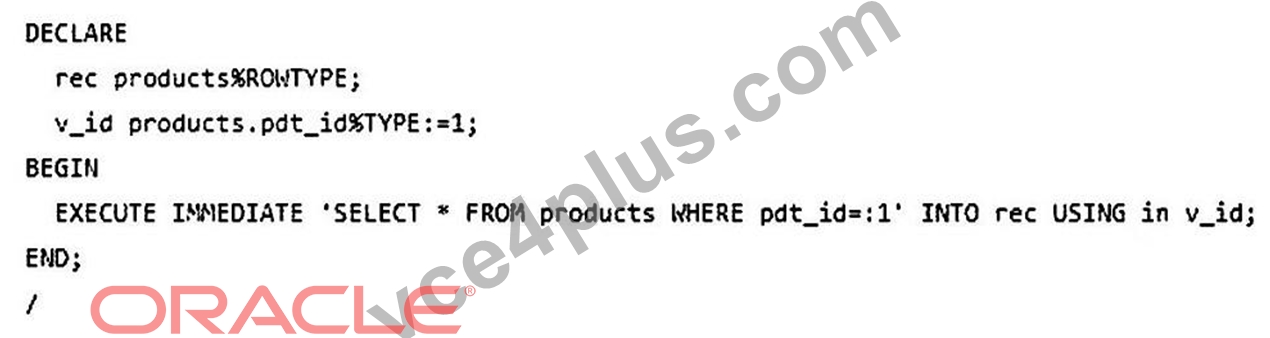
Answer: A,D
NEW QUESTION # 38
Which two are true about implicit data type conversion? (Choose two.)
- A. Comparison between character value and a number value always implicitly converts the character value to the number data type.
- B. RAW data types are always implicitly converted to a CLOB when used in a query.
- C. ROWIDS are always implicitly converted to a number when used in a query.
- D. Implicit data type conversion can negatively impact performance.
- E. Collections can be implicitly converted to records.
Answer: A,D
NEW QUESTION # 39
Which statement is true about user-defined records?
- A. They can be returned from a function.
- B. Field types must match column types.
- C. Field names must match selected column names.
- D. The number of fields must match the number of columns in a table.
Answer: D
NEW QUESTION # 40
Examine these statements:
Which is true?
- A. It will result in a compilation error for protected_proc because calling_proc must be prefixed with the schema name.
- B. It will result in a compilation error for protected_proc because calling_proc does not exist.
- C. It will result in a successful compilation because objects referenced in an ACCESSIBLE BY clause are not checked at compile time.
- D. With adequate privileges, PROTECTED_PROC procedure can be called by other programs apart from CALLING_PROC.
Answer: B
NEW QUESTION # 41
......
1Z0-149 Free Study Guide! with New Questions: https://www.vce4plus.com/Oracle/1Z0-149-valid-vce-dumps.html
Pass 1Z0-149 Exam Latest Practice Questions: https://drive.google.com/open?id=1AY0av4z-WssVY1OODeroWezG9b4ez63y