

[Dec 15, 2021] Ultimate 1Z0-1085-20 Guide to Prepare Free Latest Oracle Practice Tests Dumps
Get Top-Rated Oracle 1Z0-1085-20 Exam Dumps Now
Oracle 1Z0-1085-20 Exam Syllabus Topics:
| Topic | Details |
|---|---|
| Topic 1 |
|
| Topic 2 |
|
| Topic 3 |
|
| Topic 4 |
|
| Topic 5 |
|
| Topic 6 |
|
| Topic 7 |
|
NEW QUESTION 31
Which statement about Oracle Cloud Infrastructure (OCI) shared security model is true?
- A. You are responsible for securing the hypervisor within OCI Compute service.
- B. You are responsible for securing all data that you place in OCI
- C. You are responsible for managing security controls within the physical OCI network.
- D. You are not responsible for any aspect of security in OCI.
Answer: B
Explanation:
Explanation
Oracle Cloud Infrastructure offers best-in-class security technology and operational processes to secure its enterprise cloud services. However, for you to securely run your workloads in Oracle Cloud Infrastructure, you must be aware of your security and compliance responsibilities. By design, Oracle provides security of cloud infrastructure and operations (cloud operator access controls, infrastructure security patching, and so on), and you are responsible for securely configuring your cloud resources. Security in the cloud is a shared responsibility between you and Oracle.
In a shared, multi-tenant compute environment, Oracle is responsible for the security of the underlying cloud infrastructure (such as data-center facilities, and hardware and software systems) and you are responsible for securing your workloads and configuring your services (such as compute, network, storage, and database) securely.
In a fully isolated, single-tenant, bare metal server with no Oracle software on it, your responsibility increases as you bring the entire software stack (operating systems and above) on which you deploy your applications.
In this environment, you are responsible for securing your workloads, and configuring your services (compute, network, storage, database) securely, and ensuring that the software components that you run on the bare metal servers are configured, deployed, and managed securely.
More specifically, your and Oracle's responsibilities can be divided into the following areas:
Identity and Access Management (IAM): As with all Oracle cloud services, you should protect your cloud access credentials and set up individual user accounts. You are responsible for managing and reviewing access for your own employee accounts and for all activities that occur under your tenancy. Oracle is responsible for providing effective IAM services such as identity management, authentication, authorization, and auditing.
Workload Security: You are responsible for protecting and securing the operating system and application layers of your compute instances from attacks and compromises. This protection includes patching applications and operating systems, operating system configuration, and protection against malware and network attacks. Oracle is responsible for providing secure images that are hardened and have the latest patches. Also, Oracle makes it simple for you to bring the same third-party security solutions that you use today.
Data Classification and Compliance: You are responsible for correctly classifying and labeling your data and meeting any compliance obligations. Also, you are responsible for auditing your solutions to ensure that they meet your compliance obligations.
Host Infrastructure Security: You are responsible for securely configuring and managing your compute (virtual hosts, containers), storage (object, local storage, block volumes), and platform (database configuration) services. Oracle has a shared responsibility with you to ensure that the service is optimally configured and secured. This responsibility includes hypervisor security and the configuration of the permissions and network access controls required to ensure that hosts can communicate correctly and that devices are able to attach or mount the correct storage devices.
Network Security: You are responsible for securely configuring network elements such as virtual networking, load balancing, DNS, and gateways. Oracle is responsible for providing a secure network infrastructure.
Client and Endpoint Protection: Your enterprise uses various hardware and software systems, such as mobile devices and browsers, to access your cloud resources. You are responsible for securing all clients and endpoints that you allow to access Oracle Cloud Infrastructure services.
Physical Security: Oracle is responsible for protecting the global infrastructure that runs all of the services offered in Oracle Cloud Infrastructure. This infrastructure consists of the hardware, software, networking, and facilities that run Oracle Cloud Infrastructure services.
NEW QUESTION 32
According to shared security model, which two are a customer's responsibilities in Oracle Cloud Infrastructure (OCI)? (Choose two.)
- A. Virtual Machine hypervisor
- B. Customer data
- C. Local NVMe data persistence
- D. Physical security of OCI data center facilities
- E. Object Storage data durability
Answer: B,E
Explanation:
Explanation/Reference: https://cloudcheckr.com/cloud-security/shared-responsibility-model/
NEW QUESTION 33
Which is NOT required to register and log support requests in My Oracle Support (MOS)?
- A. Your account password
- B. Your Customer Support Identifier (CSl)
- C. Your resource OCID (Oracle Cloud Identifier)
- D. Your tenancy OCID (Orade Cloud Identifier)
Answer: A
Explanation:
Explanation
You can open a support service request with Oracle Support
To create a service request:
Go to My Oracle Support and sign in.
If you are not signed in to Oracle Cloud Support, click Switch to Cloud Support at the top of the page.
Click Create Service Request.
Select the following from the displayed menus:
Service Type: Select Oracle Cloud Infrastructure from the list.
Service Name: Select the appropriate option for your organization.
Problem Type: Select your problem type from the list.
Enter your contact information.
Enter a Description, and then enter the required fields specific to your issue. For most Oracle Cloud Infrastructure issues you need to include the OCID (Oracle Cloud Identifier) for each resource you need help with. See Locating Oracle Cloud Infrastructure IDs for instructions on locating these.
NEW QUESTION 34
Which three components are part of Oracle Cloud Infrastructure Identity and Access Management service?
- A. Roles
- B. Users
- C. Dynamic Groups
- D. Compute Instances
- E. Regional Subnets
- F. Virtual Cloud Networks
- G. Policies
Answer: B,F,G
Explanation:
https://www.oracle.com/a/ocom/docs/best-practices-for-iam-on-oci.pdf
NEW QUESTION 35
Which three services Integrate with Oracle Cloud Infrastructure (OCI) Key Management?
- A. Functions
- B. Object Storage
- C. Identity and Access Management
- D. Auto Scaling
- E. Block Volume
- F. File Storage
Answer: B,E,F
NEW QUESTION 36
A customer wants to deploy a customized e commerce Web application using multiple virtual machines, block storage, databases, load balancer and web application firewall.
What cloud model can be used to host this application?
- A. Platform as a Service (PaaS)
- B. Infrastructure as a Service (IaaS)
- C. Software as a Service (SaaS)
- D. Anything as a Service (XaaS)
Answer: B
Explanation:
Explanation
https://www.oracle.com/cloud/what-is-iaas/
NEW QUESTION 37
Which statement is correct regarding the oracle cloud infrastructure Compute services?
- A. You can attach a maximum of one public to each compute instance
- B. When you stop a compute instance, all data on the boot volume is lost
- C. You can launch either virtual machines or bare metal instances
- D. You cannot attach a block volume to a compute instance
Answer: C
Explanation:
Explanation
Oracle Cloud Infrastructure offers both bare metal and virtual machine instances:
Bare Metal: A bare metal compute instance gives you dedicated physical server access for highest performance and strong isolation.
Virtual Machine: A virtual machine (VM) is an independent computing environment that runs on top of physical bare metal hardware. The virtualization makes it possible to run multiple VMs that are isolated from each other. VMs are ideal for running applications that do not require the performance and resources (CPU, memory, network bandwidth, storage) of an entire physical machine.
An Oracle Cloud Infrastructure VM compute instance runs on the same hardware as a bare metal instance, leveraging the same cloud-optimized hardware, firmware, software stack, and networking infrastructure.
NEW QUESTION 38
A customer wants to deploy a customized e commerce Web application using multiple virtual machines, block storage, databases, load balancer and web application firewall.
What cloud model can be used to host this application?
- A. Infrastructure as a Service (IaaS)
- B. Platform as a Service (PaaS)
- C. Software as a Service (SaaS)
- D. Anything as a Service (XaaS)
Answer: B
NEW QUESTION 39
Which Oracle Cloud Infrastructure service allows you to run code without provisioning any underlying infrastructure resources (such as virtual machines)?
- A. Oracle Functions
- B. Oracle Container Engine for Kubernetes
- C. Storage Gateway
- D. Compute service
Answer: A
Explanation:
Explanation/Reference: https://blogs.oracle.com/cloud-infrastructure/announcing-oracle-functions
NEW QUESTION 40
Which Oracle Cloud Infrastructure (OCI) service is best suited for running serverless apps?
- A. Oracle Functions
- B. Audit
- C. Streaming
- D. Virtual Cloud Network
Answer: A
Explanation:
Explanation
Oracle Functions is a fully managed, multi-tenant, highly scalable, on-demand, Functions-as-a-Service platform. It is built on enterprise-grade Oracle Cloud Infrastructure and powered by the Fn Project open source engine. Use Oracle Functions (sometimes abbreviated to just Functions) when you want to focus on writing code to meet business needs.
The serverless and elastic architecture of Oracle Functions means there's no infrastructure administration or software administration for you to perform. You don't provision or maintain compute instances, and operating system software patches and upgrades are applied automatically. Oracle Functions simply ensures your app is highly-available, scalable, secure, and monitored. With Oracle Functions, you can write code in Java, Python, Node, Go, and Ruby (and for advanced use cases, bring your own Dockerfile, and Graal VM). You can then deploy your code, call it directly or trigger it in response to events, and get billed only for the resources consumed during the execution.
Oracle Functions is based on Fn Project. Fn Project is an open source, container native, serverless platform that can be run anywhere - any cloud or on-premises. Fn Project is easy to use, extensible, and performant.
You can download and install the open source distribution of Fn Project, develop and test a function locally, and then use the same tooling to deploy that function to Oracle Functions.
You can access Oracle Functions using the Console, a CLI, and a REST API. You can invoke the functions you deploy to Oracle Functions using the CLI or by making signed HTTP requests.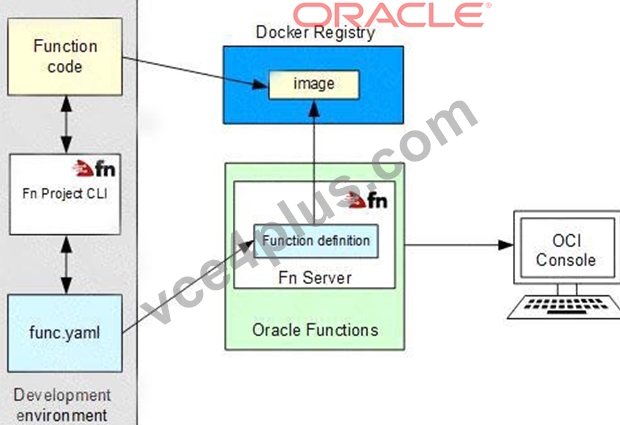
NEW QUESTION 41
What service is NOT available as part of Oracle Cloud Free Tier?
- A. Oracle Cloud Infrastructure Exadata DB Systems
- B. Oracle Cloud Infrastructure Compute
- C. Oracle Cloud Infrastructure Autonomous Data Warehouse
- D. Oracle Cloud Infrastructure Monitoring
Answer: A
Explanation:
Explanation
For more information on Oracle Cloud Infrastructure Free Tier refer below official documentation
https://docs.cloud.oracle.com/en-us/iaas/Content/FreeTier/freetier.htm?Highlight=Free%20Tier
NEW QUESTION 42
You run 5 Oracle Cloud Infrastructure (OCI) Virtual Machine instances on an OCI dedicated virtual host. How will this deployment be billed?
- A. Only the dedicated virtual machine host will be billed
- B. All 5 instances will be billed on the basis of the number of OCPUs
- C. The dedicated virtual machine host all 5 instances, and the boot volume of each instance will be billed
- D. The dedicated virtual machine host and the boot volumes of each instance will be billed
Answer: D
Explanation:
Explanation
You must create a dedicated virtual machine host before you can place any instances on it. When creating the dedicated virtual machine host, you select an availability domain and fault domain to launch it in. All the VM instances that you place on the host will subsequently be created in this availability domain and fault domain.
You also select a compartment when you create the dedicated virtual machine host, but you can move the host to a new compartment later without impacting any of the instances placed on it. You can also create the instances in a different compartment than the dedicated virtual machine host, or move them to difference compartments after they have been launched.
You are billed for the dedicated virtual machine host as soon as you create it, but you are not billed for any of the individual VM instances you place on it. You will still be billed for image licensing costs if they apply to the image you are using for the VM instances.
Read more: https://docs.cloud.oracle.com/en-us/iaas/Content/Compute/Concepts/dedicatedvmhosts.htm
NEW QUESTION 43
Which Oracle Cloud Infrastructure service allows you to run code without provisioning any underlying infrastructure resources?
- A. Oracle Functions
- B. Oracle Container Engine for Kubernetes
- C. Storage Gateway
- D. Compute service
Answer: A
Explanation:
Explanation
Oracle Functions is a fully managed, multi-tenant, highly scalable, on-demand, Functions-as-a-Service platform. It is built on enterprise-grade Oracle Cloud Infrastructure and powered by the Fn Project open source engine. Use Oracle Functions (sometimes abbreviated to just Functions) when you want to focus on writing code to meet business needs.
The serverless and elastic architecture of Oracle Functions means there's no infrastructure administration or software administration for you to perform. You don't provision or maintain compute instances, and operating system software patches and upgrades are applied automatically. Oracle Functions simply ensures your app is highly-available, scalable, secure, and monitored. With Oracle Functions, you can write code in Java, Python, Node, Go, and Ruby (and for advanced use cases, bring your own Dockerfile, and Graal VM). You can then deploy your code, call it directly or trigger it in response to events, and get billed only for the resources consumed during the execution.
NEW QUESTION 44
Which describes a key benefit of using Oracle Cloud Infrastructure (OCI)?
- A. With OCI, you can only run Java based workloads on bare metal.
- B. With OCI, you can run only cloud-native workloads.
- C. OCI offers consistent performance with a predictable pricing model.
- D. Only bare metal workloads are supported on OCI.
Answer: C
Explanation:
Explanation
https://www.oracle.com/in/cloud/pricing.html
- OCI offers consistent performance with a predictable pricing model - is the best suited answer.
- Only bare metal workloads are supported in OCI - False, since you can work with VMs etc too
- With OCI, you can run cloud native workloads - False, since you can work with on-premise by connecting it to OCI too.
- With OCI, you can only run Java based workloads on bare metal - False since Java is not the only programming language supported by OCI.
NEW QUESTION 45
Which two are enabled by Oracle Cloud Infrastructure Fault Domains?
- A. Build replicated systems for disaster recovery
- B. To mitigate the risk of large scale events such as earthquakes
- C. Protect against planned hardware maintenance
- D. To meet requirements for legal jurisdictions
- E. Protect against unexpected hardware or power supply failures
Answer: C,E
Explanation:
Explanation
A fault domain is a grouping of hardware and infrastructure within an availability domain. Each availability domain contains three fault domains. Fault domains provide anti-affinity: they let you distribute your instances so that the instances are not on the same physical hardware within a single availability domain. A hardware failure or Compute hardware maintenance event that affects one fault domain does not affect instances in other fault domains. In addition, the physical hardware in a fault domain has independent and redundant power supplies, which prevents a failure in the power supply hardware within one fault domain from affecting other fault domains.
To control the placement of your compute instances, bare metal DB system instances, or virtual machine DB system instances, you can optionally specify the fault domain for a new instance or instance pool at launch time. If you don't specify the fault domain, the system selects one for you. Oracle Cloud Infrastructure makes a best-effort anti-affinity placement across different fault domains, while optimizing for available capacity in the availability domain. To change the fault domain for an instance, terminate it and launch a new instance in the preferred fault domain.
Use fault domains to do the following things:
Protect against unexpected hardware failures or power supply failures.
Protect against planned outages because of Compute hardware maintenance.
NEW QUESTION 46
......
Passing Key To Getting 1Z0-1085-20 Certified Exam Engine PDF: https://www.vce4plus.com/Oracle/1Z0-1085-20-valid-vce-dumps.html