

Latest Linux Foundation KCNA PDF and Dumps (2023) Free Exam Questions Answers
Pass Your Kubernetes Cloud Native Associate KCNA Exam on Dec 29, 2023 with 128 Questions
Linux Foundation KCNA certification exam is aimed at professionals who are looking to enhance their skills in cloud computing and Kubernetes. KCNA exam covers a wide range of topics, including Kubernetes architecture, deployment, maintenance, and troubleshooting. It also covers cloud-native technologies such as containerization, microservices, and service mesh.
NEW QUESTION # 20
What are the two goals of Cloud-Native?
- A. Rapid innovation and automation
- B. Slow innovation and stable applications
- C. Rapid innovation and reliability
- D. Frequent deployments and well-defined organizational silos
Answer: C
Explanation:
https://www.redhat.com/en/topics/cloud-native-apps
NEW QUESTION # 21
Which of the following are characteristics of Statefulsets?
- A. Uses headless services
- B. Creates replica sets
- C. Ordered, graceful deployment and scaling
Answer: C
Explanation:
https://kubernetes.io/docs/concepts/workloads/controllers/statefulset/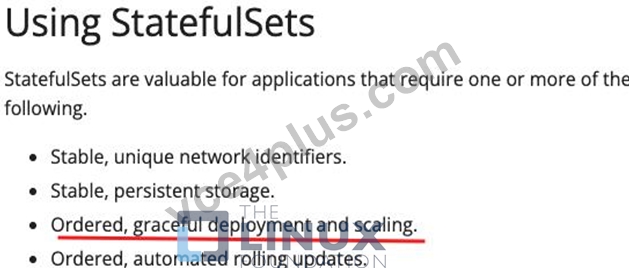
NEW QUESTION # 22
To run a startup task before a Pod's container starts up. What Kubernetes feature can help you ac-complish this?
- A. Startup probe
- B. Sidecar container
- C. DaemonSet
- D. Init container
Answer: D
Explanation:
https://kubernetes.io/docs/concepts/workloads/pods/init-containers/
NEW QUESTION # 23
What is the command to list all the available objects in your Kubernetes cluster?
- A. kubectl get api-resources
- B. kubectl get all
- C. kubectl api-resources
- D. kubectl get pods
Answer: C
Explanation:
https://kubernetes.io/docs/reference/kubectl/cheatsheet/
NEW QUESTION # 24
Which of the following is used to request storage in Kubernetes?
- A. Container Storage Interface 'CSI'
- B. PersistentVolume 'PV'
- C. StorageClasses
- D. PersistentVolumeClaim 'PVC'
Answer: D
Explanation:
https://kubernetes.io/docs/concepts/storage/persistent-volumes/
NEW QUESTION # 25
What is not semantic versioning?
- A. 2022-05-04
- B. 1.0.0-alpha
- C. 1.0.0-beta.2
- D. 1.0.0
Answer: A
Explanation:
https://semver.org/
RegEx SemVer at https://regex101.com/r/vkijKf/1/
NEW QUESTION # 26
Stateful set requires which service for the network identity of pods?
- A. Headless Service
- B. Ingress
- C. Load Balancer Service
Answer: A
Explanation:
https://kubernetes.io/docs/concepts/workloads/controllers/statefulset/
NEW QUESTION # 27
What is FinOps?
- A. Specialized cloud features used by financial industries (example: banks, insurance, etc)
- B. Using data to make cost savings decisions about cloud usage
- C. The first step in any cloud transformation
- D. Stage beyond DevOps or DevSecOps, where organization transition to serverless tech-nologies
Answer: B
Explanation:
https://www.servicenow.com/products/it-asset-management/what-is-finops.html
NEW QUESTION # 28
To specify a Kubernetes object which language is used?
- A. Node
- B. Go
- C. Python
- D. YAML
- E. JSON
Answer: D
Explanation:
https://kubernetes.io/docs/concepts/overview/working-with-objects/kubernetes-objects/
NEW QUESTION # 29
What is the name for the tool that manages communication between pods, injects a sidecar proxy container into each pod and directs network traffic through the proxy container?
- A. Service mesh
- B. Network policy
- C. namespace
- D. Service
- E. Deployment
Answer: A
NEW QUESTION # 30
Which of the following is an advantage a cloud-native microservices application has over monolithic applications?
- A. Cloud-native microservices applications tend to be faster and more responsive than monolithic applications.
- B. Cloud-native microservice applications tend to be easier to troubleshoot.
- C. Cloud-native microservice applications tend to be easier to scale and perform updates on.
Answer: C
Explanation:
Cloud-native applications tend to be microservice base, they have individual services that can be independently scaled, updated and rolled back. This makes scaling and update operations simpler and less risky.
NEW QUESTION # 31
Have a pod 'hello' and a container in that pod 'green'. Which of the following commands would get the logs for that container?
- A. alias k='kubectl'
k get logs -p hello -c green - B. alias k='kubectl'
k logs -p hello -c green - C. alias k='kubectl'
k logs -p hello green - D. alias k='kubectl'
k logs hello -c green
Answer: D
Explanation:
https://kubernetes.io/docs/reference/generated/kubectl/kubectl-commands#logs
NEW QUESTION # 32
How does service logical group set of pods?
- A. Using label and selectors
- B. Using IP address
- C. Using hostname
Answer: A
Explanation:
https://kubernetes.io/docs/concepts/services-networking/service/
NEW QUESTION # 33
What cloud-native construct does a kubernetes pod wrap?
- A. Docker image
- B. Virtual Machine (VM)
- C. side car process
- D. Container
Answer: D
Explanation:
Kubernetes is an orchestrator of containerized apps. However, containers must be wrapped in pods before they can be deployed on kubernetes.
NEW QUESTION # 34
What is the main difference between Argo vs. Flux CD?
- A. No difference; both are pull-based
- B. Argo is pull-based, and Flux is push-based
- C. No difference; both are push-based
- D. Argo is push-based, and Flux is pull-based
Answer: D
Explanation:
AgroCD: https://argo-cd.readthedocs.io/en/stable/developer-guide/ci/#can-i-retrigger-the-checks-without-pushing-a-new-commit
FluxCD: https://fluxcd.io/
NEW QUESTION # 35
Fluentd is the only way to export logs from Kubernetes cluster or applications running in cluster
- A. False
- B. True
Answer: A
Explanation:
https://github.com/cncf/landscape#trail-map
NEW QUESTION # 36
What tool allows us to build useful visual representations of prometheus data?
- A. Rook
- B. kubectl
- C. Grafana
- D. Kibana
- E. Distributed system tracing
Answer: C
Explanation:
https://prometheus.io/
NEW QUESTION # 37
What is scheduling in Kubernetes
- A. Setting a time for automated tasks
- B. Joining a new nodes to the clusters
- C. Assigning pods to nodes
- D. Determining when to execute a cron-job
Answer: C
Explanation:
https://kubernetes.io/docs/concepts/scheduling-eviction/
NEW QUESTION # 38
What do you call the pattern where you add a second container to the pod to collect logs infor-mation?
- A. Node level logging
- B. Cluster level logging
- C. Application level logging
- D. Sidecar container logging
Answer: D
Explanation:
https://kubernetes.io/docs/concepts/cluster-administration/logging/
NEW QUESTION # 39
kubeadm is an administrative dashboard for kubernetes
- A. False
- B. True
Answer: A
Explanation:
https://kubernetes.io/docs/reference/setup-tools/kubeadm/
NEW QUESTION # 40
Which of the following best describes the way kubernetes Role-based access control (RBAC) works?
- A. Kubernetes RBAC lists which operations on which resources are denied to users
- B. Kubernetes RBAC states which users can perform which actions against which re-source
- C. Kubernetes does not do RBAC
- D. Kubernetes RBAC is responsible for authenticating subjects such as users and groups
Answer: B
Explanation:
https://kubernetes.io/docs/reference/access-authn-authz/rbac/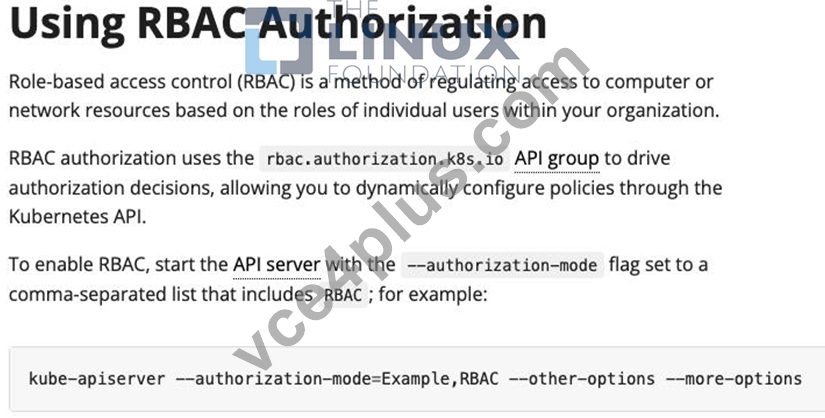
NEW QUESTION # 41
What feature is used for selecting the container runtime configuration?
- A. RuntimeContainer
- B. Runtime
- C. RuntimeConfig
- D. RuntimeClass
Answer: D
Explanation:
https://kubernetes.io/docs/concepts/containers/runtime-class/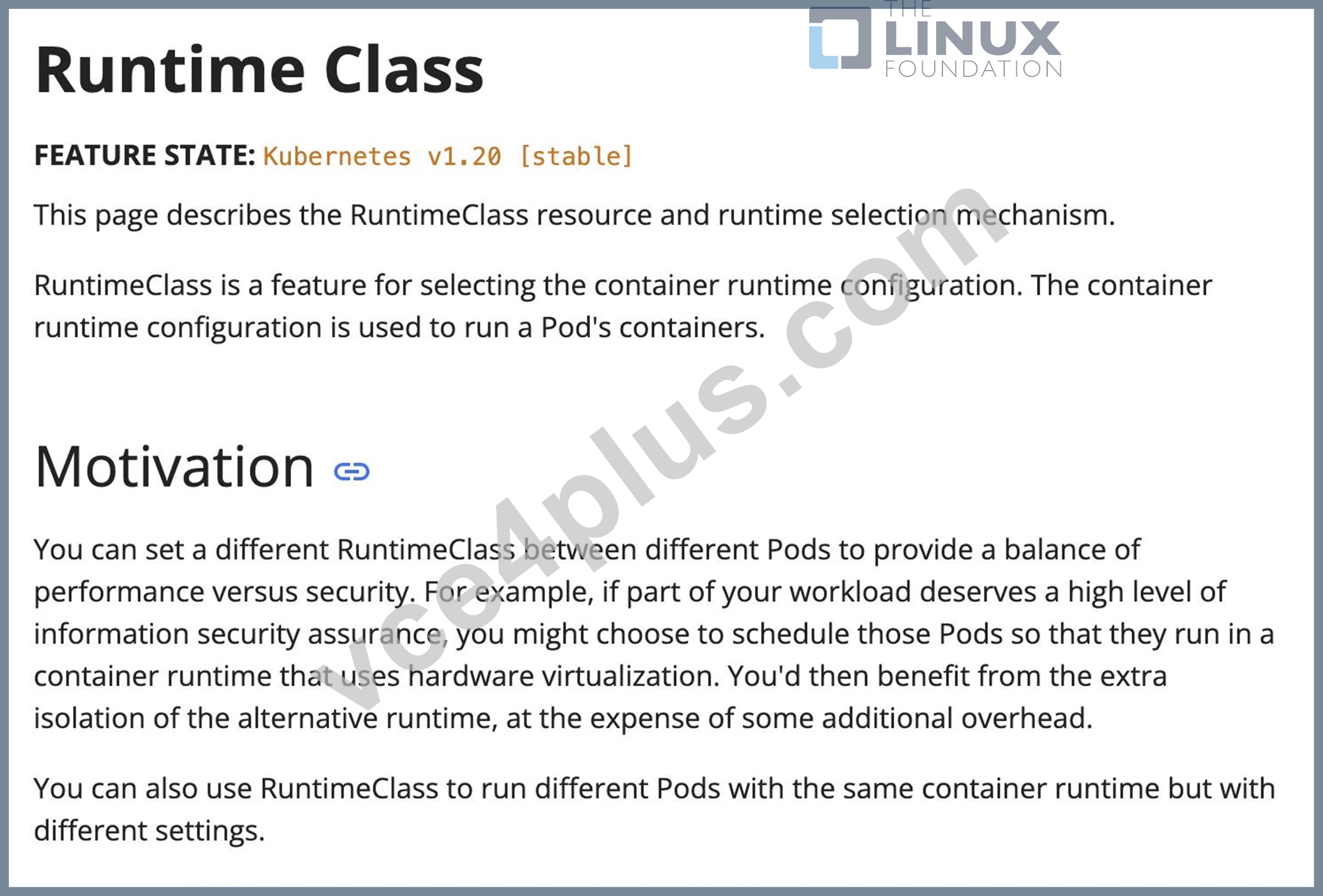
NEW QUESTION # 42
What is the default service type in Kubernetes?
- A. loadBalancer
- B. CusterIP
- C. serviceType
- D. NodePort
Answer: B
Explanation:
https://kubernetes.io/docs/concepts/services-networking/service/#publishing-services-service-types
NEW QUESTION # 43
......
Linux Foundation KCNA Exam covers a broad range of topics related to Kubernetes and cloud-native technologies, including the fundamentals of containerization, Kubernetes architecture and components, deployment and scaling of Kubernetes applications, troubleshooting Kubernetes clusters, and managing Kubernetes resources using various tools and APIs. Kubernetes and Cloud Native Associate certification exam is designed to assess an individual's knowledge and expertise in these areas and provides a reliable measure of their competency in managing and deploying cloud-native applications.
The KCNA exam is a useful credential for individuals who want to work in the field of cloud computing and containerization. It is a vendor-neutral certification that demonstrates a solid understanding of cloud native technologies and their practical applications. Kubernetes and Cloud Native Associate certification exam is open to anyone who has a basic understanding of Linux and cloud computing. It is an online exam that can be taken from anywhere in the world, making it accessible to a global audience. The KCNA certification is a valuable asset for professionals who want to advance their careers in the cloud computing industry.
KCNA Dumps for Kubernetes Cloud Native Associate Certified Exam Questions and Answer: https://www.vce4plus.com/Linux-Foundation/KCNA-valid-vce-dumps.html
KCNA Free Exam Study Guide! (Updated 128 Questions): https://drive.google.com/open?id=1QonVCGdj3OCqFKMxGMtAILMnL-DtF3wt