

CIFC Certification - The Ultimate Guide [Updated 2026]
CIFC Practice Exam and Study Guides - Verified By VCE4Plus
IFSE Institute CIFC Exam Syllabus Topics:
| Topic | Details |
|---|---|
| Topic 1 |
|
| Topic 2 |
|
| Topic 3 |
|
| Topic 4 |
|
| Topic 5 |
|
| Topic 6 |
|
| Topic 7 |
|
| Topic 8 |
|
NEW QUESTION # 100
Throughout the year, the Redwood Global Equity Fund generated the following outcomes:
. $1.00 per unit of interest income from Canadian treasury bills
. $2.50 per unit of dividend income from foreign corporations
. $7.75 per unit of capital gains from the sale of Canadian corporations
. $6.50 per unit of capital gains from the sale of foreign corporations
. $2.00 per unit of capital losses from the sale of foreign corporations Given that the Redwood Global Equity Fund is structured as a mutual fund trust, which of the following statements is true?
- A. Redwood can flow the foreign dividends to unitholders, who can then take advantage of the dividend gross-up and tax credit mechanism.
- B. Since Redwood pays the tax on foreign income, it does not distribute dividend or capital gains income from foreign sources to unitholders.
- C. Unitholders will receive $12.25 per unit of net capital gains from Redwood, of which only 50% is subject to tax.
- D. Redwood can distribute the $2.00 per unit of capital losses to unitholders, who can then use them to offset their capital gains.
Answer: C
Explanation:
Explanation
This statement is true because a mutual fund trust can distribute its net income and net realized capital gains to its unitholders, and avoid paying tax at the fund level. The unitholders then report their share of the fund's income and capital gains on their tax returns, and pay tax according to their marginal tax rates. In this case, Redwood has generated $14.25 per unit of capital gains from the sale of Canadian and foreign corporations, and $2.00 per unit of capital losses from the sale of foreign corporations. Therefore, its net capital gains are
$12.25 per unit ($14.25 - $2.00), which it can distribute to its unitholders. The unitholders will only include
50% of the net capital gains in their taxable income, as per the inclusion rate for capital gains in Canada1. The other 50% is tax-free.
The other statements are false because:
* A. Redwood cannot flow the foreign dividends to unitholders, who can then take advantage of the dividend gross-up and tax credit mechanism. This mechanism only applies to dividends received from Canadian corporations that are eligible for the enhanced dividend tax credit or the ordinary dividend tax credit2. Foreign dividends are treated as foreign income, and are subject to withholding tax by the source country and income tax by Canada3.
* C. Redwood cannot distribute the $2.00 per unit of capital losses to unitholders, who can then use them to offset their capital gains. A mutual fund trust can only distribute its net income and net realized capital gains, not its capital losses4. However, a mutual fund trust can carry forward its capital losses indefinitely and use them to reduce its taxable capital gains in future years5.
* D. Redwood does not pay the tax on foreign income, and it does distribute dividend or capital gains income from foreign sources to unitholders. A mutual fund trust pays tax on its foreign income only if it does not distribute it to its unitholders in the same year it is earned. However, most mutual fund trusts distribute all or most of their foreign income to their unitholders, as they want to avoid paying tax at the fund level and maintain their status as a mutual fund trust.
References:
* Canadian Investment Funds Course (CIFC) Study Guide, Chapter 7: Taxation, Section 7.3: Taxation of Mutual Funds, page 7-10
* Canadian Investment Funds Course (CIFC) Study Guide, Chapter 7: Taxation, Section 7.2: Taxation of Investment Income, page 7-4
* Foreign Income - Canada.ca
* Mutual Fund Trusts - Canada.ca
* Capital Losses and Deductions - Canada.ca
* Taxation of Foreign Income - IFSE Institute
* Mutual Fund Trusts - IFSE Institute
NEW QUESTION # 101
Felipe is a Dealing Representative who is developing a non-registered investment solution for Laryssa. Felipe is debating between recommending either mutual fund trusts or mutual fund corporations. He wants to recommend an investment that reduces Laryssa's exposure to taxation.
Which feature may influence his recommendation?
- A. Distributions from mutual fund corporations are not taxable to investors.
- B. Mutual fund trusts can only distribute capital gains and Canadian dividends.
- C. Capital losses may be distributed from mutual fund corporations.
- D. Any income received by a mutual fund corporation is distributed in the form of either capital gains or Canadian dividends.
Answer: D
Explanation:
Explanation
A mutual fund corporation is a type of mutual fund structure that is organized as a corporation and issues different classes of shares to investors. A mutual fund corporation has the ability to allocate its income and expenses among the different classes of shares, and to distribute any income received by the corporation in the form of either capital gains or Canadian dividends. These types of distributions are taxed at lower rates than interest or foreign income, which may reduce the tax liability of the investors. A mutual fund corporation can also use capital losses to offset capital gains, and carry them forward or back to reduce taxable income in other years.
References = Canadian Investment Funds Course, Unit 6: Mutual Funds, Lesson 2: Mutual Fund Structures, Section 6.2.2: Mutual Fund Corporations1; CIFC prepkit, Chapter 6: Mutual Funds, Question 6.2.2 2
NEW QUESTION # 102
Dakota is a Dealing Representative with Harvest Wealth Inc., a mutual fund dealer. Dakota starts a marketing campaign to contact prospective new clients and increase sales with existing clients. Which of the following CORRECTLY describes activities that Dakota can engage in under her marketing campaign?
- A. Dakota can make telemarketing calls to clients who are listed on the National Do Not Call List
- B. Dakota can send promotional emails to clients who have opted in to receive commercial electronic messages (CEMs).
- C. Dakota can send promotional emails to clients who have opted into Harvest Wealth's Do Not Call List
- D. Dakota can make telemarketing calls to clients who have opted in to receive commercial electronic messages (CEMs).
Answer: B
Explanation:
Explanation
Dakota can send promotional emails to clients who have opted in to receive commercial electronic messages (CEMs). A CEM is any electronic message that encourages participation in a commercial activity, such as an email, a text message, or a social media message. Under Canada's anti-spam legislation (CASL), Dakota must obtain consent from the recipients before sending CEMs, either explicitly (e.g., by asking them to sign up for a newsletter) or implicitly (e.g., by having an existing business relationship with them). Dakota must also identify himself and his dealer, provide contact information, and include an unsubscribe mechanism in every CEM. The other statements are incorrect. Dakota cannot make telemarketing calls to clients who are listed on the National Do Not Call List (DNCL). The DNCL is a list of telephone numbers of consumers who do not want to receive unsolicited telemarketing calls. Under the Telecommunications Act, Dakota must register with the National DNCL operator, subscribe to the National DNCL, and avoid calling any number on the list, unless he has express consent from the consumer or an exemption applies. Dakota cannot send promotional emails to clients who have opted into Harvest Wealth's Do Not Call List. A Do Not Call List is a list of telephone numbers of consumers who do not want to receive telemarketing calls from a specific organization.
Under the Telecommunications Act, Dakota must maintain an internal Do Not Call List for his dealer and respect the requests of consumers who ask not to be called by his dealer. However, this does not mean that he can send promotional emails to those consumers, as that would violate CASL. Dakota cannot make telemarketing calls to clients who have opted in to receive commercial electronic messages (CEMs). Opting in to receive CEMs does not imply consent to receive telemarketing calls, as they are different forms of communication governed by different laws . Dakota must obtain separate consent from the clients before making telemarketing calls to them, either explicitly or implicitly. References: [Canada's anti-spam legislation], [National Do Not Call List]
NEW QUESTION # 103
Xian-Li believes she is a sophisticated investor. She has constructed her own portfolio and has had some success. She does not believe in studying a company's details such as earnings, expenses, or assets. She is more concerned with patterns in a company's stock price over time. She believes patterns form and can be used to predict future movements in the market.
How does Xian-Li evaluate the companies in her portfolio?
- A. technical analysis
- B. flowchart analysis
- C. value analysis
- D. fundamental analysis
Answer: A
Explanation:
Explanation
Technical analysis is the method of evaluating securities by analyzing the statistics generated by market activity, such as past prices and volume. Technical analysts do not attempt to measure a security's intrinsic value, but instead use charts and other tools to identify patterns that can suggest future activity. Xian-Li is using technical analysis to evaluate the companies in her portfolio. References: Canadian Investment Funds Course (CIFC) | IFSE Institute
NEW QUESTION # 104
Catarina is a Dealing Representative for Ethical Financial which represents 20 different mutual fund families.
Darlene is a fund manager from one of those mutual fund families and wants to send a gift card to Catarina as a symbol of appreciation. Ethical Financial's policies and procedures manual (PPM) require that Catarina decline the gift.
What method of addressing conflict of interest is being used by Ethical Financial?
- A. Avoidance
- B. Control
- C. Disclosure
- D. Potential
Answer: A
Explanation:
Explanation
Avoidance is a method of addressing conflict of interest by preventing it from occurring in the first place.
Ethical Financial's policies and procedures manual (PPM) require that Catarina decline the gift from Darlene, which is a potential source of conflict of interest. By doing so, Catarina avoids any appearance of favouritism or bias towards Darlene's mutual fund family. (Canadian Investment Funds Course, Chapter 2, Section 2.3) References:
Canadian Investment Funds Course, Chapter 2, Section 2.3: Conflicts of Interest IFSE Institute: Conflicts of Interest1
NEW QUESTION # 105
One of your clients, Rakesh, had a portfolio composed of 60% ABC Equity Fund and 40% ABC Bond Fund.
Since equities were performing much better than fixed income, he had increased his holdings in ABC Equity Fund to 70% and had reduced his holding in ABC Bond Fund to 30% of his portfolio.
After benefitting the growth in his ABC Equity Fund for over 2 years, Rakesh is uncomfortable with this heavy exposure to equity funds and decides to rebalance his portfolio back to 60% of ABC Equity Fund and
40% of ABC Bond Fund.
He instructs you to switch 10% of the portfolio from the ABC Equity Fund to the ABC Bond Fund.
Which of the following statements is CORRECT?
- A. Rakesh will not be subjected to a switch fee if his original units were purchased with a sales charge.
- B. Rakesh will not be subjected to a switch fee if his equity fund is a no-load fund.
- C. Rakesh will not be subjected to a switch fee if it is outlined in the prospectus.
- D. Rakesh will not be subjected to a switch fee if his equity fund is a low-load fund.
Answer: C
Explanation:
Explanation
Rakesh will not be subjected to a switch fee if it is outlined in the prospectus. A switch fee is a charge that may apply when an investor switches from one fund to another within the same fund family. The prospectus is the legal document that provides information about the fund, including its fees and charges. If the prospectus states that there is no switch fee or that there are certain conditions under which the switch fee is waived, then Rakesh will not have to pay a switch fee. The type of fund (no-load, low-load, or sales charge) does not determine whether there is a switch fee or not, as different fund families may have different policies regarding switch fees. References: Mutual Fund Fees, Prospectus
NEW QUESTION # 106
Every February, Reginald, a Dealing Representative, feels pressured by his Manager to generate new registered retirement savings plans (RRSP) and contributions to assist the branch in meeting broader business targets. Reginald is nearing the end of February, and he has a meeting with a new client, Orel. Orel wants to open a tax-free savings account (TFSA) to develop emergency savings because he does not want to worry about his withdrawals being taxed. Reginald suggests that if Orel were to contribute to an RRSP first, then the resulting tax savings could be used to fund a new emergency account.
In relation to account suitability, what can be said about Reginald's advice?
- A. Reginald is putting the client's interest first by informing Orel why he should change his purpose for investing.
- B. Based on Orel's stated need, recommending an RRSP contribution is unsuitable.
- C. Recommending an investment solution that addresses two needs is putting Reginald's client's interest first
- D. By convincing Orel to contribute an RRSP, instead of a TFSA, Reginald has put his client's interest first.
Answer: B
NEW QUESTION # 107
Your client, Cosmo, recently inherited $50,000 from his uncle. He wants to use this money towards his retirement savings. Cosmo is a 50-year old, self-employed carpenter and he earns on average $65,000 per year. He has a registered retirement savings plan (RRSP) with the bank worth $425,000 and a tax-free savings account (TFSA) worth $46,000. He started saving when he was 25 years old and has always made his own investment decisions. His money is mostly invested in balanced funds. He feels most comfortable with these types of mutual funds since they offer potential investment growth but without being too aggressive. Cosmo has no other assets.
What additional information do you need about Cosmo to fulfill your know your client obligation?
- A. time horizon
- B. investment objectives
- C. risk tolerance
- D. income and net worth
Answer: C
Explanation:
Explanation
To fulfill the know your client (KYC) obligation, an advisor must collect and document information about the client's personal and financial situation, investment objectives, risk tolerance, and investment knowledge. The KYC rule is a regulatory requirement that ensures that the advisor understands the client's needs and goals, and provides suitable recommendations that match the client's profile. In this case, Cosmo has provided some information about his personal and financial situation, such as his age, occupation, income, assets, and inheritance. He has also given some indication of his investment objectives, such as saving for retirement, and his investment knowledge, such as making his own investment decisions and preferring balanced funds.
However, he has not disclosed his risk tolerance, which is his willingness and ability to accept fluctuations in the value of his investments. Risk tolerance is an important factor that affects the choice of investment strategies and products. Therefore, to complete the KYC process, the advisor needs to obtain additional information about Cosmo's risk tolerance. References:
Canadian Investment Funds Course (CIFC) Study Guide, Chapter 1: The Investment Funds Industry, Section 1.4: The Know Your Client (KYC) Rule, page 1-111 Know Your Client (KYC) Definition - Investopedia2
NEW QUESTION # 108
Xerxes, 45 years old, is a successful architect, having an annual income of $185,000. He has around $10,000 in his non-registered account, which he is looking to invest in a tax-efficient manner.
From the following options, which would be the most tax-efficient?
- A. asset allocation fund
- B. Canadian equity index fund
- C. target date fund
- D. bond fund
Answer: B
Explanation:
Explanation
A Canadian equity index fund would be the most tax-efficient option for Xerxes. A Canadian equity index fund is a type of mutual fund that invests in a portfolio of Canadian stocks that track a specific market index, such as the S&P/TSX Composite Index. A Canadian equity index fund would be tax-efficient for Xerxes because it would generate mostly capital gains and eligible dividends, which are taxed at lower rates than interest income or foreign dividends. A Canadian equity index fund would also have low turnover and minimal distributions, which would defer taxes until Xerxes sells his units. The other options are less tax-efficient than a Canadian equity index fund. A target date fund is a type of mutual fund that adjusts its asset allocation over time based on a predetermined retirement date. A target date fund would be less tax-efficient than a Canadian equity index fund because it would have higher turnover and more distributions, which would trigger taxes every year. A target date fund would also invest in a mix of asset classes, such as bonds and foreign equities, which would generate interest income and foreign dividends that are taxed at higher rates than capital gains and eligible dividends. A bond fund is a type of mutual fund that invests in a portfolio of fixed-income securities, such as government bonds, corporate bonds, and mortgage-backed securities. A bond fund would be less tax-efficient than a Canadian equity index fund because it would generate mostly interest income, which is taxed at the highest rate among different types of investment income. A bond fund would also have regular distributions, which would trigger taxes every year. An asset allocation fund is a type of mutual fund that invests in a portfolio of other mutual funds that cover different asset classes, such as stocks, bonds, and cash equivalents. An asset allocation fund would be less tax-efficient than a Canadian equity index fund because it would have higher fees and more distributions, which would reduce the net returns and trigger taxes every year. An asset allocation fund would also invest in a mix of asset classes, some of which would generate interest income and foreign dividends that are taxed at higher rates than capital gains and eligible dividends.
References: [Canadian Equity Index Funds], [Tax-Efficient Investing], [Target Date Funds], [Bond Funds],
[Asset Allocation Funds]
NEW QUESTION # 109
Dakota is a Dealing Representative with Harvest Wealth Inc., a mutual fund dealer. Dakota starts a marketing campaign to contact prospective new clients and increase sales with existing clients. Which of the following CORRECTLY describes activities that Dakota can engage in under her marketing campaign?
- A. Dakota can make telemarketing calls to clients who are listed on the National Do Not Call List
- B. Dakota can send promotional emails to clients who have opted in to receive commercial electronic messages (CEMs).
- C. Dakota can send promotional emails to clients who have opted into Harvest Wealth's Do Not Call List
- D. Dakota can make telemarketing calls to clients who have opted in to receive commercial electronic messages (CEMs).
Answer: B
NEW QUESTION # 110
Gregory is a conservative investor who wants to hold a portfolio of equity securities that would fall less than the overall market in a downturn.
Which of the following portfolios would you advise Gregory to invest in?
- A. a portfolio with a beta between 1 and 2
- B. a portfolio with a beta less than 1
- C. a portfolio with a beta greater than 2
- D. a portfolio with a beta equal to 1
Answer: B
Explanation:
Explanation
A portfolio with a beta less than 1 would be suitable for Gregory, who is a conservative investor and wants to reduce his exposure to market risk. A beta less than 1 means that the portfolio is less volatile than the market index and tends to dampen its movements. This implies that the portfolio would fall less than the market in a downturn, but also rise less than the market in an upturn. A portfolio with a beta equal to 1 would move in the same direction and magnitude as the market, while a portfolio with a beta greater than 1 would be more volatile than the market and amplify its movements.
References: Canadian Investment Funds Course, Chapter 3: Risk and Return1
NEW QUESTION # 111
Kerry's total income this past year was $100,000 and she claimed a tax deduction of $2,000. When the tax return is filed, what would be the federal tax payable when applying the following federal tax rates?
(Round to the closest whole dollar for the final answer.)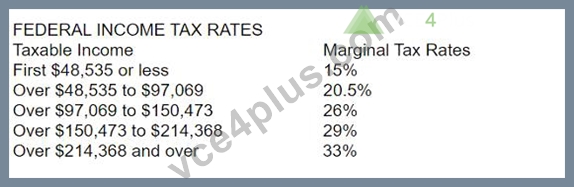
- A. $25,480
- B. $17,472
- C. $18,754
- D. $24,000
Answer: C
Explanation:
Explanation
Kerry's taxable income would be $98,000 ($100,000 - $2,000). Using the federal tax rates provided in the image, the first $48,535 of her income would be taxed at 15%, the next $48,534 at 20.5%, and the remaining
$931 at 26%. This would result in a total federal tax payable of $18,754. You can see the calculation in detail below:
Taxable Income
Marginal Tax Rate
Federal Tax Payable
$0 - $48,535
15%
$7,280.25
$48,536 - $97,069
20.5%
$9,934.47
$97,070 - $98,000
26%
$539.80
Total
$18,754.52
Note: The final answer is rounded to the closest whole dollar.
References: Canadian Investment Funds Course, Unit 8, Section 8.2; [4]
NEW QUESTION # 112
Kendrick is a newly registered Dealing Representative for Oak Solid Financial. He has been assigned the task of contacting existing clients where there has been no record of consultation within the last 12 months. The first person he sees on his list is a client named Chandra Ruffino. He double-checks if her phone number is on the Do Not Call List (DNCL) registry. Which of the following statements apply?
- A. If Chandra is on the DNCL registry, Kendrick is still eligible to contact the client of Oak Solid Financial.
- B. If Chandra had closed her account within the last 12 months and registered herself on the DNCL, then Kendrick cannot call her.
- C. If Chandra is on the DNCL, then Kendrick can only contact her if she is specifically his client.
- D. If Chandra has been on the DNCL registry for 18 months, then Kendrick is not allowed to contact her.
Answer: A
Explanation:
Explanation
The Do Not Call List (DNCL) is a national registry of personal telephone numbers that consumers can register to reduce the number of unsolicited telemarketing calls they receive. Telemarketers are required to subscribe to the DNCL and avoid calling the numbers on the list, unless they have an exemption. One of the exemptions is for existing business relationships, which means that a telemarketer can call a consumer who has purchased a product or service from them or their employer within the last 18 months, or who has made an inquiry or application within the last six months. Therefore, Kendrick is still eligible to contact Chandra, who is an existing client of Oak Solid Financial, even if she is on the DNCL registry. However, Kendrick must respect Chandra's right to request that he stop calling her and remove her number from his contact list.
References: Canadian Investment Funds Course, Chapter 1: The Canadian Financial Services Industry1, National Do Not Call List - Canada.ca2
NEW QUESTION # 113
Sylvia decided to use the savings from her bank account to purchase a 5-year bond. The face value of the bond is $10,000, the market price is $9,230 and the coupon rate is 7%.
What is the current yield on the bond? Round to 2 decimal places.
- A. 7.75%
- B. 7.25%
- C. 7.58%
- D. 7.00%
Answer: C
Explanation:
Explanation
The current yield on a bond is the annual interest payment divided by the current market price of the bond. In this case, the annual interest payment is 7% of the face value, which is $700. The current market price of the bond is $9,230. Therefore, the current yield is:
9230700*100%=7.58%
The current yield is different from the coupon rate, which is the annual interest payment divided by the face value of the bond. The coupon rate does not change over the life of the bond, but the current yield changes as the market price of the bond fluctuates. References:
* Canadian Investment Funds Course (CIFC) Study Guide, Chapter 5: Fixed-Income Securities, Section
5.2: Bond Pricing and Yield, page 5-61
* Current Yield Definition - Investopedia2
NEW QUESTION # 114
Kerry's total income this past year was $100,000 and she claimed a tax deduction of $2,000. When the tax return is filed, what would be the federal tax payable when applying the following federal tax rates?
(Round to the closest whole dollar for the final answer.)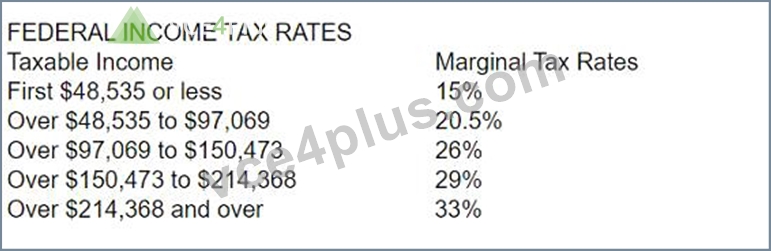
- A. $25,480
- B. $17,472
- C. $18,754
- D. $24,000
Answer: C
Explanation:
Explanation
Kerry's taxable income would be $98,000 ($100,000 - $2,000). Using the federal tax rates provided in the image, the first $48,535 of her income would be taxed at 15%, the next $48,534 at 20.5%, and the remaining
$931 at 26%. This would result in a total federal tax payable of $18,754. You can see the calculation in detail below:
Taxable Income
Marginal Tax Rate
Federal Tax Payable
$0 - $48,535
15%
$7,280.25
$48,536 - $97,069
20.5%
$9,934.47
$97,070 - $98,000
26%
$539.80
Total
$18,754.52
Note: The final answer is rounded to the closest whole dollar.
References: Canadian Investment Funds Course, Unit 8, Section 8.2; [4]
NEW QUESTION # 115
You have been researching Canadian equity mutual funds for a new client. You come across the following information.
What can you conclude from this information?
- A. Chamberlain Equity Fund has lower volatility since its 5-year annualized return is higher.
- B. Fontaine Equity Fund is a better fund because it has a higher quartile ranking.
- C. Fontaine Equity Fund's higher MER contributes to its lower 5-year annualized return.
- D. Fontaine Equity Fund has a lower risk level since its Sharpe Ratio is lower.
Answer: C
Explanation:
Explanation
The management expense ratio (MER) is the percentage of a fund's assets that is paid to the fund manager for operating and managing the fund. A higher MER means that more of the fund's returns are eaten up by fees, leaving less for the investors. Therefore, Fontaine Equity Fund's higher MER of 2.99% contributes to its lower
5-year annualized return of 11.25%, compared to Chamberlain Equity Fund's MER of 2.57% and 5-year annualized return of 13.42%. Therefore, D is the correct answer. References: Canadian Investment Funds Course (CIFC) | IFSE Institute, Management Expense Ratio (MER): Definition and How It Works - Investopedia
NEW QUESTION # 116
Yesterday, Mariana who is new to investing and purchased mutual funds for the very first time. She shared her excitement with her good friend, Julius. However, after Julius learned about her investment, he admits that he had a bad experience with mutual fund investing and that he lost money. Mariana regrets not talking to Julius prior to making her decision. Her feelings of enthusiasm have changed to fear. She is wondering if it is too late to change her mind and cancel her purchase order.
Which statement regarding the right of withdrawal is CORRECT?
- A. The Canadian Securities Administrators (CSA) created legislation that addresses the right of withdrawal for investors.
- B. Mariana has to wait two business after her purchase order has been settled to exercise the right of withdrawal.
- C. The Mutual Fund Dealers Association of Canada (MFDA) have written conduct rules regarding the right of withdrawal.
- D. The right of withdrawal for investors can be different depending on which province (or territory) the fund was purchased within.
Answer: D
Explanation:
Explanation
The right of withdrawal is a statutory right that allows investors to cancel their purchase order of mutual funds within a specified period of time and receive a refund of the amount they paid. The right of withdrawal is also known as the cooling-off period or the rescission right. The right of withdrawal for investors can be different depending on which province (or territory) the fund was purchased within, as each jurisdiction has its own securities legislation and regulations that govern the mutual fund industry. For example, in Ontario, the right of withdrawal is two business days after receiving the simplified prospectus or the fund facts document, whichever is later1. In Quebec, the right of withdrawal is two business days after receiving the simplified prospectus or confirmation of purchase, whichever is later2. In British Columbia, the right of withdrawal is 48 hours after receiving confirmation of purchase3. Therefore, Mariana may still be able to exercise her right of withdrawal, depending on where she bought her mutual funds and when she received the required documents. References:
* Canadian Investment Funds Course (CIFC) Study Guide, Chapter 3: The Regulatory Environment, Section 3.2: The Right of Withdrawal, page 3-54
* Ontario Securities Commission - Mutual Funds - Buying and Selling1
* Autorite des marches financiers - Mutual Funds - Buying and Selling2
* British Columbia Securities Commission - Mutual Funds - Buying and Selling3
NEW QUESTION # 117
Axis Wealth Management Inc. is a mutual fund dealer and member of the Mutual Fund Dealers Association of Canada (MFDA).
Indrek is a Branch Manager for the Guelph Branch and he is responsible for conducting suitability reviews in order to identify any unsuitable transactions or accounts. Which of the following accounts/transactions would be unsuitable?
- A. Hundolf holds the Fortune Small Cap Equity Fund. Hundolf is fully employed, he is saving for his retirement in 18 years, his investment objective is "growth", and his risk profile is "medium-high".
- B. Gilles has invested in various mutual funds using a leverage strategy recommended by his Dealing Representative. Gilles is 82, he is retired, he needs regular income, and his risk profile is "low".
- C. Megara bought a principal protected note (PPN) with a 7-year maturity. Megara wants principal protection and has a long-term investment time horizon (10+ years).
- D. Ulani is saving for the final payment she will owe on her pre-construction condominium. Ulani has invested in the Harbour Money Market Fund because she is seeking "safety".
Answer: B
Explanation:
Explanation
This account/transaction is unsuitable because it does not match Gilles' investment needs and objectives, risk profile, and capacity for loss. A leverage strategy involves borrowing money to invest in mutual funds, which increases the potential returns but also the potential losses. This strategy is very risky and requires a high risk tolerance, a long-term investment horizon, and a sufficient income to cover the interest payments. Gilles is 82 years old, retired, and needs regular income, which means he has a low risk tolerance, a short-term investment horizon, and a limited income. He cannot afford to lose his principal or pay the interest costs. Therefore, a leverage strategy is not appropriate for him.
References = IFSE CIFC Module 3: Investment Products, page 3-24. What is Suitability? | MFDAMSN-0069 | MFDA
NEW QUESTION # 118
Faruq is a Dealing Representative with Smart Planning Group, a mutual fund dealer. Faruq meets with his new client, Taline, and learns that she lives on a low, fixed income.
Taline tells Faruq that she wants to maximize her investment returns as high as possible to make up the difference. Taline also indicates that she cannot afford large investment losses because her income is low.
Which of the following CORRECTLY describes how Faruq should assess Taline's risk profile?
- A. Faruq should override the risk that Taline is able to accept because her return expectations cannot otherwise be met.
- B. Taline's risk profile should be"low" because her risk capacityis low and she cannot afford lame investment losses.
- C. Faruq should assess Taline's risk profilebased on the higher of her: (1) risk tolerance and (2) risk capacity
- D. Taline's risk profile should be "hiqh"" because she is willingto accept risk in order to maximize her investment returns.
Answer: B
NEW QUESTION # 119
......
Ultimate Guide to the CIFC - Latest Edition Available Now: https://www.vce4plus.com/IFSE-Institute/CIFC-valid-vce-dumps.html
2026 Updated Verified Pass CIFC Study Guides & Best Courses: https://drive.google.com/open?id=12-UnSfC1cBZOmqB5HPh5ZdpzSU-fcXOJ