

Pass Your 1Z0-931-20 Exam Easily With 100% Exam Passing Guarantee [2022]
1Z0-931-20 Dumps are Available for Instant Access from VCE4Plus
Topics of Oracle 1Z0-931-20: Oracle Autonomous Database Cloud 2020 Specialist Exam
Candidates must know the exam topics before they start preparation. Our 1Z0-931-20 exam dumps will include the following topics:
Autonomous Database Technical Overview
- Describe the added functionality unique to ADB Dedicated Infrastructure
- Describe the different ADB offerings
- Articulate the key features of an Autonomous Database
- Describe how database security is leveraged in ADB
- Describe the architectural components of an Autonomous Database (ADB)
- Describe a typical workflow for using ADB Shared Infrastructure
- Describe the Autonomous Dedicated Fleet Admin Role
- Describe a typical workflow for using ADB Dedicated Infrastructure
- Use Service Limits and Compartment Quotas
Provisioning
- Provision a Dedicated Autonomous Exadata Infrastructure
- Provision Dedicated Infrastructure
- Provision a Dedicated Autonomous Database
- Provision an Autonomous Database service
Connectivity
- Describe the options and considerations for migrating to ADB
- Connect to an ADB service
- Explore ADB using SQL Developer
- Describe how to use ADW with 3rd party software
- Connect to APEX
Managing and Maintaining Autonomous Database
- Move resources options and results
- Perform Cloning (backup or live, version to clone to)
- Set up Compartment Quotas
- Explain Data Safe
- Explain Patching and Upgrade Processes
- Manage ADB Backups and Restores
- Start, stop and scale ADB
- Migrate to ADB using Data Pump
- Use the OCI command line to manage ADB
- Understand ADB for Experienced Users
- Load data using DBMS_CLOUD
- Manage users and user privileges in ADB, and change admin password
Monitoring Autonomous Database
- Describe Enterprise Manager
- Use services in ADB
- Monitor ADB auto-scaling
- Set up service notifications
- Monitor Dedicated Infrastructure
For more info, visit:
Oracle-Community Oracle-exam-preparation Oracle-1Z0-931-20-exam-guide
How to Prepare for Oracle 1Z0-931-20: Oracle Autonomous Database Cloud 2020 Specialist Exam
Preparation Guide for Oracle 1Z0-931-20: Oracle Autonomous Database Cloud 2020 Specialist Exam
Introduction
Oracle offers the most encompassing, up-to-date, and sought-after global training and certification program for IT professionals. Certification is evidence of your skills and expertise in those areas in which you like to work. If the candidate wants to work on 1Z0-931-20 and prove his knowledge, this certification offered by Oracle is the best solution. This 1Z0-931-20 Certification helps a candidate to validate his skills in database cloud management concepts. Oracle also develops and builds tools and technologies for database management systems for middle-tier applications, Human Capital Management systems (HCM), Customer Relationship Management systems (CRM), Enterprise Resource Planning systems (ERP), and Supply Chain Management systems (SCM). Oracle Database, commonly known as Oracle Database Management System (DBMS), is a multi-model database management system. It is a widely used database to run tasks for data warehousing and online transaction processing databases. Different service providers make Oracle Database accessible on cloud, premises, or a hybrid cloud installation.
The Database cloud Certified Implementation Specialist certification is designed for individuals who possess a strong foundation and expertise in selling and implementing PeopleSoft Database cloud solutions. This certification covers topics such as Core Foundation Tables, Administering Data Permission Security, Adding People, Managing Worker Data, Managing Person and Job Data, and Managing Positions. This certification differentiates candidates in the marketplace by providing a competitive edge through proven expertise. Up-to-date training and field experience are recommended. This certification is available to all candidates but is geared toward members of the Oracle Partner Network. OPN members earning this certification will be recognized as OPN Certified Specialists. In this guide, we will cover the 1Z0-931-20 practice test, 1Z0-931-20 Certified professional salary and all aspects of the 1Z0-931-20 exam dumps.
NEW QUESTION 13
A Corporation is building a web application to allow its customers to schedule service requests online.
There is also a need to run operational reports at times during non-peak hours. The architecture team is debating whether such reports should be run on the OLTP database or in a separate data mart. The DBA Manager does not want to add anymore admin responsibility to the team and is looking for a database option that's low to zero maintenance, but meets their strict performance requirements as well.
Which Oracle Cloud Infrastructure database service is appropriate for this scenario?
- A. Since the application needs to be highly available, it should to be deployed on a Kubernetes Cluster.
- B. ADW since operational reporting is a higher priority in this scenario.
- C. It is best to build a separate data warehouse, and move the OLTP data on a nightly basis.
- D. ATP. Using 'tpurgent' and 'high' TNS services to separate connection types.
Answer: D
Explanation:
Autonomous Transaction Processing provides all of the performance of the market leading Oracle Database in an environment that is tuned and optimized to meet the demands of a variety of applications, including: mission-critical transaction processing, mixed transactions and analytics, loT, and JSON document store.
As a service Autonomous Transaction Processing does not require database administration. With Autonomous Transaction Processing you do not need to configure or manage any hardware, or install any software. Autonomous Transaction Processing handles creating the database, backing up the database, patching and upgrading the database, and growing or shrinking the database.
NEW QUESTION 14
What is the correct way to list all files in the default data pump directory?
- A. Log onto ADW server and issue is -al on the command line.
- B. By executing select * from DBMS_CLOUD.LIST_FILES('DATA_PUMP_DIR');
- C. You cannot list files in the default data pump directory from Autonomous Data Warehouse (ADW).
- D. By executing select * from utl_file . list ( 'DATA_PUMP_DIR ' ) ;
Answer: B
NEW QUESTION 15
Migrating an on-premise database to Autonomous Database (ADB) for large amounts of data involves multiple steps like creating a credential object, creating (access to) a storage object/location, running datapump export and running a datapump import.
Which three statements are true for SQL Developer (18.3 and up) in combination with ADB Data Loading? (Choose three.)
- A. SQL Developer can import files (.dmp and .csv for example) into ADB which are located on Amazon S3 Object storage.
- B. SQL Developer can import .csv files into ADB which are located on the system where SQL Developer is running.
- C. SQL Developer can be used to export/move/import of a database to ADB in 1 set of wizard steps.
- D. SQL Developer can only export/move/import files using datapump from databases running on Linux systems.
Answer: A,B,C
Explanation:
SQL Developer is a free integrated development environment (IDE) provided by Oracle that simplifies the development and management of Oracle databases. A Java based platform, this IDE can run on Linux, Mac OS X, and Windows platforms. SQL Developer facilitates database migrations by providing options to use Oracle tools like Data Pump export, database copy, and SQL'Loader
https://docs.oracle.com/en/cloud/paas/autonomous-data-warehouse-cloud/user/sql-developer-web.html#GUID-102845D9-6855-4944-8937-5C688939610F
NEW QUESTION 16
Which procedure within the DBMS_CLOUD package is used to load data?
- A. PUT_OBJECT
- B. COPY_DATA
- C. LIST_FILES
- D. LOAD_DATA
- E. CREATE_EXTERNAL_TABLE
Answer: B
NEW QUESTION 17
What are three methods to load data into the Autonomous Database?
- A. Oracle GoldenGate
- B. Transportable Tablespace
- C. Oracle Data Pump
- D. RMAN Restore
- E. SQL*Loader
Answer: A,C,E
Explanation:
https://www.oracle.com/database/technologies/datawarehouse-bigdata/adb-faqs.html#ATPD
https://docs.oracle.com/en/cloud/paas/autonomous-data-warehouse-cloud/user/load-data-intro.html#GUID-5D2F70D8-4FA1-482C-BFB0-43441FB897F3
NEW QUESTION 18
Which statement is true about connecting an OCI compute instance to a Shared Autonomous Database?
- A. The OCI compute instance can be used with an Always-Free Autonomous Database account.
- B. The Autonomous Database must be in the same VCN and Subnet as the Compute instance.
- C. A Private Endpoint is required to connect to the Shared-Autonomous Database.
- D. The OCI compute instance does not support connecting to a Shared Autonomous Database.
- E. The Autonomous Database must belong to a Network Security Group (NSG).
Answer: B
NEW QUESTION 19
Which is correct about security features that are available in Oracle Autonomous Database?
- A. Neither Data Redaction nor TDE are supported.
- B. Data Redaction and TDE are both supported.
- C. TDE but not Data Redaction.
- D. Data Redaction but not TDE.
Answer: B
Explanation:
https://www.oracle.com/database/technologies/datawarehouse-bigdata/adb-faqs.html
NEW QUESTION 20
When using Data Pump to migrate your Oracle database to Autonomous Database, which two objects are exported?
- A. Tablespaces
- B. Data
- C. Schemas
- D. Reports
Answer: B,C
NEW QUESTION 21
Which two statements are true about the Oracle Cloud Infrastructure (OCI)? (Choose two.)
- A. Because availability domains do not share infrastructure such as power or cooling, or the internal availability domain network, a failure at one availability domain within a region is unlikely to impact the availability of the others within the same region.
- B. Regions are dependent on other regions and must be located with 5 thousand kilometers of each other.
- C. An OCI region is a localized geographic area, and an availability domain is one or more data centers located within a region.
- D. A single fault domain can be associated with multiple regions and availability domains.
Answer: A,C
Explanation:
A region is a localized geographic area, and an availability domain is one or more data centers located within a region.
Because availability domains do not share infrastructure such as power or cooling, or the internal availability domain network, a failure at one availability domain within a region is unlikely to impact the availability of the others within the same region.
Oracle Cloud Infrastructure is hosted in regions and availability domains. A region is a localized geographic area. And an availability domain is one or more data centers located within a region. Our region is composed of one or more available domains. Most cloud infrastructure resources are either region-specific, such as virtual cloud networks, or availability-domain-specific, such as compute instance.
Traffic between availability domains and between regions is encrypted. Availability domains are isolated from each other, fault tolerant, and very unlikely to fail simultaneously. Because availability domains do not share infrastructure such as power or cooling, or the internal availability domain network, a failure at one domain within a region is unlikely to impact the availability of the others within the same region.
https://docs.cloud.oracle.com/iaas/Content/General/Concepts/regions.htm
NEW QUESTION 22
What are two advantages of using Data Pump to migrate your Oracle Databases to Autonomous Database? (Choose two.)
- A. Data Pump is faster to migrate database than using RMAN.
- B. Data Pump is platform independent -it can migrate Oracle Databases running on any platform.
- C. Data Pump creates the tablespaces used by your Autonomous Database.
- D. Data Pump can exclude migration of objects like indexes and materialized views that are not needed by Autonomous Database.
Answer: A,D
Explanation:
https://docs.oracle.com/en/cloud/paas/autonomous-data-warehouse-cloud/user/load-data-data- pump.html#GUID-30DB1EEA-DB45-49EA-9E97-DF49A9968E24
NEW QUESTION 23
What are two advantages of using Data Pump to migrate your Oracle Databases to Autonomous Database? (Choose two.)
- A. Data Pump is platform independent - it can migrate Oracle Databases running on any platform.
- B. Data Pump creates the tablespaces used by your Autonomous Database.
- C. Data Pump can exclude migration of objects like indexes and materialized views that are not needed by Autonomous Database.
- D. Data Pump is faster to migrate database than using RMAN.
Answer: A,C
Explanation:
The default data and temporary tablespaces for the database are configured automatically. Adding, removing, or modifying tablespaces is not allowed.
Oracle Data Pump offers very fast bulk data and metadata movement between Oracle databases and Autonomous Database .
Data Pump Import lets you import data from Data Pump files residing on Oracle Cloud Infrastructure Object Storage, Microsoft Azure, AWS S3, and Oracle Cloud Infrastructure Object Storage Classic. You can save your data to your Cloud Object Store and use Oracle Data Pump to load data to
https://docs.oracle.com/en/cloud/paas/atp-cloud/atpug/load-data-data-pump.html#GUID-297FE3E6-A823-4F98-AD50-959ED96E6969
NEW QUESTION 24
Which three Oracle Cloud Infrastructure (OCI) resources do you need to configure before provisioning your Autonomous Database with Private Endpoint?
- A. Network Security Group
- B. Route Table
- C. Subnet
- D. VCN
- E. Security List
Answer: A,C,D
Explanation:
To provision an Autonomous Database with a private endpoint, you must have the following resources already created:
A VCN within the region that will contain your Autonomous Database with shared Exadata infrastructure. Cannot be changed after provisioning.
A private subnet within your VCN configured with default DHCP options. Cannot be changed after provisioning.
At least 1 network security group (NSG) within your VCN for the Autonomous Database. Can be changed or edited after provisioning.
https://docs.oracle.com/en-us/iaas/Content/Database/Concepts/adbsprivateaccess.htm
NEW QUESTION 25
Which statement is false about Autonomous Database Oracle Client Credentials (Wallets)?
- A. The Oracle Client Credential file is downloaded as a ZIP file.
- B. You MUST have an Oracle Client Credential Wallet in order to connect to the Autonomous Database.
- C. In addition to the Oracle Client Credential Wallet, a user must have a username and password in order to connect to the Autonomous Database.
- D. The Wallet for the Autonomous Database is the same as the Transparent Data Encryption (TDE) wallet.
Answer: D
Explanation:
When you download the client credentials from the Download Wallet dialog, you must enter a wallet password in the password field and confirm the password in the confirm password field. The password must be at least eight characters long and must include at least one letter and one numeric character or one special character. This password protects the download client credentials wallet. This wallet is not the same as the transparent data encryption wallet for the database. Therefore, a different password is used to protect the client credentials wallet.
NEW QUESTION 26
Which TWO statements are TRUE about using an Autonomous Database with Private Endpoints
- A. Private Endpoints can be configured when you clone a Shared Autonomous Database that was initially created with public endpoints.
- B. You can configure Private Endpoints for an Always Free Autonomous Database
- C. An Autonomous Database with private endpoints can be accessed from the public internet by adding your ip address to an Access Control List.
- D. A Network Security Group is required within your Virtual Cloud Network before you can provision a Shared Autonomous Database to use Private Endpoints
Answer: A,C
NEW QUESTION 27
Which two system privileges does a user need to create analytic views? (Choose two.)
- A. CREATE ATTRIBUTE DIMENSION
- B. CREATE ANALYTIC HIERARCHY
- C. CREATE ANALYTIC VIEW
- D. CREATE ANALYTIC MEASURE
- E. CREATE ANALYTIC LEVEL
Answer: A,C
Explanation:
https://docs.oracle.com/en/database/oracle/oracle-database/19/dwhsg/overview-analytic-views.html#GUID-6F948948-6AE6-4A89-8AAC-5B8952CEF41D
NEW QUESTION 28
What is the default port number for accessing a newly created Autonomous Database?
- A. 0
- B. 1
- C. 2
- D. 3
- E. 4
Answer: B
Explanation:
https://www.oracle.com/a/ocom/docs/cloud/autonomous-database-100.pdf
NEW QUESTION 29
Given the steps:
1. Create Oracle Machine Learning User
2. Create projects
3. Create workspaces
4. Create Notebooks
5. Run SQL Scripts
Which two steps are out of order when working with Oracle Machine learning? (Choose two.)
- A. Create Notebooks
- B. Create projects
- C. Create Oracle Machine Learning User
- D. Run SQL Scripts
- E. Create workspaces
Answer: C,E
Explanation: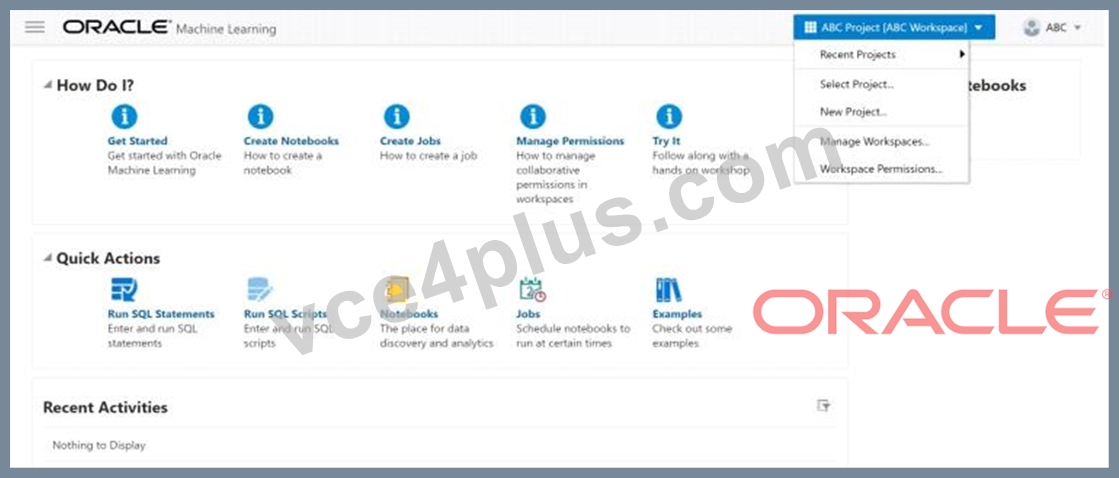
https://docs.oracle.com/en/cloud/paas/autonomous-data-warehouse-cloud/omlug/get-started-oracle-machine-learning.html#GUID-13452045-6AF6-402B-83CC-C9AFBCEC30CA
NEW QUESTION 30
Which operating system can Data Visualization Desktop be run on?
- A. AIX
- B. Windows
- C. Solaris
- D. Linux
Answer: B
Explanation: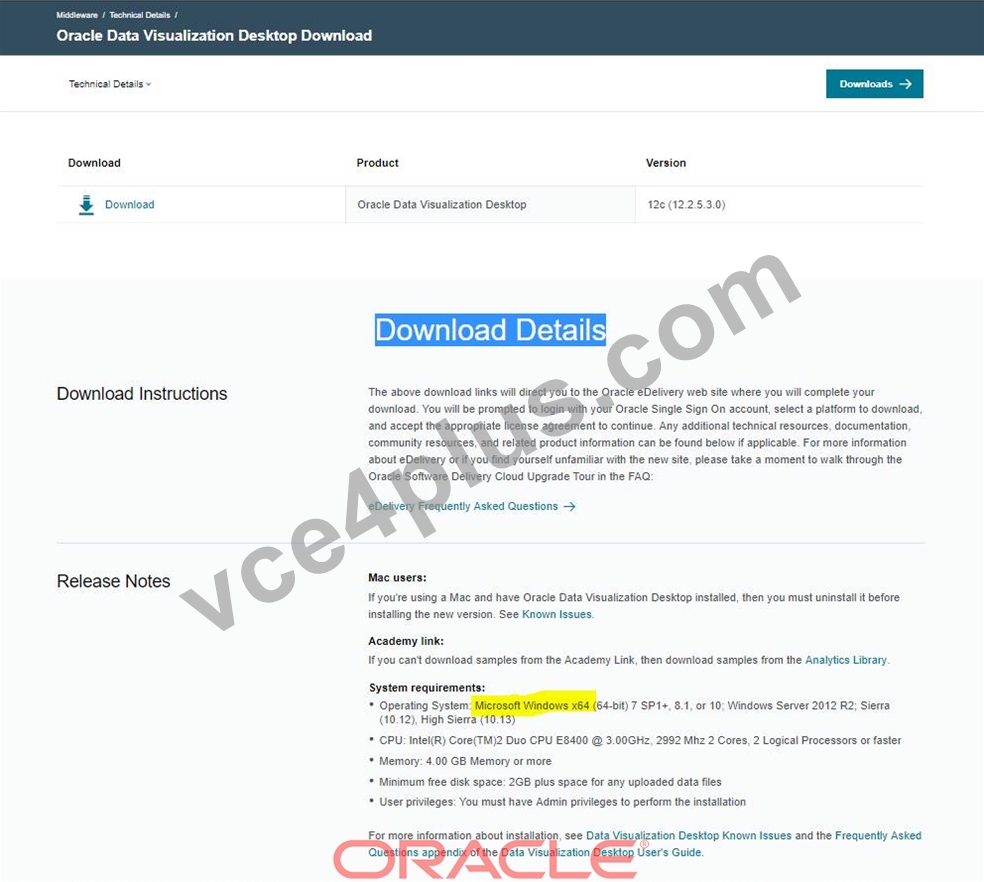
NEW QUESTION 31
Which two methods can you use to create users and grant roles in Autonomous Database services?
(Choose two.)
- A. through the Oracle Cloud Infrastructure service console
- B. through SQL/Developer s
- C. through SQLPIus
- D. using DBMS_CLOUD_ADMIN package
Answer: B,C
Explanation:
https://oracle-base.com/articles/vm/oracle-cloud-autonomous-data-warehouse-adw-create-service
https://docs.oracle.com/en/cloud/paas/autonomous-data-warehouse-cloud/user/connect-sqlplus.html#GUID-A3005A6E-9ECF-40CB-8EFC-D1CFF664EC5A
https://docs.oracle.com/en/cloud/paas/autonomous-data-warehouse-cloud/user/connect-sql-dev.html#GUID-FB611317-2999-4C8C-8A3B-B3B3D3C5B417
https://docs.oracle.com/en/cloud/paas/autonomous-data-warehouse-cloud/user/dbms-cloud-admin.html#GUID-D76B229E-781E-45C0-9F14-CAF30F9E6E3B
NEW QUESTION 32
On what infrastructure does the Autonomous Database run on?
- A. Any Oracle Engineered system
- B. Exadata on Oracle Cloud Infrastructure
- C. Bare-metal on Oracle Cloud Infrastructure
- D. VM on Oracle Cloud Infrastructure
Answer: D
NEW QUESTION 33
Which three statements are correct when the Autonomous Database is stopped? (Choose three.)
- A. In-flight transactions and queries are stopped.
- B. CPU billing is halted based on full-hour cycles of usage.
- C. User with DWROLE can still access the database.
- D. Tools are no longer able to connect to a stopped instance.
Answer: A,B,D
Explanation:
https://docs.oracle.com/en/cloud/paas/autonomous-data-warehouse-cloud/user/autonomous-stop.html#GUID-9AF677F3-027A-43FD-B018-9F4A42D5CDE9
NEW QUESTION 34
As a database architect you are tasked with configuring a high concurrency, production OLTP application to connect to an Autonomous Transaction Processing database with a requirement to have some reporting queries run in parallel mode.
Which connection service is appropriate for such a workload?
- A. TPURGENT
- B. MEDIUM
- C. TP
- D. HIGH
Answer: B
Explanation:
Medium is A typical application connection service for reporting and batch operations. All operations run in parallel and are subject to queuing. Using this service the degree of parallelism is limited to four (4) and concurrency is 1.25 X CPU_COUNT QUERIES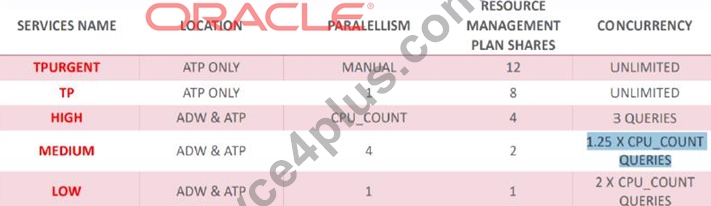
NEW QUESTION 35
Which two license types does the customer need to benefit from BYOL when leveraging on-premise Enterprise Database licenses in Oracle Autonomous Database?
- A. Active Data Guard
- B. RAC, but only when scaling beyond 16 OCPUs
- C. Exadata
- D. Transparent Data Encryption
- E. Multitenant
Answer: A,B
NEW QUESTION 36
An Autonomous Database (ADB) user with an instance wallet has left the company and they shared a database user id with other users when accessing ADB.
Other than changing the shared user password, what can the admin do to protect the instance?
- A. Trust the user who left to not access the database.
- B. Delete the user.
- C. Shutdown and restart the instance.
- D. Rotate the instance wallet and share the new wallet with the remaining users.
Answer: C
NEW QUESTION 37
......
Study resources for the Valid 1Z0-931-20 Braindumps: https://www.vce4plus.com/Oracle/1Z0-931-20-valid-vce-dumps.html