

[Sep-2021] Get 100% Real AZ-204 Exam Questions, Accurate & Verified VCE4Plus Dumps in the Real Exam!
Pass Your Microsoft Azure Exams Fast. All Top AZ-204 Exam Questions Are Covered.
NEW QUESTION 139
You need to add code at line EG15 in EventGridController.cs to ensure that the Log policy applies to all services.
How should you complete the code? To answer, drag the appropriate code segments to the correct locations. Each code segment may be used once, more than once, or not at all. You may need to drag the split bar between panes or scroll to view content.
NOTE: Each correct selection is worth one point.
Answer:
Explanation:
Reference:
https://docs.microsoft.com/en-us/azure/role-based-access-control/resource-provider-operations
NEW QUESTION 140
You need to ensure disaster recovery requirements are met.
What code should you add at line PC16?
To answer, drag the appropriate code fragments to the correct locations. Each code fragment may be used once, more than once, or not at all. You may need to drag the split bar between panes or scroll to view content.
NOTE: Each correct selection is worth one point.
Answer:
Explanation:
Explanation
Scenario: Disaster recovery. Regional outage must not impact application availability. All DR operations must not be dependent on application running and must ensure that data in the DR region is up to date.
Box 1: DirectoryTransferContext
We transfer all files in the directory.
Note: The TransferContext object comes in two forms: SingleTransferContext and DirectoryTransferContext.
The former is for transferring a single file and the latter is for transferring a directory of files.
Box 2: ShouldTransferCallbackAsync
The DirectoryTransferContext.ShouldTransferCallbackAsync delegate callback is invoked to tell whether a transfer should be done.
Box 3: False
If you want to use the retry policy in Copy, and want the copy can be resume if break in the middle, you can use SyncCopy (isServiceCopy = false).
Note that if you choose to use service side copy ('isServiceCopy' set to true), Azure (currently) doesn't provide SLA for that. Setting 'isServiceCopy' to false will download the source blob loca Reference:
https://docs.microsoft.com/en-us/azure/storage/common/storage-use-data-movement-library
https://docs.microsoft.com/en-us/dotnet/api/microsoft.windowsazure.storage.datamovement.directorytransfercon
NEW QUESTION 141
A company is implementing a publish-subscribe (Pub/Sub) messaging component by using Azure Service Bus. You are developing the first subscription application.
In the Azure portal you see that messages are being sent to the subscription for each topic. You create and initialize a subscription client object by supplying the correct details, but the subscription application is still not consuming the messages.
You need to complete the source code of the subscription client
What should you do?
- A. await subscriptionClient.CloseAsync();
- B. subscriptionClient = new SubscriptionClient(ServiceBusConnectionString, TopicName, SubscriptionName);
- C. subscriptionClient.RegisterMessageHandler(ProcessMessagesAsync, messageHandlerOptions);
- D. await subscriptionClient.AddRuleAsync(new RuleDescription(RuleDescription.DefaultRuleName, new TrueFilter()));
Answer: C
NEW QUESTION 142
You need to implement the bindings for the CheckUserContent function.
How should you complete the code segment? To answer, select the appropriate options in the answer area.
NOTE: Each correct selection is worth one point.
Answer:
Explanation:
Explanation
Box 1: [BlobTrigger(..)]
Box 2: [Blob(..)]
Azure Blob storage output binding for Azure Functions. The output binding allows you to modify and delete blob storage data in an Azure Function.
The attribute's constructor takes the path to the blob and a FileAccess parameter indicating read or write, as shown in the following example:
[FunctionName("ResizeImage")]
public static void Run(
[BlobTrigger("sample-images/{name}")] Stream image,
[Blob("sample-images-md/{name}", FileAccess.Write)] Stream imageSmall)
{
}
Scenario: You must create an Azure Function named CheckUserContent to perform the content checks.
The company's data science group built ContentAnalysisService which accepts user generated content as a string and returns a probable value for inappropriate content. Any values over a specific threshold must be reviewed by an employee of Contoso, Ltd.
Reference:
https://docs.microsoft.com/en-us/azure/azure-functions/functions-bindings-storage-blob-output
NEW QUESTION 143
You need to implement the bindings for the CheckUserContent function.
How should you complete the code segment? To answer, select the appropriate options in the answer area.
NOTE: Each correct selection is worth one point.
Answer:
Explanation:
Explanation
Box 1: [BlobTrigger(..)]
Box 2: [Blob(..)]
Azure Blob storage output binding for Azure Functions. The output binding allows you to modify and delete blob storage data in an Azure Function.
The attribute's constructor takes the path to the blob and a FileAccess parameter indicating read or write, as shown in the following example:
[FunctionName("ResizeImage")]
public static void Run(
[BlobTrigger("sample-images/{name}")] Stream image,
[Blob("sample-images-md/{name}", FileAccess.Write)] Stream imageSmall)
{
}
Scenario: You must create an Azure Function named CheckUserContent to perform the content checks.
The company's data science group built ContentAnalysisService which accepts user generated content as a string and returns a probable value for inappropriate content. Any values over a specific threshold must be reviewed by an employee of Contoso, Ltd.
Reference:
https://docs.microsoft.com/en-us/azure/azure-functions/functions-bindings-storage-blob-output
NEW QUESTION 144
You
are developing an Azure App Service hosted ASP.NET Core web app to deliver video on-demand streaming media. You enable an Azure Content Delivery Network (CDN) Standard for the web endpoint. Customer videos are downloaded from the web app by using the following example URL.:
http://www.contoso.com/content.mp4?quality=1
All media content must expire from the cache after one hour. Customer videos with varying quality must be delivered to the closest regional point of presence (POP) node.
You need to configure Azure CDN caching rules.
Which options should you use? To answer, select the appropriate options in the answer area.
NOTE: Each correct selection is worth one point.
Answer:
Explanation:
Explanation
Box 1: Override
Override: Ignore origin-provided cache duration; use the provided cache duration instead. This will not override cache-control: no-cache.
Set if missing: Honor origin-provided cache-directive headers, if they exist; otherwise, use the provided cache duration.
Incorrect:
Bypass cache: Do not cache and ignore origin-provided cache-directive headers.
Box 2: 1 hour
All media content must expire from the cache after one hour.
Box 3: Cache every unique URL
Cache every unique URL: In this mode, each request with a unique URL, including the query string, is treated as a unique asset with its own cache. For example, the response from the origin server for a request for example.ashx?q=test1 is cached at the POP node and returned for subsequent caches with the same query string. A request for example.ashx?q=test2 is cached as a separate asset with its own time-to-live setting.
Reference:
https://docs.microsoft.com/en-us/azure/cdn/cdn-query-string
NEW QUESTION 145
You are implementing an Azure API app that uses built-in authentication and authorization functionality.
All app actions must be associated with information about the current user.
You need to retrieve the information about the current user.
What are two possible ways to achieve the goal? Each correct answer presents a complete solution.
NOTE: Each correct selection is worth one point.
- A. /.auth/login endpoint
- B. HTTP headers
- C. environment variables
- D. /.auth/me HTTP endpoint
Answer: B,D
Explanation:
Explanation
A: After App Service Authentication has been configured, users trying to access your API are prompted to sign in with their organizational account that belongs to the same Azure AD as the Azure AD application used to secure the API. After signing in, you are able to access the information about the current user through the HttpContext.Current.User property.
C: While the server code has access to request headers, client code can access GET /.auth/me to get the same access tokens ( References:
https://docs.microsoft.com/en-us/azure/app-service/app-service-web-tutorial-auth-aad
https://docs.microsoft.com/en-us/sharepoint/dev/spfx/web-parts/guidance/connect-to-api-secured-with-aad
NEW QUESTION 146
You are creating a script that will run a large workload on an Azure Batch pool. Resources will be reused and do not need to be cleaned up after use.
You have the following parameters:
You need to write an Azure CLI script that will create the jobs, tasks, and the pool.
In which order should you arrange the commands to develop the solution? To answer, move the appropriate commands from the list of command segments to the answer area and arrange them in the correct order.
Answer:
Explanation:
Explanation
Step 1: az batch pool create
# Create a new Linux pool with a virtual machine configuration.
az batch pool create \
--id mypool \
--vm-size Standard_A1 \
--target-dedicated 2 \
--image canonical:ubuntuserver:16.04-LTS \
--node-agent-sku-id "batch.node.ubuntu 16.04"
Step 2: az batch job create
# Create a new job to encapsulate the tasks that are added.
az batch job create \
--id myjob \
--pool-id mypool
Step 3: az batch task create
# Add tasks to the job. Here the task is a basic shell command.
az batch task create \
--job-id myjob \
--task-id task1 \
--command-line "/bin/bash -c 'printenv AZ_BATCH_TASK_WORKING_DIR'"
Step 4: for i in {1..$numberOfJobs} do
References:
https://docs.microsoft.com/bs-latn-ba/azure/batch/scripts/batch-cli-sample-run-job
NEW QUESTION 147
Note: This question is part of a series of questions that present the same scenario. Each question in the series contains a unique solution. Determine whether the solution meets the stated goals.
You develop an entertainment application where users can buy and trade virtual real estate. The application must scale to support thousands of users.
The current architecture includes five Azure Virtual Machines (VM) that connect to an Azure SQL Database for account information and Azure Table Storage for backend services. A user interacts with these components in the cloud at any given time Routing Service - Routes a request to the appropriate service and must not persist data across sessions Account Service - Stores and manages all account information and authentication and requires data to persist across sessions.
User Service - Stores and manages all user information and requires data to persist across sessions.
Housing Network Service - Stores and manages the current real-estate economy and requires data to persist across sessions.
Trade Service - Stores and manages virtual trade between accounts and requires data to persist across sessions.
Due to volatile user traffic, a microservices solution is selected for scale agility.
You need to migrate to a distributed microservices solution on Azure Service Fabric.
Solution: Create a Service Fabric Cluster with a stateless Reliable Service for Routing Service.
Create stateful Reliable Services for all other components.
Does the solution meet the goal?
- A. No
- B. Yes
Answer: B
Explanation:
We should use stateful services when we want data to persist, and stateless service when data must not persist.
Note:
For stateful services, the Reliable Services programming model allows you to consistently and reliably store your state right inside your service by using Reliable Collections.
A stateless service is one where there is no state maintained within the service across calls. Any state that is present is entirely disposable and doesn't require synchronization, replication, persistence, or high availability.
References:
https://docs.microsoft.com/en-us/azure/service-fabric/service-fabric-reliable-services-introduction
NEW QUESTION 148
You are maintaining an existing application that uses an Azure Blob GPv1 Premium storage account. Data older than three months is rarely used.
Data newer than three months must be available immediately. Data older than a year must be saved but does not need to be available immediately.
You need to configure the account to support a lifecycle management rule that moves blob data to archive storage for data not modified in the last year.
Which three actions should you perform in sequence? To answer, move the appropriate actions from the list of actions to the answer area and arrange them in the correct order.
Answer:
Explanation:
Reference:
https://docs.microsoft.com/en-us/azure/storage/blobs/storage-blob-storage-tiers
NEW QUESTION 149
You are creating a script that will run a large workload on an Azure Batch pool. Resources will be reused and do not need to be cleaned up after use.
You have the following parameters:
You need to write an Azure CLI script that will create the jobs, tasks, and the pool.
In which order should you arrange the commands to develop the solution? To answer, move the appropriate commands from the list of command segments to the answer area and arrange them in the correct order.
Answer:
Explanation:
Explanation
Step 1: az batch pool create
# Create a new Linux pool with a virtual machine configuration.
az batch pool create \
--id mypool \
--vm-size Standard_A1 \
--target-dedicated 2 \
--image canonical:ubuntuserver:16.04-LTS \
--node-agent-sku-id "batch.node.ubuntu 16.04"
Step 2: az batch job create
# Create a new job to encapsulate the tasks that are added.
az batch job create \
--id myjob \
--pool-id mypool
Step 3: az batch task create
# Add tasks to the job. Here the task is a basic shell command.
az batch task create \
--job-id myjob \
--task-id task1 \
--command-line "/bin/bash -c 'printenv AZ_BATCH_TASK_WORKING_DIR'"
Step 4: for i in {1..$numberOfJobs} do
References:
https://docs.microsoft.com/bs-latn-ba/azure/batch/scripts/batch-cli-sample-run-job
NEW QUESTION 150
You are a developer for a software as a service (SaaS) company that uses an Azure Function to process orders.
The Azure Function currently runs on an Azure Function app that is triggered by an Azure Storage queue.
You are preparing to migrate the Azure Function to Kubernetes using Kubernetes-based Event Driven Autoscaling (KEDA).
You need to configure Kubernetes Custom Resource Definitions (CRD) for the Azure Function.
Which CRDs should you configure? To answer, drag the appropriate CRD types to the correct locations. Each CRD type may be used once, more than once, or not at all. You may need to drag the split bar between panes or scroll to view content.
NOTE: Each correct selection is worth one point.
Answer:
Explanation:
Explanation
Box 1: Deployment
To deploy Azure Functions to Kubernetes use the func kubernetes deploy command has several attributes that directly control how our app scales, once it is deployed to Kubernetes.
Box 2: ScaledObject
With --polling-interval, we can control the interval used by KEDA to check Azure Service Bus Queue for messages.
Example of ScaledObject with polling interval
apiVersion: keda.k8s.io/v1alpha1
kind: ScaledObject
metadata:
name: transformer-fn
namespace: tt
labels:
deploymentName: transformer-fn
spec:
scaleTargetRef:
deploymentName: transformer-fn
pollingInterval: 5
minReplicaCount: 0
maxReplicaCount: 100
Box 3: Secret
Store connection strings in Kubernetes Secrets.
Example: to create the Secret in our demo Namespace:
# create the k8s demo namespace
kubectl create namespace tt
# grab connection string from Azure Service Bus
KEDA_SCALER_CONNECTION_STRING=$(az servicebus queue authorization-rule keys list \
-g $RG_NAME \
--namespace-name $SBN_NAME \
--queue-name inbound \
-n keda-scaler \
--query "primaryConnectionString" \
-o tsv)
# create the kubernetes secret
kubectl create secret generic tt-keda-auth \
--from-literal KedaScaler=$KEDA_SCALER_CONNECTION_STRING \
--namespace tt
Reference:
https://www.thinktecture.com/en/kubernetes/serverless-workloads-with-keda/
NEW QUESTION 151
You need to ensure receipt processing occurs correctly.
What should you do?
- A. Use blob metadata to prevent concurrency problems
- B. Use blob SnapshotTime to prevent concurrency problems
- C. Use blob leases to prevent concurrency problems
- D. Use blob properties to prevent concurrency problems
Answer: B
Explanation:
You can create a snapshot of a blob. A snapshot is a read-only version of a blob that's taken at a point in time. Once a snapshot has been created, it can be read, copied, or deleted, but not modified. Snapshots provide a way to back up a blob as it appears at a moment in time.
Scenario: Processing is performed by an Azure Function that uses version 2 of the Azure Function runtime. Once processing is completed, results are stored in Azure Blob Storage and an Azure SQL database. Then, an email summary is sent to the user with a link to the processing report. The link to the report must remain valid if the email is forwarded to another user.
Reference:
https://docs.microsoft.com/en-us/rest/api/storageservices/creating-a-snapshot-of-a-blob
NEW QUESTION 152
You are developing an Azure function that connects to an Azure SQL Database instance. The function is triggered by an Azure Storage queue.
You receive reports of numerous System.InvalidOperationExceptions with the following message:
"Timeout expired. The timeout period elapsed prior to obtaining a connection from the pool. This may have occurred because all pooled connections were in use and max pool size was reached." You need to prevent the exception.
What should you do?
- A. In the function.json file, change the value of the type option to queueScaling
- B. In the host.json file, decrease the value of the batchSize option
- C. Convert the Azure Function to the Premium plan
- D. Convert the trigger to Azure Event Hub
Answer: C
Explanation:
With the Premium plan the max outbound connections per instance is unbounded compared to the 600 active (1200 total) in a Consumption plan.
Note: The number of available connections is limited partly because a function app runs in a sandbox environment. One of the restrictions that the sandbox imposes on your code is a limit on the number of outbound connections, which is currently 600 active (1,200 total) connections per instance. When you reach this limit, the functions runtime writes the following message to the logs: Host thresholds exceeded:
Connections.
Reference:
https://docs.microsoft.com/en-us/azure/azure-functions/manage-connections
https://docs.microsoft.com/en-us/azure/azure-functions/functions-scale#service-limits Connect to and consume Azure services and third-party services Testlet 1 Case study This is a case study. Case studies are not timed separately. You can use as much exam time as you would like to complete each case. However, there may be additional case studies and sections on this exam.
You must manage your time to ensure that you are able to complete all questions included on this exam in the time provided.
To answer the questions included in a case study, you will need to reference information that is provided in the case study. Case studies might contain exhibits and other resources that provide more information about the scenario that is described in the case study. Each question is independent of the other questions in this case study.
At the end of this case study, a review screen will appear. This screen allows you to review your answers and to make changes before you move to the next section of the exam. After you begin a new section, you cannot return to this section.
To start the case study
To display the first question in this case study, click the Next button. Use the buttons in the left pane to explore the content of the case study before you answer the questions. Clicking these buttons displays information such as business requirements, existing environment, and problem statements. When you are ready to answer a question, click the Question button to return to the question.
Current environment
Windows Server 2016 virtual machine
This virtual machine (VM) runs BizTalk Server 2016. The VM runs the following workflows:
* Ocean Transport - This workflow gathers and validates container information including container contents and arrival notices at various shipping ports.
* Inland Transport - This workflow gathers and validates trucking information including fuel usage, number of stops, and routes.
The VM supports the following REST API calls:
* Container API - This API provides container information including weight, contents, and other attributes.
* Location API - This API provides location information regarding shipping ports of call and trucking stops.
* Shipping REST API - This API provides shipping information for use and display on the shipping website.
Shipping Data
The application uses MongoDB JSON document storage database for all container and transport information.
Shipping Web Site
The site displays shipping container tracking information and container contents. The site is located at http:// shipping.wideworldimporters.com/ Proposed solution The on-premises shipping application must be moved to Azure. The VM has been migrated to a new Standard_D16s_v3 Azure VM by using Azure Site Recovery and must remain running in Azure to complete the BizTalk component migrations. You create a Standard_D16s_v3 Azure VM to host BizTalk Server. The Azure architecture diagram for the proposed solution is shown below:
Requirements
Shipping Logic app
The Shipping Logic app must meet the following requirements:
* Support the ocean transport and inland transport workflows by using a Logic App.
* Support industry-standard protocol X12 message format for various messages including vessel content details and arrival notices.
* Secure resources to the corporate VNet and use dedicated storage resources with a fixed costing model.
* Maintain on-premises connectivity to support legacy applications and final BizTalk migrations.
Shipping Function app
Implement secure function endpoints by using app-level security and include Azure Active Directory (Azure AD).
REST APIs
The REST API's that support the solution must meet the following requirements:
* Secure resources to the corporate VNet.
* Allow deployment to a testing location within Azure while not incurring additional costs.
* Automatically scale to double capacity during peak shipping times while not causing application downtime.
* Minimize costs when selecting an Azure payment model.
Shipping data
Data migration from on-premises to Azure must minimize costs and downtime.
Shipping website
Use Azure Content Delivery Network (CDN) and ensure maximum performance for dynamic content while minimizing latency and costs.
Issues
Windows Server 2016 VM
The VM shows high network latency, jitter, and high CPU utilization. The VM is critical and has not been backed up in the past. The VM must enable a quick restore from a 7-day snapshot to include in-place restore of disks in case of failure.
Shipping website and REST APIs
The following error message displays while you are testing the website:
Failed to load http://test-shippingapi.wideworldimporters.com/: No 'Access- Control-Allow-Origin' header is present on the requested resource. Origin
'http://test.wideworldimporters.com/' is therefore not allowed access.
NEW QUESTION 153
You are developing a medical records document management website. The website is used to store scanned copies of patient intake forms. If the stored intake forms are downloaded from storage by a third party, the content of the forms must not be compromised.
You need to store the intake forms according to the requirements.
Solution:
* Create a Azure Key Vault key named skey.
* Encrypt the intake forms using the public key portion of skey.
* Store the encrypted data in Azure Blob storage
Does the solution meet the goal?
- A. No
- B. Yes
Answer: B
NEW QUESTION 154
You need to correct the corporate website error.
Which four actions should you recommend be performed in sequence? To answer, move the appropriate actions from the list of actions to the answer area and arrange them in the correct order.
Answer:
Explanation:
Explanation
Scenario: Corporate website
While testing the site, the following error message displays:
CryptographicException: The system cannot find the file specified.
Step 1: Generate a certificate
Step 2: Upload the certificate to Azure Key Vault
Scenario: All SSL certificates and credentials must be stored in Azure Key Vault.
Step 3: Import the certificate to Azure App Service
Step 4: Update line SCO5 of Security.cs to include error handling and then redeploy the code Reference:
https://docs.microsoft.com/en-us/azure/app-service/configure-ssl-certificate
NEW QUESTION 155
You need to configure Azure CDN for the Shipping web site.
Which configuration options should you use? To answer, select the appropriate options in the answer area.
NOTE: Each correct selection is worth one point.
Answer:
Explanation:
Reference:
https://docs.microsoft.com/en-us/azure/cdn/cdn-optimization-overview
NEW QUESTION 156
You plan to deploy a web app to App Service on Linux. You create an App Service plan. You create and push a custom Docker image that image that contains the web app to Azure Container Registry.
You need to access the console logs generated from inside the container in real-time.
How should you complete the Azure CLI command? To answer, select the appropriate options in the answer area.
NOTE: Each correct selection is worth one point.
Answer:
Explanation:
Explanation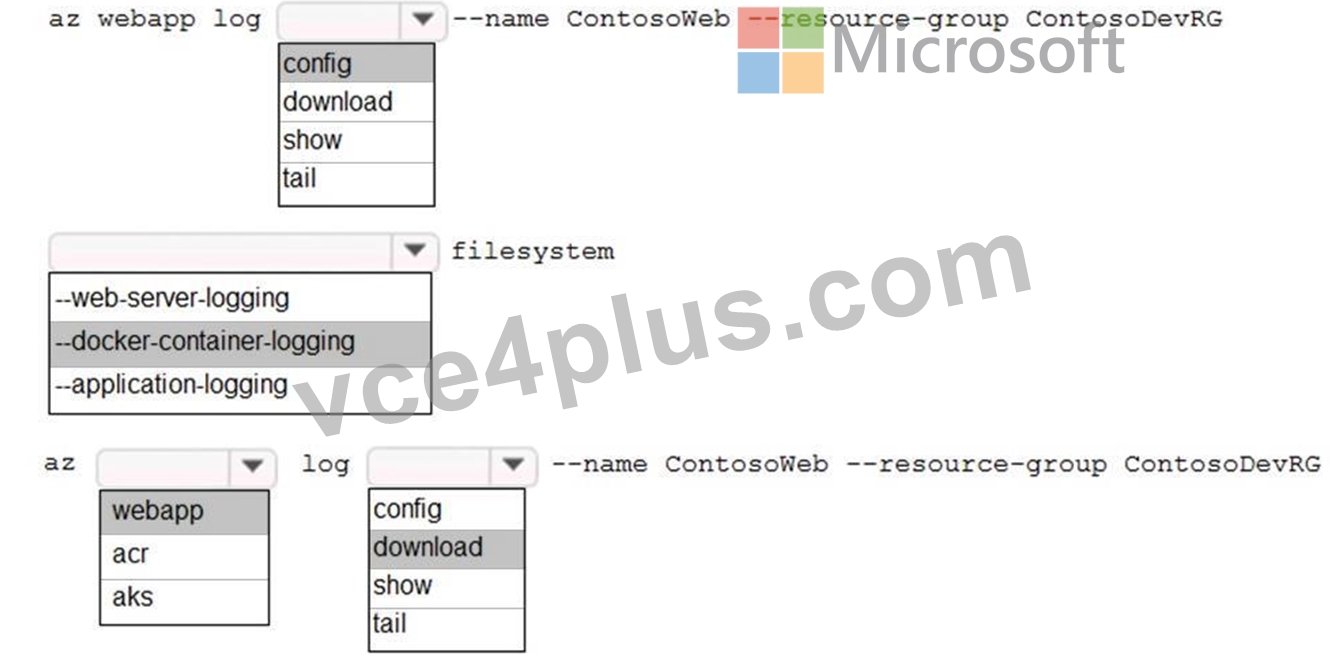
Box 1: config
To Configure logging for a web app use the command:
az webapp log config
Box 2: --docker-container-logging
Syntax include:
az webapp log config [--docker-container-logging {filesystem, off}]
Box 3: webapp
To download a web app's log history as a zip file use the command:
az webapp log download
Box 4: download
References:
https://docs.microsoft.com/en-us/cli/azure/webapp/log
NEW QUESTION 157
You plan to create a Docker image that runs as ASP.NET Core application named ContosoApp. You have a setup script named setupScript.ps1 and a series of application files including ContosoApp.dll.
You need to create a Dockerfile document that meets the following requirements:
* Call setupScript.ps1 when the container is built.
* Run ContosoApp.dll when the container starts.
The Docker document must be created in the same folder where ContosoApp.dll and setupScript.ps1 are stored.
Which four commands should you use to develop the solution? To answer, move the appropriate commands from the list of commands to the answer area and arrange them in the correct order.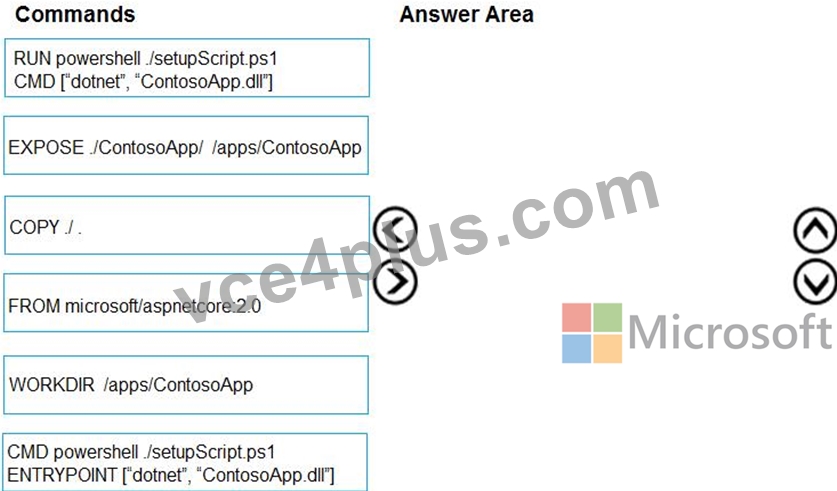
Answer:
Explanation:
1 - WORKDIR /apps/ContosoApp
2 - COPY ./-
3 - EXPOSE ./ContosApp/ /app/ContosoApp
4 - CMD powershell ./setupScript.ps1
References:
https://docs.microsoft.com/en-us/azure/app-service/containers/tutorial-custom-docker-image
NEW QUESTION 158
......
Penetration testers simulate AZ-204 exam: https://www.vce4plus.com/Microsoft/AZ-204-valid-vce-dumps.html
Free Test Engine For Developing Solutions for Microsoft Azure Certification Exams: https://drive.google.com/open?id=1kx3TrtY9qH39FvTkIczSLtlMJSQJztLq