

Updated Aug-2021 Test Engine or PDF for the Microsoft SC-300 test to help you quickly prepare for the Microsoft exam!
Full SC-300 Practice Test and 112 unique questions with explanations waiting just for you, get it now!
NEW QUESTION 15
You have an Azure Active Directory (Azure AD) tenant that contains an administrative unit named Department1.
Department1 has the users shown in the Users exhibit. (Click the Users tab.)
Department1 has the groups shown in the Groups exhibit. (Click the Groups tab.)
Department1 has the user administrator assignments shown in the Assignments exhibit. (Click the Assignments tab.)
The members of Group2 are shown in the Group2 exhibit. (Click the Group2 tab.)
For each of the following statements, select Yes if the statement is true. Otherwise, select No.
NOTE: Each correct selection is worth one point.
Answer:
Explanation:
Reference:
https://docs.microsoft.com/en-us/azure/active-directory/roles/administrative-units
NEW QUESTION 16
You have a Microsoft Exchange organization that uses an SMTP' address space of contoso.com.
Several users use their contoso.com email address for self-service sign up to Azure Active Directory (Azure AD).
You gain global administrator privileges to the Azure AD tenant that contains the self-signed users.
You need to prevent the users from creating user accounts in the contoso.com Azure AD tenant for self-service sign-up to Microsoft 365 services.
Which PowerShell cmdlet should you run?
- A. Set-MsolCompanySettings
- B. Set-MsolCompanySettings
- C. Set-Mso1DomaininFederationSettings
- D. Update-MsolfederateDomain
Answer: A
NEW QUESTION 17
You have an Azure Active Directory (Azure AD) tenant that contains an administrative unit named Department1.
Department1 has the users shown in the Users exhibit. (Click the Users tab.)
Department1 has the groups shown in the Groups exhibit. (Click the Groups tab.)
Department1 has the user administrator assignments shown in the Assignments exhibit. (Click the Assignments tab.)
The members of Group2 are shown in the Group2 exhibit. (Click the Group2 tab.)
For each of the following statements, select Yes if the statement is true. Otherwise, select No.
NOTE: Each correct selection is worth one point.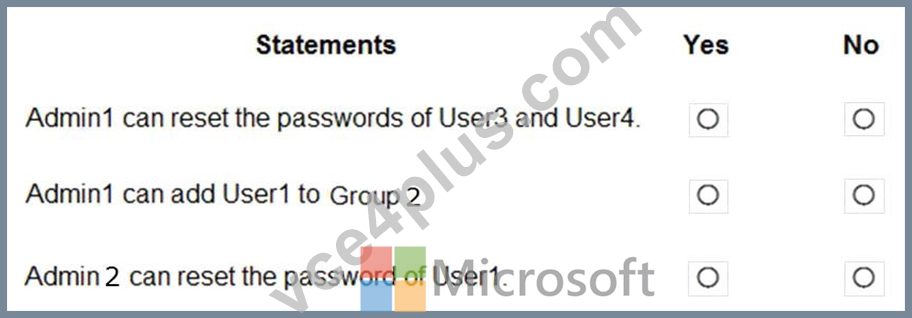
Answer:
Explanation:
Explanation
Reference:
https://docs.microsoft.com/en-us/azure/active-directory/roles/administrative-units
NEW QUESTION 18
You have an Azure Active Directory (Azure AD) tenant that has the default App registrations settings. The tenant contains the users shown in the following table.
You purchase two cloud apps named App1 and App2. The global administrator registers App1 in Azure AD.
You need to identify who can assign users to App1, and who can register App2 in Azure AD.
What should you identify? To answer, select the appropriate options in the answer area.
NOTE: Each correct selection is worth one point.
Answer:
Explanation:
Explanation
Reference:
https://docs.microsoft.com/en-us/azure/active-directory/manage-apps/add-application-portal-assign-users
https://docs.microsoft.com/en-us/azure/active-directory/develop/active-directory-how-applications-are-added
NEW QUESTION 19
You have an on-premises Microsoft Exchange organization that uses an SMTP address space of contoso.com.
You discover that users use their email address for self-service sign-up to Microsoft 365 services.
You need to gain global administrator privileges to the Azure Active Directory (Azure AD) tenant that contains the self-signed users.
Which four actions should you perform in sequence? To answer, move the appropriate actions from the list of actions to the answer area and arrange them in the correct order.
Answer:
Explanation:
1 - Create a self-signed user account in the Azure AD tenant.
2 - Sign in to the Microsoft 365 admin center.
3 - Respond to the Become the admin message.
4 - Create a TXT record in the contoso.com DNS zone.
Reference:
https://docs.microsoft.com/en-us/azure/active-directory/enterprise-users/domains-admin-takeover
NEW QUESTION 20
You need to implement password restrictions to meet the authentication requirements.
You install the Azure AD password Protection DC agent on DC1.
What should you do next? To answer, select the appropriate options in the answer area.
NOTE: Each correct selection is worth one point.
Answer:
Explanation:
NEW QUESTION 21
Your network contains an on-premises Active Directory domain that syncs to an Azure Active Directory (Azure AD) tenant- Users sign in to computers that run Windows 10 and are joined to the domain.
You plan to implement Azure AD Seamless Single Sign-On (Azure AD Seamless SSO).
You need to configure the computers for Azure AD Seamless SSO.
What should you do?
- A. Enable Enterprise State Roaming.
- B. Configure Sign-in options.
- C. Install the Azure AD Connect Authentication Agent.
- D. Modify the Intranet Zone settings.
Answer: B
NEW QUESTION 22
You have an Azure subscription that contains the resources shown in the following table.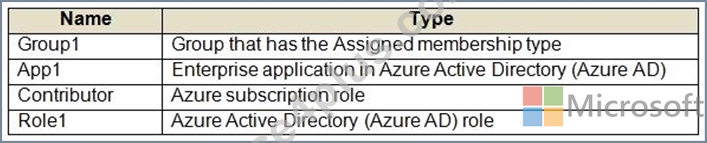
For which resources can you create an access review?
- A. Group1, Role1, and Contributor only
- B. Group1, App1, Contributor, and Role1
- C. Hotel and Contributor only
- D. Group1 only
Answer: B
Explanation:
Access reviews require an Azure AD Premium P2 license.
Access reviews for Group1 and App1 can be configured in Azure AD Access Reviews.
Access reviews for the Contributor role and Role1 would need to be configured in Privileged Identity Management (PIM). PIM is included in Azure AD Premium P2.
Reference:
https://docs.microsoft.com/en-us/azure/active-directory/privileged-identity-management/pim-how-to-start-security-review?toc=/azure/active-directory/governance/toc.json
https://docs.microsoft.com/en-us/azure/active-directory/governance/access-reviews-overview
NEW QUESTION 23
Your company has an Azure Active Directory (Azure AD) tenant named Contoso.com. The company has a business partner named Fabrikam, Inc.
Fabrikam uses Azure AD and has two verified domain names of fabrikam.com and litwarein.com Both domain names are sued for Fabrikam email addresses.
You create a connected organization for Fabrikam.
You need to ensure that the package1 will be accessible only to users who have fabrikam.com email addresses.
What should you do? To answer, select the appropriate options in the answer area.
NOTE: Each correct selection is worth one point.
Answer:
Explanation:
NEW QUESTION 24
You have an Azure Active Directory (Azure AD) tenant that contains the users shown in the following table.
For which users can you configure the Job title property and the Usage location property in Azure AD? To answer, select the appropriate options in the answer area.
NOTE: Each correct selection is worth one point.
Answer:
Explanation:
NEW QUESTION 25
You have 2,500 users who are assigned Microsoft Office 365 Enterprise E3 licenses. The licenses are assigned to individual users.
From the Groups blade in the Azure Active Directory admin center, you assign Microsoft 365 Enterprise E5 licenses to the users.
You need to remove the Office 365 Enterprise E3 licenses from the users by using the least amount of administrative effort.
What should you use?
- A. the Set-AzureAdUser cmdlet
- B. the Licenses blade in the Azure Active Directory admin center
- C. the Identity Governance blade in the Azure Active Directory admin center
- D. the Set-WindowsProductKey cmdlet
Answer: B
NEW QUESTION 26
Your network contains an on-premises Active Directory domain that syncs to an Azure Active Directory (Azure AD) tenant. The tenant contains the users shown in the following table.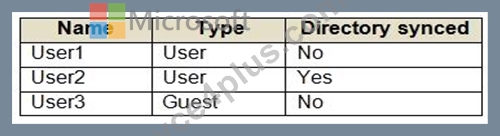
All the users work remotely.
Azure AD Connect is configured in Azure AD as shown in the following exhibit.
Connectivity from the on-premises domain to the internet is lost.
Which users can sign in to Azure AD?
- A. User1 only
- B. User1, User2, and User3
- C. User1 and User3 only
- D. User1 and User2 only
Answer: C
Explanation:
Reference:
https://docs.microsoft.com/en-us/azure/active-directory/hybrid/how-to-connect-pta-current-limitations
NEW QUESTION 27
You have a Microsoft 365 tenant.
All users must use the Microsoft Authenticator app for multi-factor authentication (MFA) when accessing Microsoft 365 services.
Some users report that they received an MFA prompt on their Microsoft Authenticator app without initiating a sign-in request.
You need to block the users automatically when they report an MFA request that they did not Initiate.
Solution: From the Azure portal, you configure the Block/unblock users settings for multi-factor authentication (MFA).
Does this meet the goal?
- A. No
- B. Yes
Answer: B
NEW QUESTION 28
Note: This question is part of a series of questions that present the same scenario. Each question in the series contains a unique solution that might meet the stated goals. Some question sets might have more than one correct solution, while others might not have a correct solution.
After you answer a question in this section, you will NOT be able to return to it. As a result, these questions will not appear in the review screen.
You have a Microsoft 365 tenant.
You have 100 IT administrators who are organized into 10 departments.
You create the access review shown in the exhibit. (Click the Exhibit tab.)
You discover that all access review requests are received by Megan Bowen.
You need to ensure that the manager of each department receives the access reviews of their respective department.
Solution: You add each manager as a fallback reviewer.
Does this meet the goal?
- A. No
- B. Yes
Answer: A
Explanation:
Reference:
https://docs.microsoft.com/en-us/azure/active-directory/governance/create-access-review
NEW QUESTION 29
You have a Microsoft 365 tenant.
You need to identify users who have leaked credentials. The solution must meet the following requirements.
* Identity sign-Ins by users who ate suspected of having leaked credentials.
* Rag the sign-ins as a high risk event.
* Immediately enforce a control to mitigate the risk, while still allowing the user to access applications.
What should you use? To answer, select the appropriate options in the answer area.
NOTE: Each correct selection is worth one point.
Answer:
Explanation:
Topic 2, Litware, Inc
Overview
Litware, Inc. is a pharmaceutical company that has a subsidiary named fabrikam, inc Litware has offices in Boston and Seattle, but has employees located across the United States. Employees connect remotely to either office by using a VPN connection.
Identity Environment
The network contains an Active Directory forest named litware.com that is linked to an Azure Active Directory (Azure AD) tenant named litware.com. Azure AD Connect uses pass-through authentication and has password hash synchronization disabled.
Litware.com contains a user named User1 who oversees all application development. Litware implements Azure AD Application Proxy.
Fabrikam has an Azure AD tenant named fabrikam.com. The users at Fabrikam access the resources in litware.com by using guest accounts in the litware.com tenant.
Cloud Environment
All the users at Litware have Microsoft 365 Enterprise E5 licenses. All the built-in anomaly detection polices in Microsoft Cloud App Security are enabled.
Litware has an Azure subscription associated to the litware.com Azure AD tenant. The subscription contains an Azure Sentinel instance that uses the Azure Active Directory connector and the Office 365 connector.
Azure Sentinel currently collects the Azure AD sign-ins logs and audit logs.
On-premises Environment
The on-premises network contains the severs shown in the following table.
Both Litware offices connect directly to the internet. Both offices connect to virtual networks in the Azure subscription by using a site-to-site VPN connection. All on-premises domain controllers are prevented from accessing the internet.
Delegation Requirements
Litware identifies the following delegation requirements:
* Delegate the management of privileged roles by using Azure AD Privileged Identity Management (PIM).
* Prevent nonprivileged users from registering applications in the litware.com Azure AD tenant-
* Use custom catalogs and custom programs for Identity Governance.
* Ensure that User1 can create enterprise applications in Azure AD. Use the principle of least privilege.
Licensing Requirements
Litware recently added a custom user attribute named LWLicenses to the litware.com Active Directory forest.
Litware wants to manage the assignment of Azure AD licenses by modifying the value of the LWLicenses attribute. Users who have the appropriate value for LWLicenses must be added automatically to Microsoft 365 group that he appropriate license assigned.
Management Requirement
Litware wants to create a group named LWGroup1 will contain all the Azure AD user accounts for Litware but exclude all the Azure AD guest accounts.
Authentication Requirements
Litware identifies the following authentication requirements:
* Implement multi-factor authentication (MFA) for all Litware users.
* Exempt users from using MFA to authenticate to Azure AD from the Boston office of Litware.
* Implement a banned password list for the litware.com forest.
* Enforce MFA when accessing on-premises applications.
* Automatically detect and remediate externally leaked credentials
Access Requirements
Litware wants to create a group named LWGroup1 that will contain all the Azure AD user accounts for Litware but exclude all the Azure AD guest accounts.
Monitoring Requirements
Litware wants to use the Fusion rule in Azure Sentinel to detect multi-staged that include a combination of suspicious Azure AD sign-ins followed by anomalous Microsoft Office 365 activity.
NEW QUESTION 30
You have a Microsoft 365 tenant.
The Azure Active Directory (Azure AD) tenant syncs to an on-premises Active Directory domain. The domain contains the servers shown in the following table.
The domain controllers are prevented from communicating to the internet.
You implement Azure AD Password Protection on Server1 and Server2.
You deploy a new server named Server4 that runs Windows Server 2019.
You need to ensure that Azure AD Password Protection will continue to work if a single server fails.
What should you implement on Server4?
- A. Azure AD Application Proxy
- B. the Azure AD Password Protection proxy service
- C. Password Change Notification Service (PCNS)
- D. Azure AD Connect
Answer: B
Explanation:
Reference:
https://docs.microsoft.com/en-us/azure/active-directory/authentication/howto-password-ban-bad-on-premisesdep
NEW QUESTION 31
You have an Azure Active Directory (Azure AD) tenant named conto.so.com that has Azure AD Identity Protection enabled. You need to Implement a sign-in risk remediation policy without blocking access.
What should you do first?
- A. Configure access reviews in Azure AD.
- B. Configure self-service password reset (SSPR) for all users.
- C. implement multi-factor authentication (MFA) for all users.
- D. Enforce Azure AD Password Protection.
Answer: B
NEW QUESTION 32
You need to implement on-premises application and SharePoint Online restrictions to meet the authentication requirements and the access requirements.
What should you do? To answer, select the appropriate options in the answer area.
NOTE: Each correct selection is worth one point.
Answer:
Explanation:
NEW QUESTION 33
You have a Microsoft 365 tenant.
In Azure Active Directory (Azure AD), you configure the terms of use.
You need to ensure that only users who accept the terms of use can access the resources in the tenant. Other users must be denied access.
What should you configure?
- A. an access policy in Microsoft Cloud App Security.
- B. a compliance policy in Microsoft Endpoint Manager
- C. Terms and conditions in Microsoft Endpoint Manager.
- D. a conditional access policy in Azure AD
Answer: D
Explanation:
Reference:
https://docs.microsoft.com/en-us/azure/active-directory/conditional-access/terms-of-use
NEW QUESTION 34
Your company has an Azure Active Directory (Azure AD) tenant named Contoso.com. The company has a business partner named Fabrikam, Inc.
Fabrikam uses Azure AD and has two verified domain names of fabrikam.com and litwarein.com Both domain names are sued for Fabrikam email addresses.
You create a connected organization for Fabrikam.
You need to ensure that the package1 will be accessible only to users who have fabrikam.com email addresses.
What should you do? To answer, select the appropriate options in the answer area.
NOTE: Each correct selection is worth one point.
Answer:
Explanation:
NEW QUESTION 35
Note: This question is part of a series of questions that present the same scenario. Each question in the series contains a unique solution that might meet the stated goals. Some question sets might have more than one correct solution, while others might not have a correct solution.
After you answer a question in this section, you will NOT be able to return to it. As a result, these questions will not appear in the review screen.
You have an Azure Active Directory (Azure AD) tenant that syncs to an Active Directory forest.
You discover that when a user account is disabled in Active Directory, the disabled user can still authenticate to Azure AD for up to 30 minutes.
You need to ensure that when a user account is disabled in Active Directory, the user account is immediately prevented from authenticating to Azure AD.
Solution: You configure conditional access policies.
Does this meet the goal?
- A. No
- B. Yes
Answer: A
Explanation:
Reference:
https://docs.microsoft.com/en-us/azure/active-directory/hybrid/choose-ad-authn
NEW QUESTION 36
You have a Microsoft 365 tenant.
You configure a conditional access policy as shown in the Conditional Access policy exhibit. (Click the Conditional Access policy tab.)
You view the User administrator role settings as shown in the Role setting details exhibit. (Click the Role setting details tab.)
You view the User administrator role assignments as shown in the Rote assignments exhibit. (Click the Role assignments lab.)
For each of the following statement, select Yes if the statement is true. Otherwise, select No.
NOTE: Each correct selection is worth one point.
Answer:
Explanation:
NEW QUESTION 37
You have an Azure Active Directory (Azure AD) tenant that has multi-factor authentication (MFA) enabled.
The account lockout settings are configured as shown in the following exhibit.
Use the drop-down menus to select the answer choice that completes each statement based on the information presented in the graphic.
NOTE: Each correct selection is worth one point.
Answer:
Explanation:
NEW QUESTION 38
......
Get Latest SC-300 Dumps Exam Questions: https://drive.google.com/open?id=1tgy8SzZo7bruNGPmmzVLjt31j9ytWeAc
Full SC-300 Practice Test and 112 unique questions with explanations waiting just for you, get it now: https://www.vce4plus.com/Microsoft/SC-300-valid-vce-dumps.html