

Updated Aug-2023 Test Engine to Practice JN0-649 Dumps & Practice Exam
Dumps Collection JN0-649 Test Engine Dumps Training With 65 Questions
Juniper JN0-649 (Enterprise Routing and Switching, Professional (JNCIP-ENT)) Certification Exam is designed for IT professionals who specialize in enterprise routing and switching technologies. Enterprise Routing and Switching, Professional (JNCIP-ENT) certification exam validates the knowledge and skills required to design, configure, and troubleshoot Juniper Networks enterprise routing and switching platforms.
Juniper JN0-649 (Enterprise Routing and Switching, Professional (JNCIP-ENT)) certification exam is designed for network engineers or technicians who are experienced in Juniper Networks technology and want to validate their skills and knowledge in enterprise routing and switching. JN0-649 exam covers a broad range of topics, including advanced routing technologies, Ethernet switching, virtualization, and security. The JN0-649 exam is part of the Juniper Networks Certification Program (JNCP) and is a prerequisite for the highest level of Juniper certification, the Juniper Networks Certified Internet Expert (JNCIE-ENT).
NEW QUESTION # 19
What are three well-known mandatory BGP attributes? (Choose three.)
- A. next-hop
- B. AS-path
- C. origin
- D. community
- E. MED
Answer: A,B,C
NEW QUESTION # 20
You configured static mode power management on an EX4300 to provide PoE power to telephone and access point equipment.
Which statement is correct regarding the PoE power budget?
- A. The power budgeted to ports will adjust to how much power a device actually uses.
- B. Power is budgeted to a port even if no device is connected to the port.
- C. The power budgeted will be based on the device class connected to each port.
- D. Power is budgeted to devices on a first come, first served basis as devices are connected.
Answer: B
NEW QUESTION # 21
Referring to the exhibit, which TTL value will be sent to the LLDP neighbors?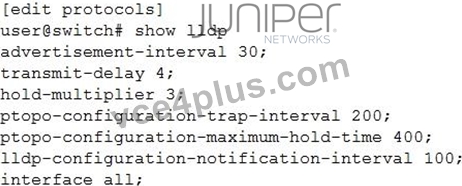
- A. 90 seconds
- B. 200 seconds
- C. 400 seconds
- D. 120 seconds
Answer: D
NEW QUESTION # 22
Which three MSTP parameters must match on all switches in the same MST region? (Choose three.)
- A. revision number
- B. MSTI-to-VLAN mapping
- C. bridge priority
- D. configuration name
- E. forwarding delay
Answer: A,B,D
Explanation:
https://www.juniper.net/documentation/us/en/software/junos/stp-l2/topics/topic-map/spanning-tree-configuring-mstp.html
NEW QUESTION # 23
Packets enter a Juniper device and are classified as best effort. During the processing of the packet, the classification of the packets is changed to expedited forwarding by a multi-field classifier. The device is using the default CoS policies Which statement is true in this scenario?
- A. The packet is forwarded according to the new packet classification, and the DSCP bits do not change.
- B. The packet is forwarded according to the original packet classification, and the DSCP bits are rewritten to the new class.
- C. The packet is forwarded according to the original packet classification, and the DSCP bits do not change.
- D. The packet is forwarded according to the new packet classification, and the DSCP bits are rewritten to the new class.
Answer: A
NEW QUESTION # 24
You are configuring MVRP for automatic VLAN registration. Which two statements are true?
(Choose two.)
- A. MVRP must be configured on all access ports
- B. the trunk port must not be configured with vlan members
- C. the trunk port must be configured with "vlan all"
- D. MVRP must be configured on all trunk ports
Answer: B,D
NEW QUESTION # 25
You recently implemented the configurations shown in the exhibit. After committing these changes, the community devices connected to AS-1 are not able to communication with the appropriate community devices connected to AS-2.
What must be to allow these community devices to communicate?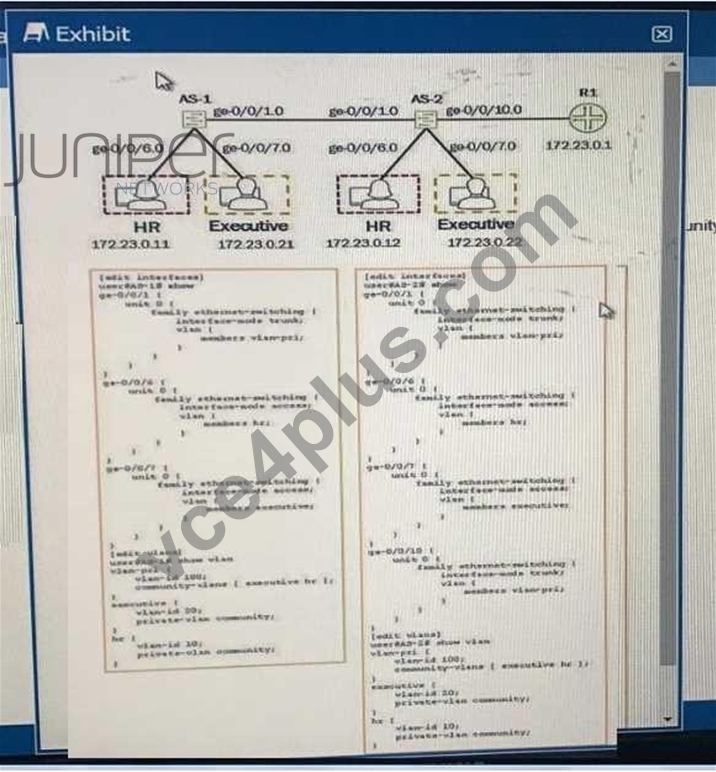
- A. You must configure an isolation VLAN ID under the vlan-pri VLAN on both switches.
- B. You must configure to allow the ge-0/0/1 interface on AS-1 as the inter-switch.
- C. You must configure the ge-0/0/10 interface on AS-1 as the inter-switch link.
- D. You must configure the ge-0/0/1 interface on both switches the inter-switch links.
- E. You must configure an isolation VLAN ID under the vlan-pri vlan on the AS-2 switch.
Answer: D
NEW QUESTION # 26
You are asked to establish interface level authentication for users connecting to your network. You must ensure that only corporate devices, identified by MAC addresses, are allowed to connect and authenticate. Authentication must be handled by a centralized server to increase scalability.
Which authentication method would satisfy this requirement?
- A. captive portal
- B. MAC RADIUS
- C. 802.1X with multiple supplicant mode
- D. 802.1X with single-secure supplicant mode
Answer: B
Explanation:
https://www.juniper.net/documentation/us/en/software/junos/user-access/topics/topic-map/mac-radius-authentication-switching-devices.html You can configure MAC RADIUS authentication on an interface that also allows 802.1X authentication, or you can configure either authentication method alone.
If both MAC RADIUS and 802.1X authentication are enabled on the interface, the switch first sends the host three EAPoL requests to the host. If there is no response from the host, the switch sends the host's MAC address to the RADIUS server to check whether it is a permitted MAC address. If the MAC address is configured as permitted on the RADIUS server, the RADIUS server sends a message to the switch that the MAC address is a permitted address, and the switch opens LAN access to the nonresponsive host on the interface to which it is connected.
NEW QUESTION # 27
You are asked to merge a RIP network with your OSPF network. As a first step, you establish connectivity between the RIP network and the OSPF network. The RIP network connects to an NSSA area. Which two statements are true in this scenario? (Choose two.)
- A. To share RIP routes with the OSPF network, an export policy will be required on the ASBR.
- B. Be default, RIP routes have a higher route preference than external OSPF routes.
- C. By default, external OSPF routes have a higher route preference than RIP routes.
- D. To share RIP routes with the OSPF network, an export policy will be required on the ABR.
Answer: A,C
Explanation:
Route Preference Values
OSPF Internal = 10
RIP = 100
OSPF External = 150
NEW QUESTION # 28
Which statement is correct about MSTP?
- A. MSTP enables dynamic discovery of Layer 2 neighbors.
- B. MSTP dynamically manages VLAN registration in a LAN.
- C. MSTP enables mapping multiple independent spanning-tree instances onto one physical topology.
- D. MSTP uses stacked VLAN tags to extend a Layer 2 Ethernet connection between multiple sites.
Answer: C
NEW QUESTION # 29
Your network is multihomed to two ISPs. The BGP sessions are established; however, the ISP peers are not receiving any routes.
Which two statements are correct about troubleshooting your configuration? (Choose two.)
- A. Verity that the multihop settings are configured on your router.
- B. Verify the import policies on your router.
- C. Verify the export policies on your router.
- D. Verify that the BGP routes are active in your routing table.
Answer: A,C
NEW QUESTION # 30
Remote branches connect to the corporate WAN through access switches. The access switches connect to access ports on the WAN distribution switch, as shown in the exhibit. L2PT has previously been configured on the tunnel Layer 2 traffic across the WAN. You decide to move the L2PT tunnel endpoints to the access switches. When you apply the L2PT configuration to the access switches, the ports that connect the access switches to the distribution switch shut down.
Which action would solve this problem?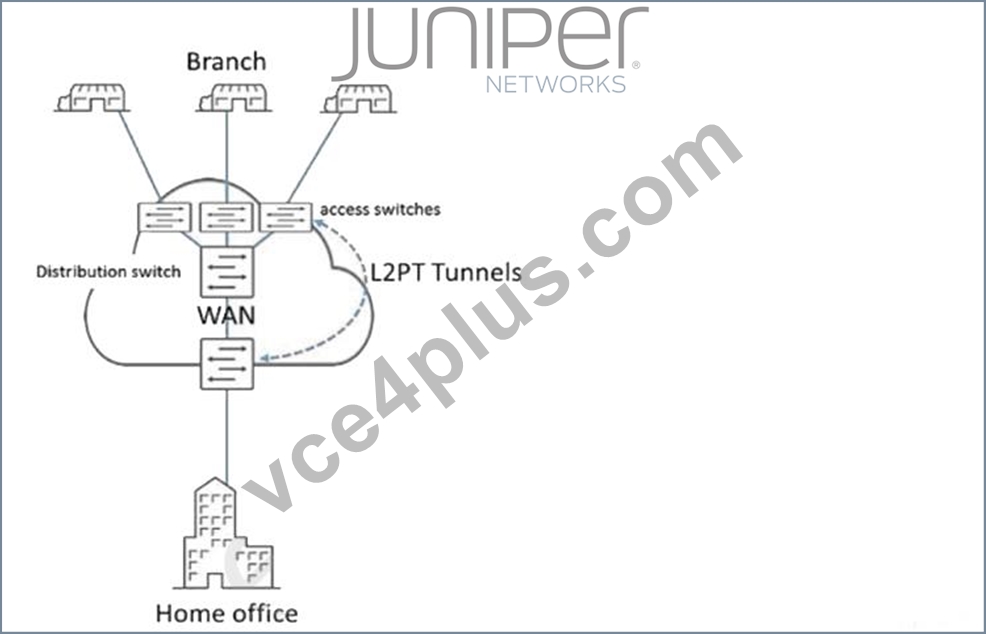
- A. Configure a GRE tunnel to encapsulate the L2PT traffic across the WAN.
- B. Configure the links between the access switches and the distribution switch as a trunk port.
- C. Disable the BPDU block function on the distribution switch.
- D. Disable the BPDU block function on the access switches.
Answer: B
Explanation:
Access interfaces in an L2PT-enabled VLAN should not receive L2PT-tunneled PDUs. If an access interface does receive L2PT-tunneled PDUs, there might be a loop in the network, and the device will shut down the interface. https://www.juniper.net/documentation/us/en/software/junos/multicast-l2/topics/topic-map/layer-2-protocol-tunneling.html
NEW QUESTION # 31
Click the exhibit.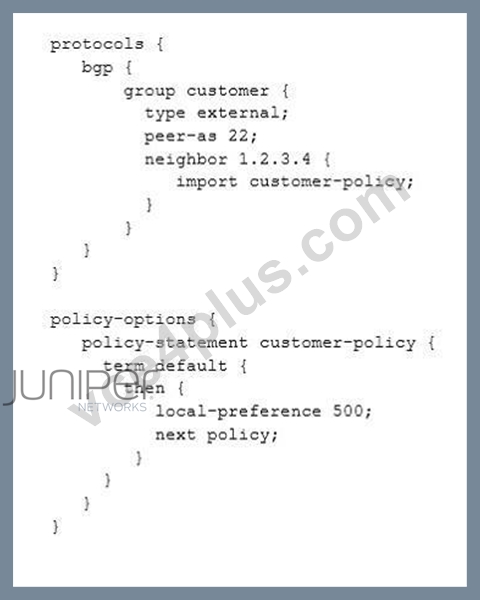
Where is the policy shown in the exhibit enforced?
- A. Between the RIB-LOCAL and the RIB-OUT tables
- B. Between the RIB-IN and the RIB-LOCAL tables
- C. Between the BGP peer and the RIB-In table
- D. Between the RIB-OUT table and the BGP peer
Answer: B
NEW QUESTION # 32
A user is attempting to watch a high-definition video being streamed from the media server over the network. However, the user complains that the experienced video quality is poor. While logged on to router B, a Juniper Networks device, you notice that video packets are being dropped.
In this scenario, what would solve this problem?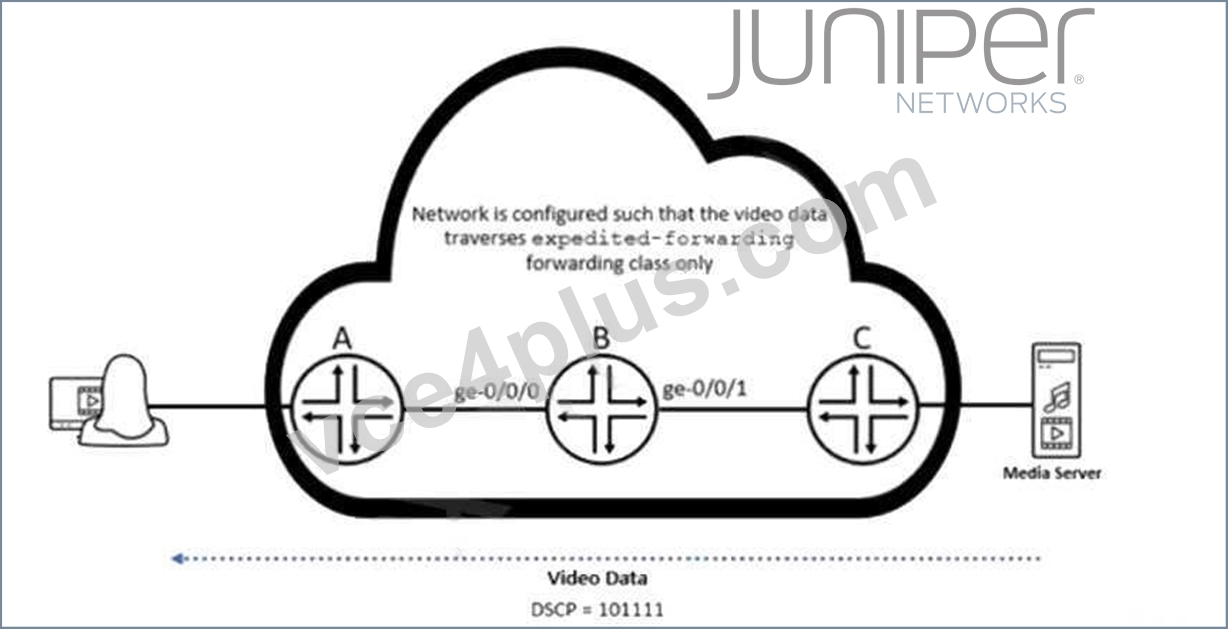
- A. Adjust the expedited-forwarding BA classifier to router B's ge-0/0/0 interface to support a higher transmit rate.
- B. Adjust the expedited-forwarding BA classifier on router B's ge-0/0/1 interface to support a higher transmit rate.
- C. Adjust the scheduler-map to support a higher transmit rate.
- D. Adjust the scheduler for the expedited-forwarding forwarding class to support a higher transmit rate.
Answer: B
NEW QUESTION # 33
Referring to the exhibit, which statement is correct?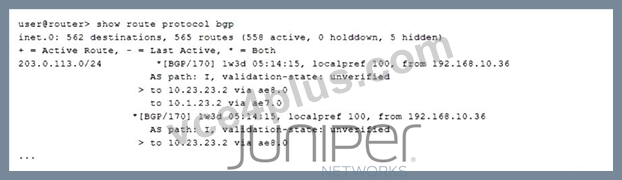
- A. The route is learned from three different neighbors.
- B. The route is learned from only one neighbor.
- C. The route is learned from a multihop BGP session.
- D. The route is learned from a multipath BGP session.
Answer: B
NEW QUESTION # 34
You recently committed a change to a router to reject OSPF routes sourced from area 10. However, you are still seeing area 10 routes in the routing table.
Referring to the exhibit, which statement is correct?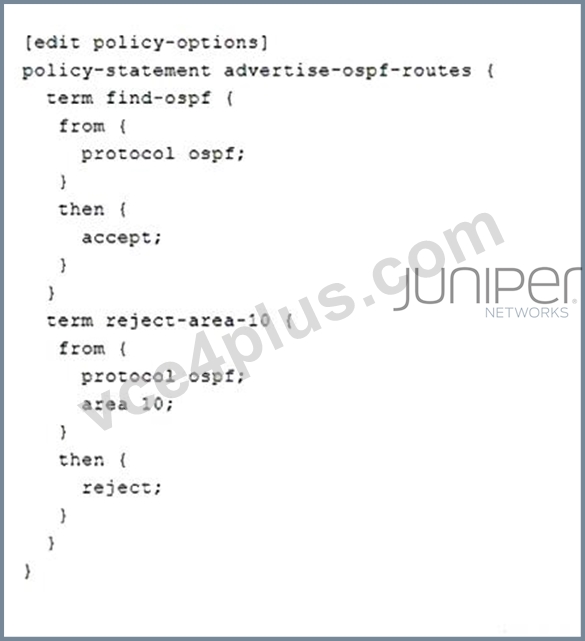
- A. The routes only timeout after 24 hours.
- B. The OSPF protocol is first matched by find-ospf and accepted.
- C. The routes remain in the table until the device is rebooted.
- D. The routes remain in the table until the routing daemon is restarted.
Answer: B
Explanation:
Once a route is accepted, no other terms in the routing policy are evaluated.
NEW QUESTION # 35
Referring to the exhibit, which two statements are correct? (Choose two.)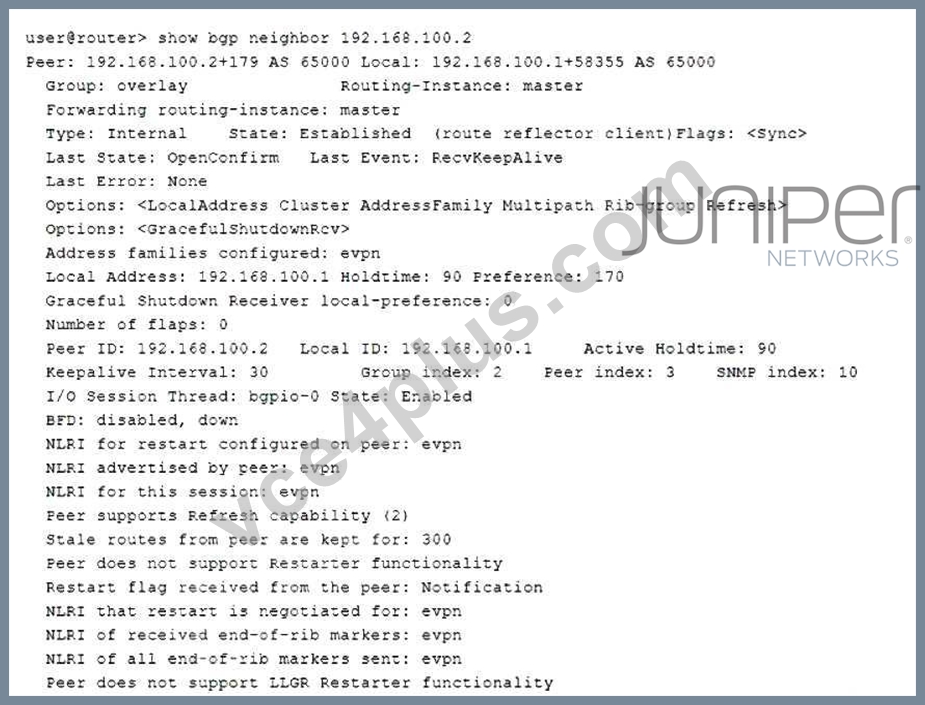
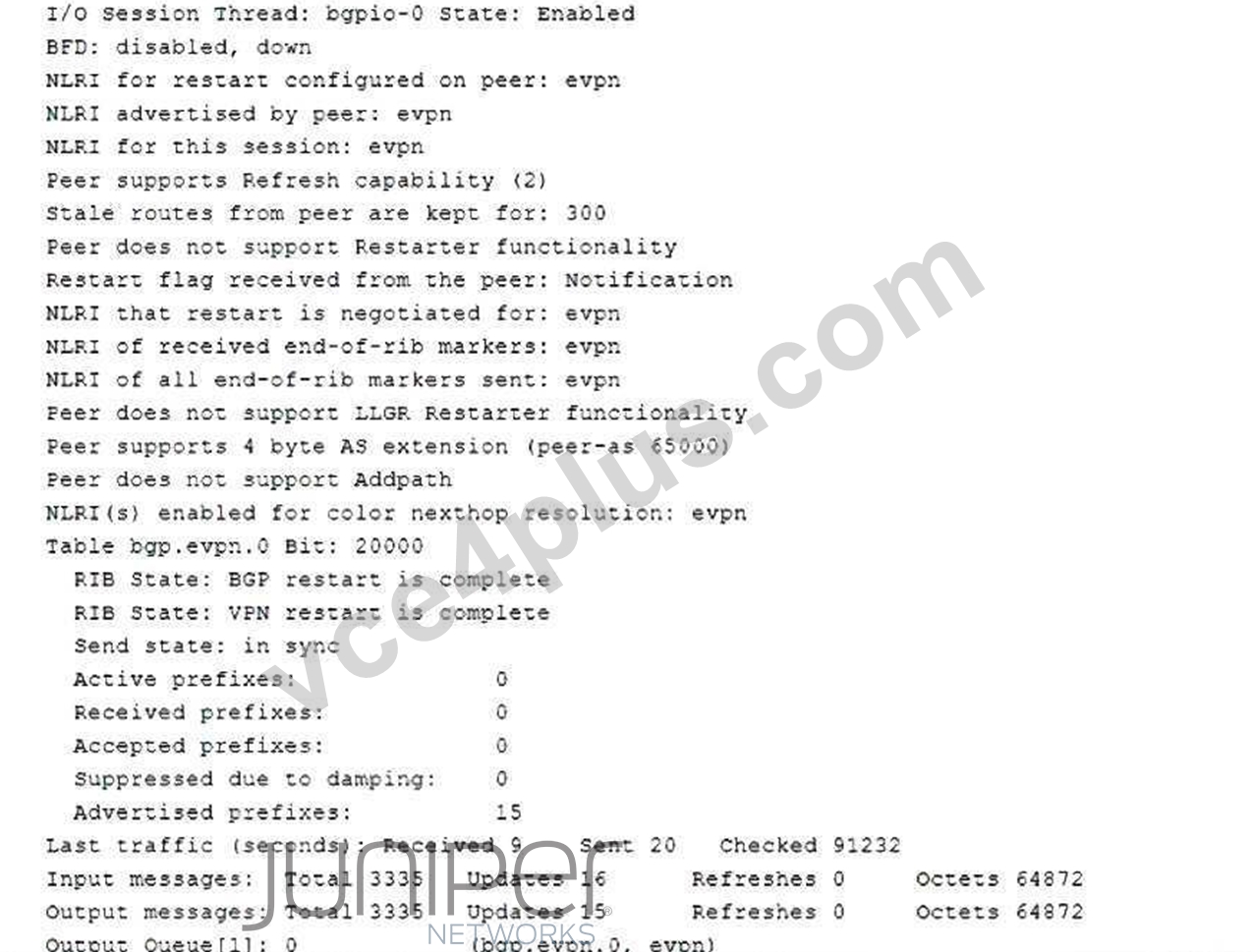
- A. The BGP neighbor can advertise L3 VPN related routes.
- B. The BGP neighbor can advertise EVPN related routes.
- C. The BGP neighbor cannot advertise EVPN related routes.
- D. The BGP neighbor cannot advertise L3 VPN related routes.
Answer: A,B
NEW QUESTION # 36
You have multiple BGP routes to the same prefix with equal local-preference values and AS-path lengths.
In this scenario, which route will be preferred in the route selection process?
- A. The route with the least preferred origin value.
- B. The route with the lowest MED value.
- C. The route with the most preferred origin value.
- D. The route with the highest MED value.
Answer: C
Explanation:
https://www.juniper.net/documentation/en_US/junos/topics/reference/general/routing-protocols- address-representation.html
NEW QUESTION # 37
Which address range is used for source-specific multicast?
- A. 232.0.0.0/8
- B. 239.0.0.0/8
- C. 233.0.0.0/8
- D. 224.2.0.0/16
Answer: A
NEW QUESTION # 38
Referring to the log shown in the exhibit, what is the problem with the OSPF adjacency establishment?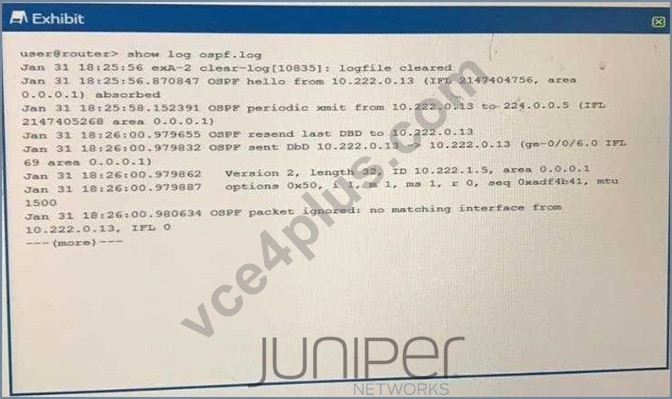
- A. The referenced IP address does not exist on the network segment.
- B. There is an MDS authentication mismatch.
- C. The OSPF database description packet is malformed.
- D. The interface IP addresses on the subnet are duplicates.
Answer: D
NEW QUESTION # 39
A customer requires that the switch responds to an ARP request only if the source and target IP address are on different subnets.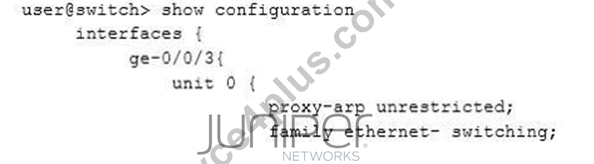
Referring to the Exhibit, how would you accomplish this task?
- A. Create a static ARP entry for the host.
- B. Enable the no-gratuitous-arp request command under the interface hierarchy.
- C. Change the proxy ARP parameter setting to restricted.
- D. Remove the proxy ARP setting and clear the entry.
Answer: C
NEW QUESTION # 40
Which statement is correct about CoS policers on Junos devices?
- A. A policer can assign in-profile traffic to a specific forwarding class.
- B. Policers can be configured to buffer traffic that exceeds the policer's traffic profile.
- C. A policer does not alter in-profile traffic.
- D. Traffic that exceeds a policer's traffic profile can be dropped or assigned to a specific drop profile.
Answer: D
NEW QUESTION # 41
......
The JNCIP-ENT certification is valuable for network engineers, administrators, and architects who want to validate their advanced knowledge and abilities in enterprise routing and switching technologies using Juniper's advanced networking products. Juniper certifications help professionals stay updated with the latest technologies and best practices, reaffirming their capabilities, and boosting their professional credibility.
Juniper JN0-649 Dumps Cover Real Exam Questions: https://www.vce4plus.com/Juniper/JN0-649-valid-vce-dumps.html
Real JN0-649 dumps - Real Juniper dumps PDF: https://drive.google.com/open?id=1EsTQWggqLYUYOyz-2ohwEUQcnU_XK-vj