

Verified DP-300 Q&As - Pass Guarantee DP-300 Exam Dumps
Check the Free demo of our DP-300 Exam Dumps with 271 Questions
Microsoft DP-300 exam has become increasingly popular among database administrators due to the growing demand for cloud-based database solutions. As more businesses move their data to the cloud, the need for skilled professionals who can administer and maintain these databases has increased. Administering Relational Databases on Microsoft Azure certification provides a competitive edge to professionals who are looking to advance their careers in the field of database administration.
NEW QUESTION # 76
You are planning the migration of the SERVER1 databases. The solution must meet the business requirements.
What should you include in the migration plan? To answer, select the appropriate options in the answer area.
NOTE: Each correct selection is worth one point.
Answer:
Explanation:
Explanation
Azure Database Migration service
Box 1: Premium 4-VCore
Scenario: Migrate the SERVER1 databases to the Azure SQL Database platform.
* Minimize downtime during the migration of the SERVER1 databases.
Premimum 4-vCore is for large or business critical workloads. It supports online migrations, offline migrations, and faster migration speeds.
Reference:
https://azure.microsoft.com/pricing/details/database-migration/
https://docs.microsoft.com/en-us/azure/dms/tutorial-sql-server-azure-sql-online
NEW QUESTION # 77
You are evaluating the role assignments.
For each of the following statements, select Yes if the statement is true. Otherwise, select No.
NOTE: Each correct selection is worth one point.
Answer:
Explanation: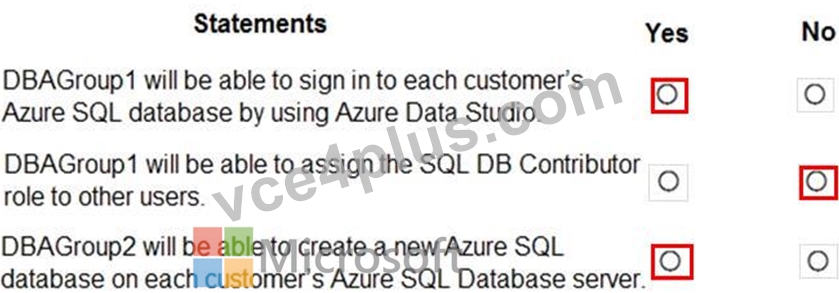
Reference:
https://docs.microsoft.com/en-us/azure/role-based-access-control/built-in-roles
NEW QUESTION # 78
You have an Azure Synapse Analytics dedicated SQL pool named Pool1 and an Azure Data Lake Storage Gen2 account named Account1.
You plan to access the files in Account1 by using an external table.
You need to create a data source in Pool1 that you can reference when you create the external table.
How should you complete the Transact-SQL statement? To answer, select the appropriate options in the answer area.
NOTE: Each correct selection is worth one point.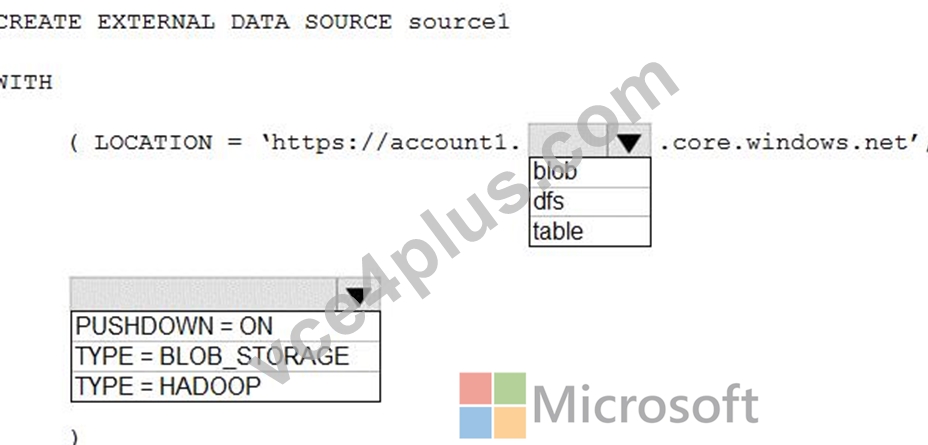
Answer:
Explanation:
Reference:
https://docs.microsoft.com/en-us/azure/synapse-analytics/sql/develop-tables-external-tables
NEW QUESTION # 79
You have an Azure SQL database.
You need to identify whether a delayed query execution is associated to a RESOURCE wait.
How should you complete the Transact -SQL statement? To answer, select the appropriate option in the answer area.
NOTE: Each correct selection is worth one point.
Answer:
Explanation:
Explanation
NEW QUESTION # 80
DRAG DROP
You have SQL Server 2019 on an Azure virtual machine that contains an SSISDB database.
A recent failure causes the master database to be lost.
You discover that all Microsoft SQL Server integration Services (SSIS) packages fail to run on the virtual
machine.
Which four actions should you perform in sequence to resolve the issue? To answer, move the appropriate
actions from the list of actions to the answer area and arrange them in the correct.
Select and Place:
Answer:
Explanation:
Section: [none]
Explanation:
Step 1: Attach the SSISDB database
Step 2: Turn on the TRUSTWORTHY property and the CLR property
If you are restoring the SSISDB database to an SQL Server instance where the SSISDB catalog was never
created, enable common language runtime (clr)
Step 3: Open the master key for the SSISDB database
Restore the master key by this method if you have the original password that was used to create SSISDB.
open master key decryption by password = 'LS1Setup!' --'Password used when creating SSISDB'
Alter Master Key Add encryption by Service Master Key
Step 4: Encrypt a copy of the mater key by using the service master key
Reference:
https://docs.microsoft.com/en-us/sql/integration-services/backup-restore-and-move-the-ssis-catalog
NEW QUESTION # 81
You have an Azure subscription that contains an Azure SQL database.
The database fails to respond to queries in a timely manner.
You need to identify whether the issue relates to resource_semaphore waits.
How should you complete the Transact-SQL query? To answer, select the appropriate options in the answer area.
NOTE: Each correct selection is worth one point.
Answer:
Explanation:
Explanation
Graphical user interface, text, application Description automatically generated
Reference:
https://docs.microsoft.com/en-us/azure/azure-sql/database/monitoring-with-dmvs
NEW QUESTION # 82
You have a new Azure SQL database named DB1 on an Azure SQL server named AzSQL1.
The only user who was created is the server administrator.
You need to create a contained database user in DB1 who will use Azure Active Directory (Azure AD) for authentication.
Which three actions should you perform in sequence? To answer, move the appropriate actions from the list of actions to the answer area and arrange them in the correct order.
Answer:
Explanation:
1 - Set up the Active Directory Admin for AzSQL1.
2 - Connect to DB1 by using the server administrator.
3 - Create a user by using the FROM EXTERNAL PROVIDER clause.
Reference:
https://docs.microsoft.com/en-us/sql/t-sql/statements/create-user-transact-sql
NEW QUESTION # 83
You need to identify the cause of the performance issues on SalesSQLDb1.
Which two dynamic management views should you use? Each correct answer presents part of the solution.
NOTE: Each correct selection is worth one point.
- A. sys.dm_exec_compute_node_errors
- B. sys.dm_cdc_errors
- C. sys.dm_exec_requests
- D. sys.dm_pdw_nodes_tran_locks
- E. sys.dm_pdw_nodes_os_wait_stats
- F. sys.dm_tran_locks
Answer: D,E
Explanation:
Section: [none]
Explanation:
SalesSQLDb1 experiences performance issues that are likely due to out-of-date statistics and frequent blocking queries.
A: Use sys.dm_pdw_nodes_tran_locks instead of sys.dm_tran_locks from Azure Synapse Analytics (SQL Data Warehouse) or Parallel Data Warehouse.
E: Example:
The following query will show blocking information.
SELECT
t1.resource_type,
t1.resource_database_id,
t1.resource_associated_entity_id,
t1.request_mode,
t1.request_session_id,
t2.blocking_session_id
FROM sys.dm_tran_locks as t1
INNER JOIN sys.dm_os_waiting_tasks as t2
ON t1.lock_owner_address = t2.resource_address;
Note: Depending on the system you're working with you can access these wait statistics from one of three locations:
sys.dm_os_wait_stats: for SQL Server
sys.dm_db_wait_stats: for Azure SQL Database
sys.dm_pdw_nodes_os_wait_stats: for Azure SQL Data Warehouse
Incorrect Answers:
F: sys.dm_tran_locks returns information about currently active lock manager resources in SQL Server 2019 (15.x). Each row represents a currently active request to the lock manager for a lock that has been granted or is waiting to be granted.
Instead use sys.dm_pdw_nodes_tran_locks.
Reference:
https://docs.microsoft.com/en-us/sql/relational-databases/system-dynamic-management-views/sys-dm-tran- locks-transact-sql Question Set 2
NEW QUESTION # 84
You need to implement statistics maintenance for SalesSQLDb1. The solution must meet the technical requirements.
Which four actions should you perform in sequence? To answer, move the appropriate actions from the list of actions to the answer area and arrange them in the correct order.
Answer:
Explanation:
1 - Create an Azure Automation account.
2 - Import the SqlServer module.
3 - Create a runbook that runs a PowerShell script.
4 - Create and configure a schedule.
Reference:
https://techcommunity.microsoft.com/t5/azure-database-support-blog/automating-azure-sql-db-index-and-statistics-maintenance-using/ba-p/368974
NEW QUESTION # 85
You have the following Azure Resource Manager template.
For each of the following statements, select Yes if the statement is true. Otherwise, select No.
NOTE: Each correct selection is worth one point.
Answer:
Explanation:
Explanation
A screenshot of a computer Description automatically generated with low confidence
Reference:
https://docs.microsoft.com/en-us/azure/azure-sql/database/purchasing-models
https://docs.microsoft.com/en-us/azure/azure-sql/database/single-database-create-arm-template-quickstart
NEW QUESTION # 86
Your company analyzes images from security cameras and sends alerts to security teams that respond to unusual activity. The solution uses Azure Databricks.
You need to send Apache Spark level events, Spark Structured Streaming metrics, and application metrics to Azure Monitor.
Which three actions should you perform in sequence? To answer, move the appropriate actions from the list of actions in the answer area and arrange them in the correct order.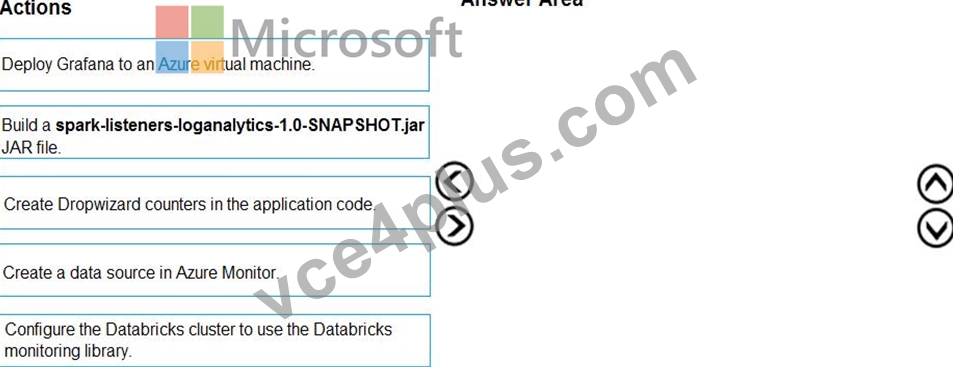
Answer:
Explanation:
1 - Configure your Azure Databricks cluster to use the Databricksmonitoring library.
2 - Build the spark-listeners-loganalytics-1.0-SNAPSHOT.jar JAR file
3 - Create Dropwizard counters in your application code
NEW QUESTION # 87
You have a new Azure SQL database. The database contains a column that stores confidential information.
You need to track each time values from the column are returned in a query. The tracking information must be stored for 365 days from the date the query was executed.
Which three actions should you perform? Each correct answer presents part of the solution.
NOTE: Each correct selection is worth one point.
- A. Turn on auditing and write audit logs to an Azure Storage account.
- B. Turn on Advanced Data Security for the Azure SQL server.
- C. Add extended properties to the column.
- D. Turn on Azure Advanced Threat Protection (ATP).
- E. Apply sensitivity labels named Highly Confidential to the column.
Answer: A,B,E
Explanation:
Explanation
C: Advanced Data Security (ADS) is a unified package for advanced SQL security capabilities. ADS is available for Azure SQL Database, Azure SQL Managed Instance, and Azure Synapse Analytics. It includes functionality for discovering and classifying sensitive data D: You can apply sensitivity-classification labels persistently to columns by using new metadata attributes that have been added to the SQL Server database engine. This metadata can then be used for advanced, sensitivity-based auditing and protection scenarios.
A: An important aspect of the information-protection paradigm is the ability to monitor access to sensitive data. Azure SQL Auditing has been enhanced to include a new field in the audit log called data_sensitivity_information. This field logs the sensitivity classifications (labels) of the data that was returned by a query. Here's an example:
Reference:
https://docs.microsoft.com/en-us/azure/azure-sql/database/data-discovery-and-classification-overview
NEW QUESTION # 88
You have an Azure Synapse Analytics workspace named WS1 that contains an Apache Spark pool named Pool1.
You plan to create a database named DB1 in Pool1.
You need to ensure that when tables are created in DB1, the tables are available automatically as external tables to the built-in serverless SQL pool.
Which format should you use for the tables in DB1?
- A. JSON
- B. CSV
- C. ORC
- D. Parquet
Answer: D
Explanation:
Section: [none]
Explanation:
Serverless SQL pool can automatically synchronize metadata from Apache Spark. A serverless SQL pool database will be created for each database existing in serverless Apache Spark pools.
For each Spark external table based on Parquet and located in Azure Storage, an external table is created in a serverless SQL pool database. As such, you can shut down your Spark pools and still query Spark external tables from serverless SQL pool.
Reference:
https://docs.microsoft.com/en-us/azure/synapse-analytics/sql/develop-storage-files-spark-tables
NEW QUESTION # 89
You have a version-8.0 Azure Database for MySQL database.
You need to identify which database queries consume the most resources.
Which tool should you use?
- A. Metrics
- B. Alerts
- C. Query Store
- D. Query Performance Insight
Answer: C
Explanation:
The Query Store feature in Azure Database for MySQL provides a way to track query performance over time.
Query Store simplifies performance troubleshooting by helping you quickly find the longest running and most resource-intensive queries. Query Store automatically captures a history of queries and runtime statistics, and it retains them for your review. It separates data by time windows so that you can see database usage patterns.
Data for all users, databases, and queries is stored in the mysql schema database in the Azure Database for MySQL instance.
Reference:
https://docs.microsoft.com/en-us/azure/mysql/concepts-query-store
NEW QUESTION # 90
You have a Microsoft SQL Server 2019 database named DB1 that uses the following database-level and instance-level features.
Clustered columnstore indexes
Automatic tuning
Change tracking
PolyBase
You plan to migrate DB1 to an Azure SQL database.
What feature should be removed or replaced before DB1 can be migrated?
- A. Change tracking
- B. Clustered columnstore indexes
- C. PolyBase
- D. Automatic tuning
Answer: C
Explanation:
This table lists the key features for PolyBase and the products in which they're available.
Reference:
https://docs.microsoft.com/en-us/sql/relational-databases/polybase/polybase-versioned-feature-summary
NEW QUESTION # 91
You need to implement the monitoring of SalesSQLDb1. The solution must meet the technical requirements.
How should you collect and stream metrics? To answer, select the appropriate options in the answer area.
NOTE: Each correct selection is worth one point.
Answer:
Explanation:
NEW QUESTION # 92
You have an Azure SQL Database server named sqlsrv1 that hosts 10 Azure SQL databases.
The databases perform slower than expected.
You need to identify whether the performance issue relates to the use of tempdb on sqlsrv1.
What should you do?
- A. Run Query Store-based queries
- B. Run dynamic management view-based queries
- C. Review information provided by Query Performance Insight
- D. Review information provided by SQL Server Profiler-based traces
Answer: B
Explanation:
Explanation
The diagnostics log outputs tempDB contention details. You can use the information as the starting point for troubleshooting.
You can use the Intelligent Insights performance diagnostics log of Azure SQL Database to troubleshoot performance issues.
Reference:
https://docs.microsoft.com/en-us/azure/azure-sql/database/intelligent-insights-troubleshoot-performance#tempdb
https://docs.microsoft.com/en-us/azure/azure-sql/database/intelligent-insights-use-diagnostics-log
NEW QUESTION # 93
You have an Azure SQL database.
You identify a long running query.
You need to identify which operation in the query is causing the performance issue.
What should you use to display the query execution plan in Microsoft SQL Server Management Studio
(SSMS)?
- A. an actual execution plan
- B. an estimated execution plan
- C. Live Query Statistics
- D. Client Statistics
Answer: A
Explanation:
Section: [none]
Explanation:
To include an execution plan for a query during execution
1. On the SQL Server Management Studio toolbar, click Database Engine Query. You can also open an
existing query and display the estimated execution plan by clicking the Open File toolbar button and locating the
existing query.
2. Enter the query for which you would like to display the actual execution plan.
3. On the Query menu, click Include Actual Execution Plan or click the Include Actual Execution Plan toolbar
button.
Note: Actual execution plans are generated after the Transact-SQL queries or batches execute. Because of
this, an actual execution plan contains runtime information, such as actual resource usage metrics and runtime
warnings (if any). The execution plan that is generated displays the actual query execution plan that the SQL
Server Database Engine used to execute the queries.
Reference:
https://docs.microsoft.com/en-us/sql/relational-databases/performance/display-an-actual-execution-plan
NEW QUESTION # 94
You plan to move two 100-GB databases to Azure.
You need to dynamically scale resources consumption based on workloads. The solution must minimize downtime during scaling operations.
What should you use?
- A. two databases hosted in SQL Server on an Azure virtual machine
- B. two single Azure SQL databases
- C. two databases in an Azure SQL Managed instance
- D. two Azure SQL Databases in an elastic pool
Answer: D
Explanation:
Azure SQL Database elastic pools are a simple, cost-effective solution for managing and scaling multiple databases that have varying and unpredictable usage demands. The databases in an elastic pool are on a single server and share a set number of resources at a set price.
Reference:
https://docs.microsoft.com/en-us/azure/azure-sql/database/elastic-pool-overview
NEW QUESTION # 95
You configure backup for an Azure SQL database as shown in the following exhibit.
Use the drop-down menus to select the answer choice the completes each statement based on the information presented in the graphic.
NOTE: Each correct selection is worth one point.
Answer:
Explanation:
Explanation
NEW QUESTION # 96
You have an on-premises Microsoft SQL server that uses the FileTables and Filestream features.
You plan to migrate to Azure SQL.
Which service should you use?
- A. Azure SQL Managed Instance
- B. SQL Server on an Azure Virtual Machine
- C. Azure SQL Database
- D. Azure Database for MySQL
Answer: B
Explanation:
Reference:
https://docs.microsoft.com/en-us/azure/azure-sql/migration-guides/database/sql-server-to-sql-database-overview
NEW QUESTION # 97
You are designing a dimension table in an Azure Synapse Analytics dedicated SQL pool.
You need to create a surrogate key for the table. The solution must provide the fastest query performance.
What should you use for the surrogate key?
- A. a sequence object
- B. a GUID column
- C. an IDENTITY column
Answer: C
Explanation:
Section: [none]
Explanation:
Dedicated SQL pool supports many, but not all, of the table features offered by other databases.
Surrogate keys are not supported. Implement it with an Identity column.
Reference:
https://docs.microsoft.com/en-us/azure/synapse-analytics/sql-data-warehouse/sql-data-warehouse-tables- overview
NEW QUESTION # 98
You have an Azure Data Lake Storage Gen2 account named account1 that stores logs as shown in the following table.
You do not expect that the logs will be accessed during the retention periods.
You need to recommend a solution for account1 that meets the following requirements:
Automatically deletes the logs at the end of each retention period
Minimizes storage costs
What should you include in the recommendation? To answer, select the appropriate options in the answer area.
NOTE: Each correct selection is worth one point.
Answer:
Explanation:
Reference:
https://docs.microsoft.com/en-us/azure/storage/blobs/storage-blob-storage-tiers
NEW QUESTION # 99
You have an Azure subscription.
You need to deploy an Azure SQL resource that will support cross database queries by using an Azure Resource Manager (ARM) template.
How should you complete the ARM template? To answer, select the appropriate options in the answer area.
NOTE: Each correct selection is worth one point.
Answer:
Explanation:
Reference:
https://docs.microsoft.com/en-us/azure/azure-sql/managed-instance/create-template-quickstart?tabs=azure-powershell
NEW QUESTION # 100
......
Get professional help from our DP-300 Dumps PDF: https://www.vce4plus.com/Microsoft/DP-300-valid-vce-dumps.html
Clear your concepts with DP-300 Questions Before Attempting Real exam: https://drive.google.com/open?id=1gf-4SBCltWgTRNlKIiDkWvCRowkMHvTq