

Updated Feb-2024 Data-Architect Exam Practice Test Questions
Verified Data-Architect dumps Q&As 100% Pass in First Attempt Guaranteed Updated Dump
NEW QUESTION # 35
As part of addressing general data protection regulation (GDPR) requirements, UC plans to implement a data classification policy for all its internal systems that stores customer information including salesforce.
What should a data architect recommend so that UC can easily classify consumer information maintained in salesforce under both standard and custom objects?
- A. Use data classification metadata fields available in field definition.
- B. Build reports for customer information and validate.
- C. Use App Exchange products to classify fields based on policy.
- D. Create a custom picklist field to capture classification of information on customer.
Answer: A
Explanation:
The correct answer is B, use data classification metadata fields available in field definition. Data classification metadata fields are standard fields that allow you to classify the sensitivity level of your data based on your organization's policies. You can use these fields to indicate whether a field contains confidential, restricted, or general data. These fields are available for both standard and custom objects in Salesforce. Using app exchange products, creating a custom picklist field, or building reports would not be as effective or consistent as using data classification metadata fields.
NEW QUESTION # 36
Universal Containers is experiencing frequent and persistent group membership locking issues that severely restricts its ability to manage manual and a automated updates at the same time.
What should a data architect do in order to restore the issue?
- A. Enable granular locking
- B. Enable implicit sharing
- C. Enable parallel sharing rule calculation.
- D. Enable defer sharing calculation
Answer: A
NEW QUESTION # 37
UC is migrating individual customers (B2C) data from legacy systems to SF. There are millions of customers stored as accounts and contacts in legacy database.
Which object model should a data architect configure within SF?
- A. Leverage person account object in Salesforce
- B. Leverage custom account and contact object in SF
- C. Leverage standard account and contact object in SF
- D. Leverage custom person account object in SF
Answer: A
Explanation:
The best object model to configure within SF for migrating individual customers (B2C) data from legacy systems is to leverage person account object in Salesforce. Person accounts are a special type of accounts that store information about individual people by combining certain account and contact fields into a single record4. Person accounts are useful for B2C scenarios where there is no need to associate a company name with a contact. Person accounts also support standard Salesforce features and functionality, such as leads, campaigns, reports, dashboards, etc5. Leverage custom person account object in SF is not a good option because there is no such thing as a custom person account object. Leverage custom account and contact object in SF is not a good option because it would require creating and maintaining additional objects and fields that may not be necessary or compatible with standard Salesforce features. Leverage standard account and contact object in SF is not a good option because it would require filling in dummy values for the account name field, which is mandatory for standard accounts.
NEW QUESTION # 38
US has released a new disaster recovery (DR)policy that states that cloud solutions need a business continuity plan in place separate from the cloud providers built in data recovery solution.
Which solution should a data architect use to comply with the DR policy?
- A. Leverage salesforce weekly exports, and store data in Flat files on a protected system.
- B. Write a custom batch job to extract data changes nightly, and store in an external protected system.
- C. Utilize an ETL tool to migrate data to an on-premise archive solution.
- D. Leverage a 3rd party tool that extract salesforce data/metadata and stores the information in an external protected system.
Answer: D
NEW QUESTION # 39
Universal Containers (UC) is launching an RFP to acquire a new accounting product available on AppExchange. UC is expecting to issue 5 million invoices per year, with each invoice containing an average of 10 line items. What should UC's Data Architect recommend to ensure scalability?
- A. Ensure the account product vendor provides a sound data archiving strategy.
- B. Ensure invoice line items simply reference existing Opportunity line items.
- C. Ensure the accounting product runs 100% natively on the Salesforce platform.
- D. Ensure the account product vendor includes Wave Analytics in their offering.
Answer: A
NEW QUESTION # 40
Universal Containers is looking to use Salesforce to manage their sales organization. They will be migrating legacy account data from two aging systems into Salesforce. Which two design considerations should an architect take to minimize data duplication? Choose 2 answers
- A. Use a workflow to check and prevent duplicates.
- B. Import the data concurrently.
- C. Use Salesforce matching and duplicate rules.
- D. Clean data before importing to Salesforce.
Answer: C,D
NEW QUESTION # 41
DreamHouse Realty has a data model as shown in the image. The Project object has a private sharing model, and it has Roll-Up summary fields to calculate the number of resources assigned to the project, total hours for the project, and the number of work items associated to the project.
There will be a large amount of time entry records to be loaded regularly from an external system into Salesforce.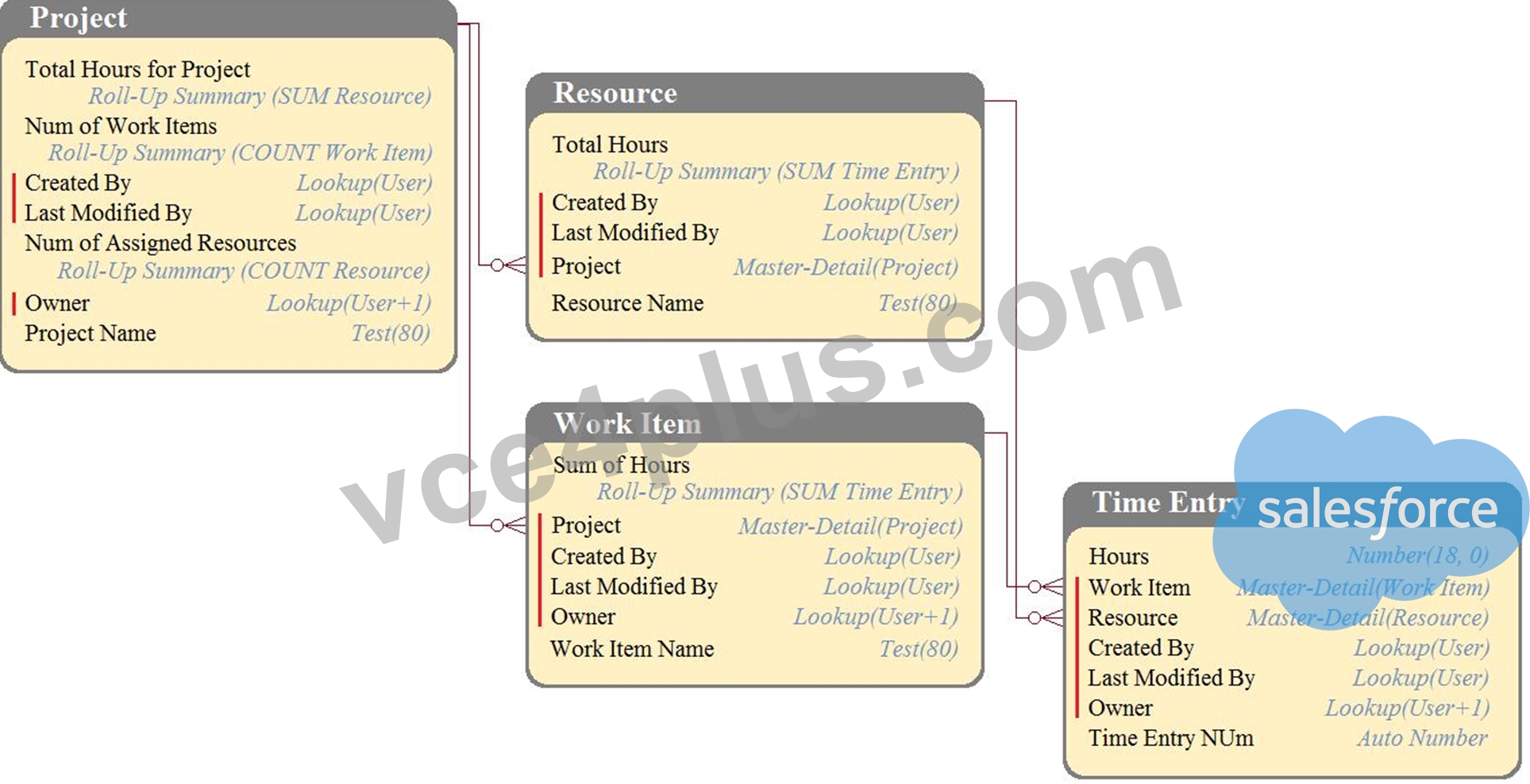
What should the Architect consider in this situation?
- A. Load all data using external IDs to link to parent records.
- B. Load all data after deferring sharing calculations.
- C. Calculate summary values instead of Roll-Up by using workflow.
- D. Calculate summary values instead of Roll-Up by using triggers.
Answer: B
NEW QUESTION # 42
Universal Containers is establishing a call center that will use Salesforce. UC receives 10 million calls and creates 100 million cases every month. Cases are linked to a custom call object using lookup relationship. UC would like to run reports and dashboard to better understand different case types being created on calls to better serve customers.
What solution should a data architect recommend to meet the business requirement?
- A. Leverage custom objects to store aggregate data and run analytics.
- B. Archive records to a data warehouse and run analytics on the data warehouse.
- C. Leverage big objects to archive records and Einstein Analytics to run reports.
- D. Leverage out-of-the-box reports and dashboard on case and interactive voice response (IVR) custom object.
Answer: C
Explanation:
According to this article, big objects can store and manage massive amounts of data on the Salesforce platform. This can help UC to archive records from other objects or bring massive datasets from outside systems into a big object. According to this article, Einstein Analytics can be used to create dashboards and lenses to analyze big object data and get insights from advanced AI-driven analytics.
NEW QUESTION # 43
DreamHouse Realty has a legacy system that captures Branch Offices and Transactions. DreamHouse Realty has 15 Branch Offices. Transactions can relate to any Branch Office. DreamHouse Realty has created hundreds of thousands of Transactions per year.
A Data Architect needs to denormalize this data model into a single Transaction object with a Branch Office picklist.
What are two important considerations for the Data Architect in this scenario? (Choose two.)
- A. Standard list view in-line editing.
- B. Limitations on master-detail relationships.
- C. Limitations on Org data storage.
- D. Bulk API limitations on picklist fields.
Answer: C,D
Explanation:
The Data Architect should consider the limitations on Org data storage and the Bulk API limitations on picklist fields when denormalizing the data model into a single Transaction object with a Branch Office picklist. The Org data storage limit is the total amount of data that can be stored in a Salesforce Org, and it depends on the edition and license type of the Org1. The Bulk API limit on picklist fields is the maximum number of values that can be imported or exported using the Bulk API, and it is 1,000 values per picklist field2. These limitations could affect the performance and scalability of the data model, and the Data Architect should plan accordingly.
NEW QUESTION # 44
Based on government regulations, a Salesforce customer plans to implement the following in Salesforce for compliance:
Access to customer information based on record ownership
Ability for customers to request removal of their information from Salesforce Prevent users from accessing Salesforce from outside company network (virtual private network, or VPN) What should a data architect recommend to address these requirements?
- A. Implement Salesforce shield with Event Monitoring to address the requirement.
- B. Implement IP restrictions, sharing settings, and custom Apex to support customer requests.
- C. Contact Salesforce support to restrict access only with VPN and other requirements
- D. Allow users access to Salesforce through a custom web application hosted within VPN.
Answer: B
Explanation:
IP restrictions can be used to prevent users from accessing Salesforce from outside the company network or VPN. According to this article, sharing settings can be used to control access to customer information based on record ownership. According to this article, custom Apex can be used to support customer requests for removal of their information from Salesforce.
NEW QUESTION # 45
Get Cloudy Consulting is migrating their legacy system's users and data to Salesforce. They will be creating 15,000 users, 1.5 million Account records, and 15 million Invoice records. The visibility of these records is controlled by a 50 owner and criteria-based sharing rules.
Get Cloudy Consulting needs to minimize data loading time during this migration to a new organization.
Which two approaches will accomplish this goal? (Choose two.)
- A. Create the users, upload all data, and then deploy the sharing rules.
- B. Defer sharing calculations until the data has finished uploading.
- C. Contact Salesforce to activate indexing before uploading the data.
- D. First, load all account records, and then load all user records.
Answer: A,B
Explanation:
Creating the users, uploading all data, and then deploying the sharing rules will reduce the number of sharing recalculations that occur during the data load. Deferring sharing calculations until the data has finished uploading will also improve the performance by postponing the sharing rule evaluation. These are the recommended best practices for loading large data sets into Salesforce
NEW QUESTION # 46
Northern Trail Outfitters (NTO) has recently implemented Salesforce to track opportunities across all their regions. NTO sales teams across all regions have historically managed their sales process in Microsoft Excel. NTO sales teams are complaining that their data from the Excel files were not migrated as part of the implementation and NTO is now facing low Salesforce adoption.
What should a data architect recommend to increase Salesforce adoption?
- A. Create a chatter group and upload all Excel files to the group.
- B. Use the Excel connector to Salesforce to sync data from individual Excel files.
- C. Load data in external database and provide access to database to sales users.
- D. Define a standard mapping and train sales users to import opportunity data.
Answer: D
NEW QUESTION # 47
A data architect has been tasked with optimizing a data stewardship engagement for a Salesforce instance Which three areas of Salesforce should the architect review before proposing any design recommendation? Choose 3 answers
- A. Run key reports to determine what fields should be required.
- B. Determine if any integration points create records in Salesforce.
- C. Export the setup audit trail to review what fields are being used.
- D. Review the sharing model to determine impact on duplicate records.
- E. Review the metadata xml files for redundant fields to consolidate.
Answer: A,D,E
NEW QUESTION # 48
Universal Containers (UC) has an Application custom object, which has tens of millions of records created in the past 5 years. UC needs the last 5 years of data to exist in Salesforce at all times for reporting and queries. UC is currently encountering performance issues when reporting and running queries on this Object using date ranges as filters. Which two options can be used to improve report performance?
- A. Ask support to create a skinny table for Application with the necessary reporting fields.
- B. Add custom indexes to the Date fields used for filtering the report.
- C. Add custom indexes to all fields on Application without a standard index.
- D. Run multiple reports to get different pieces of the data and combine them.
Answer: A,B
Explanation:
Ask support to create a skinny table for Application with the necessary reporting fields. This is an option that can improve report performance by creating a custom table that contains frequently used fields and copies their values from standard or custom objects. Skinny tables are kept in sync with their source tables and are used in place of them for reports and queries4. Add custom indexes to the Date fields used for filtering the report. This is another option that can improve report performance by creating custom indexes on fields that are often used as filters or join conditions in reports and queries. Custom indexes can speed up data retrieval and reduce query execution time
NEW QUESTION # 49
Universal Containers has 30 million case records. The Case object has 80 fields. Agents are reporting performance issues and time-outs while running case reports in the Salesforce org.
Which solution should a data architect recommend to improve reporting performance?
- A. Contact Salesforce support to enable skinny table for cases.
- B. Create a custom object to store aggregate data and run reports.
- C. Move data off of the platform and run reporting outside Salesforce, and give access to reports.
- D. Build reports using custom Lightning components.
Answer: B
NEW QUESTION # 50
Cloud Kicks has the following requirements:
- Data needs to be sent from Salesforce to an external system to generate invoices from their Order Management System (OMS).
- A Salesforce administrator must be able to customize which fields will be sent to the external system without changing code.
What are two approaches for fulfilling these requirements? (Choose two.)
- A. Enable the field -level security permissions for the fields to send.
- B. A Field Set that determines which fields to send in an HTTP callout.
- C. A set<sobjectFieldset> to determine which fields to send in an HTTP callout.
- D. An Outbound Message to determine which fields to send to the OMS.
Answer: B,D
NEW QUESTION # 51
A company wants to document the data architecture of a Salesforce organization.
What are two valid metadata types that should be included? (Choose two.)
- A. SecuritySettings
- B. RecordType
- C. CustomField
- D. Document
Answer: B,C
Explanation:
Option A is correct because RecordType is a valid metadata type that should be included in documenting the data architecture of a Salesforce organization1. RecordType defines different business processes, picklist values, and page layouts for different users2. Option C is correct because CustomField is another valid metadata type that should be included in documenting the data architecture of a Salesforce organization1. CustomField defines custom attributes for standard or custom objects3. Option B is not correct because Document is not a valid metadata type, but a standard object that stores documents in folders4. Option D is not correct because SecuritySettings is not a valid metadata type, but a setup menu that allows administrators to configure various security features such as password policies, network access, session settings, etc.
NEW QUESTION # 52
The architect is planning a large data migration for Universal Containers from their legacy CRM system to Salesforce. What three things should the architect consider to optimize performance of the data migration? Choose 3 answers
- A. Remove custom indexes on the data being loaded.
- B. Review the time zones of the User loading the data.
- C. Determine if the legacy system is still in use.
- D. Deactivate approval processes and workflow rules.
- E. Defer sharing calculations of the Salesforce Org.
Answer: A,D,E
Explanation:
Removing custom indexes on the data being loaded will prevent unnecessary index maintenance and improve the data load speed. Deferring sharing calculations of the Salesforce Org will avoid frequent sharing rule evaluations and reduce the load time. Deactivating approval processes and workflow rules will prevent triggering any automation logic that might slow down or fail the data load.
NEW QUESTION # 53
Universal Containers (UC) is building a Service Cloud call center application and has a multisystem support solution. UC would like or ensure that all systems have access to the same customer information.
What solution should a data architect recommend?
- A. Make Salesforce the system of record for all data.
- B. Implement a master data management (MDM) strategy for customer data.
- C. Let each system be an owner of data it generates.
- D. Load customer data in all systems.
Answer: B
Explanation:
A master data management (MDM) strategy for customer data can help UC ensure that all systems have access to the same customer information, without loading or duplicating data in all systems. An MDM strategy can also help UC avoid data conflicts and inconsistencies that may arise from having multiple systems as owners of data.
NEW QUESTION # 54
NTO has decided that it is going to build a channel sales portal with the following requirements:
1. External resellers are able to authenticate to the portal with a login.
2. Lead data, opportunity data and order data are available to authenticated users.
3. Authenticated users many need to run reports and dashboards.
4. There is no need for more than 10 custom objects or additional file storage.
Which community cloud license type should a data architect recommend to meet the portal requirements?
- A. Customer community.
- B. Lightning external apps starter.
- C. Partner community.
- D. Customer community plus.
Answer: C
NEW QUESTION # 55
Cloud Kicks stores Invoice records in a custom object. Invoice records are being sent to the Accounting department with missing States and incorrectly formatted Postal Codes.
Which two actions should Cloud Kicks take to improve data quality? (Choose two.)
- A. Change each address field to require on the Page Layout.
- B. Utilize a Validation Rule with a REGEX operator on Postal Code.
- C. Write an Apex Trigger to require all fields to be populated.
- D. Utilize a Validation Rule with a CONTAINS operator on address fields.
Answer: B,D
Explanation:
Utilizing a Validation Rule with a REGEX operator on Postal Code and utilizing a Validation Rule with a CONTAINS operator on address fields are two actions that Cloud Kicks should take to improve data quality for their Invoice records. A Validation Rule with a REGEX operator can check if the Postal Code field matches a specific pattern or format, such as a five-digit number or a combination of letters and numbers. A Validation Rule with a CONTAINS operator can check if the address fields contain certain values, such as valid state abbreviations or country names. These Validation Rules can prevent users from saving invalid or incomplete data and display error messages to guide them to correct the data. The other options are not effective or recommended for improving data quality, as they would either require additional customization, not enforce data standards, or not address the specific issues of missing states and incorrectly formatted postal codes
NEW QUESTION # 56
Ursa Major Solar has defined a new Data Quality Plan for their Salesforce data.
Which two approaches should an Architect recommend to enforce the plan throughout the organization? (Choose two.)
- A. Schedule a weekly dashboard displaying records that are missing information to be sent to managers for review.
- B. Schedule reports that will automatically catch duplicates and merge or delete the records every week.
- C. Ensure all data is stored in an external system and set up an integration to Salesforce for view-only access.
- D. Enforce critical business processes by using Workflow, Validation Rules, and Apex code.
Answer: A,D
NEW QUESTION # 57
......
Salesforce Data-Architect certification exam consists of multiple-choice questions and scenarios that test candidates on their ability to apply their knowledge to real-world situations. Data-Architect exam covers a wide range of topics, including data modeling, data integration, data governance, data security, and data quality. Candidates must have a strong understanding of all these areas to succeed in the exam.
Ultimate Guide to Prepare Free Data-Architect Exam Questions and Answer: https://drive.google.com/open?id=1LuDvBmBt4Ya_6d2rHJj_qnunnE7ddjd2
Pass Salesforce Application Architect Data-Architect Exam With 259 Questions: https://www.vce4plus.com/Salesforce/Data-Architect-valid-vce-dumps.html